Cadillac V-Series History: Every Model Explained
Explore Cadillac V-Series history, from the original CTS-V and supercharged V8 engines to CT4-V Blackwing, CT5-V Blackwing, Escalade-V and electric performance SUVs.
HEAD-TO-HEAD MUSCLE CAR VS COMPARISON
Compare 0-60, peak horsepower, torque, and quarter-mile times across iconic builds.
Cadillac V-Series: The Complete History of America's Luxury Performance Legacy
From the original CTS-V and supercharged V8 legends to the Blackwing sedans, Escalade-V and electric performance SUVs, discover how Cadillac built one of America's most distinctive high-performance divisions.
Cadillac has spent more than a century building some of America's most recognizable luxury automobiles. Its name is associated with elegant design, advanced engineering, premium interiors and a distinctly American approach to automotive luxury. But during the early 2000s, the brand recognized that luxury alone was no longer enough to define its future.
European manufacturers had established powerful performance divisions. BMW had M. Mercedes-Benz had AMG. Audi had its RS models. These brands demonstrated that a luxury automobile could also deliver serious racetrack capability, precise handling and extraordinary acceleration.
Cadillac wanted to compete in that same territory.
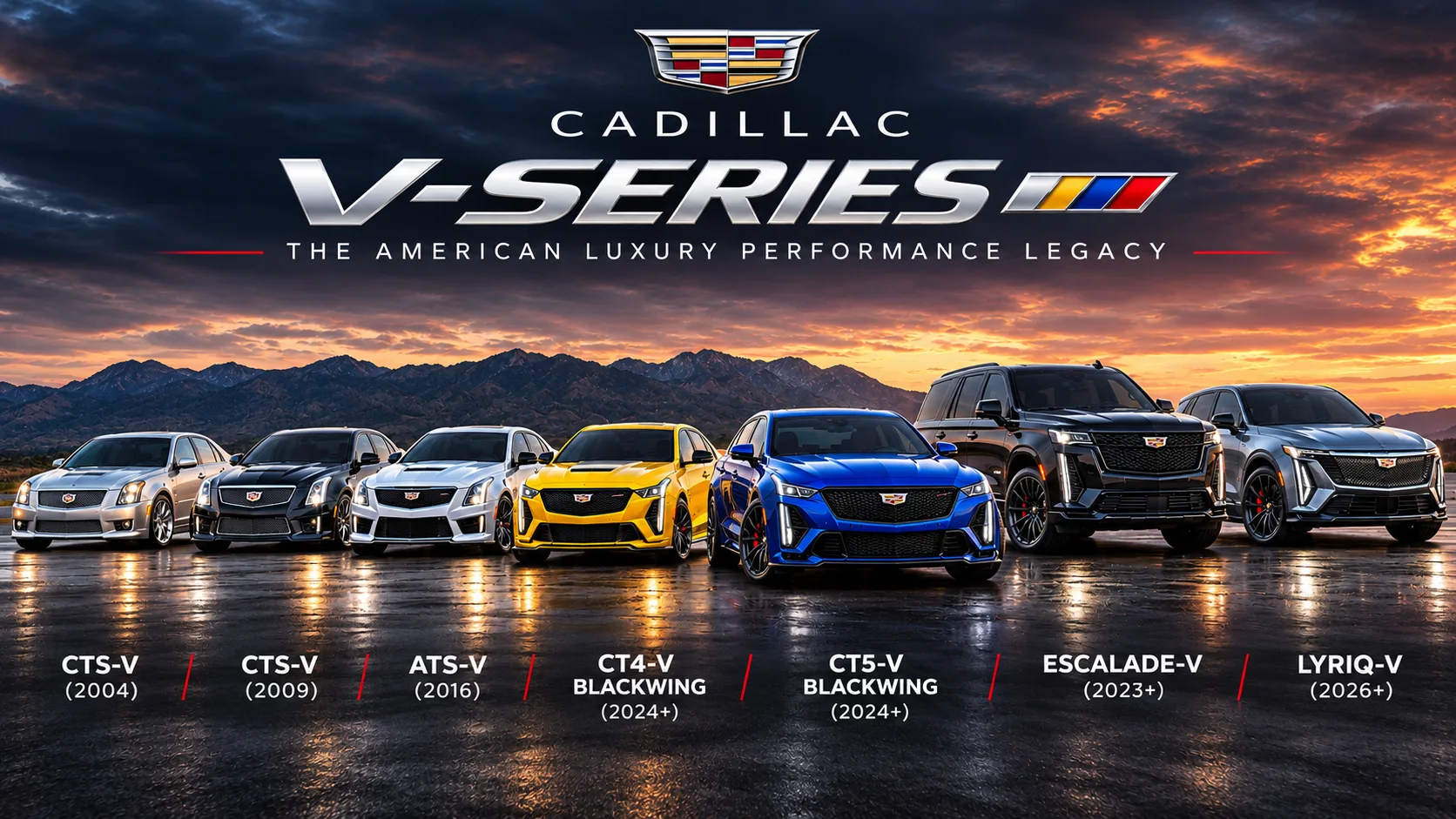
The answer was Cadillac V-Series, a performance division created to combine American power with advanced chassis engineering and luxury-car refinement. Its first production model, the 2004 CTS-V, introduced a new direction for Cadillac. What followed was a remarkable evolution involving naturally aspirated V8 engines, supercharged V8 power, twin-turbocharged V6 technology, manual transmissions, motorsport development and, more recently, electric performance.
Today, the V-Series name represents much more than a powerful engine. It connects Cadillac's racing history with a diverse range of road-going performance vehicles, including the CT4-V Blackwing, CT5-V Blackwing, Escalade-V, LYRIQ-V and OPTIQ-V.
This is the complete story of Cadillac V-Series: its origins, every major generation, its most important engines, the technology behind its performance and the direction Cadillac is taking next.
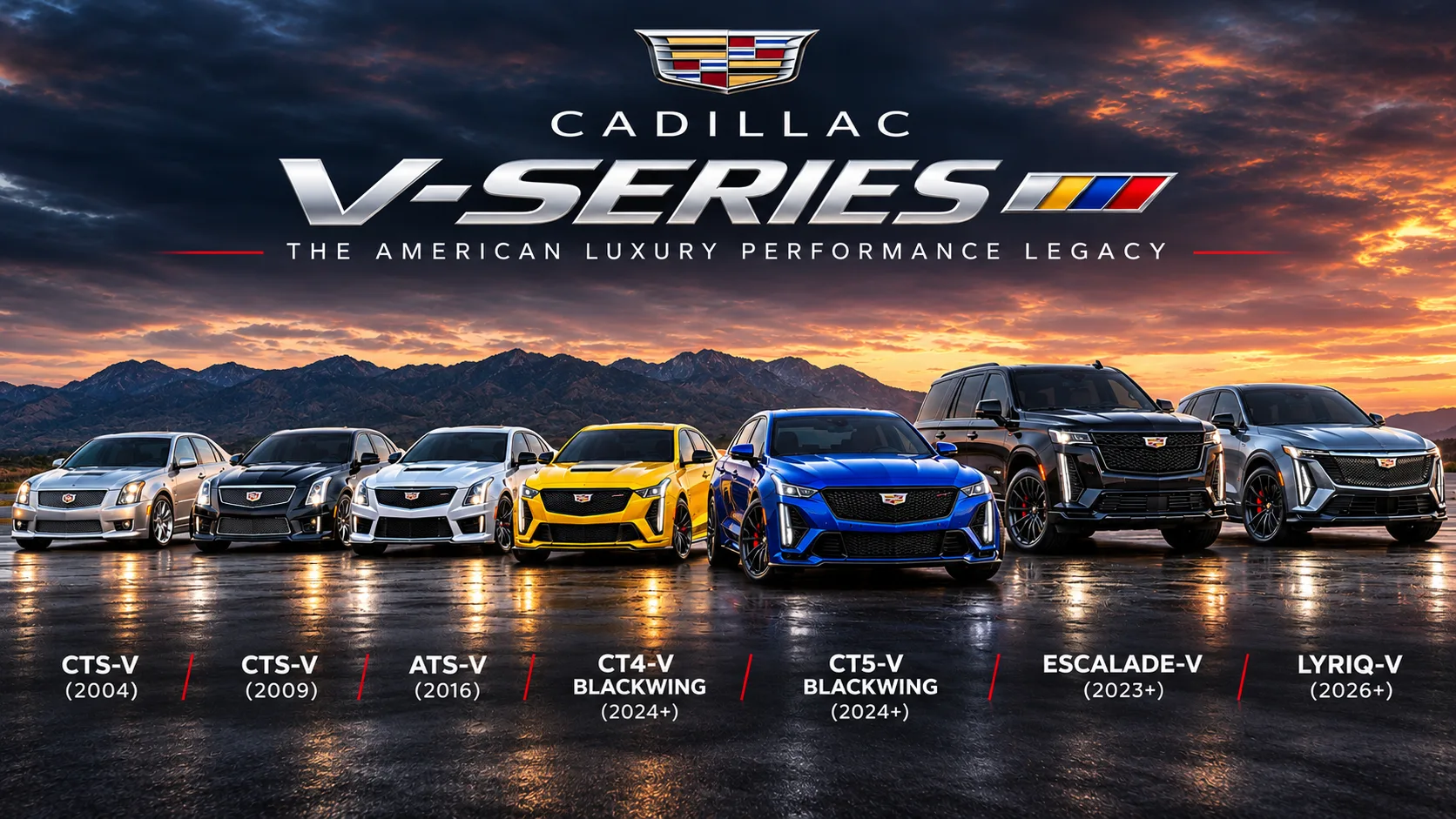
From the original CTS-V to modern Blackwing sedans and electric performance SUVs, Cadillac V-Series represents more than two decades of American luxury performance.
1. What Is Cadillac V-Series?
Cadillac V-Series is the American luxury brand's dedicated performance vehicle family. It was created to bring motorsport-inspired engineering and more serious driving capability to Cadillac production vehicles.
The original concept was straightforward: start with a strong Cadillac platform, increase its performance potential and develop the suspension, braking and chassis systems needed to make that additional power useful.
That philosophy is important because a genuine performance vehicle is not defined by horsepower alone.
A powerful engine can produce impressive acceleration, but a complete performance car also needs predictable handling, effective braking, sufficient cooling, controlled suspension movement and a drivetrain capable of delivering power consistently.
Cadillac's V-Series engineers have worked across these areas to create vehicles that can perform on public roads and, where appropriate, on closed racing circuits.
Depending on the model, V-Series engineering can include:
High-output naturally aspirated, turbocharged or supercharged engines
Dedicated engine and transmission calibration
Performance suspension tuning
Magnetic Ride Control or other advanced damping systems
Brembo performance braking hardware
Electronic limited-slip differential technology
Performance Traction Management
Specialized tires and wheels
Aerodynamic and cooling improvements
Performance driving modes and data-recording technology
The exact equipment varies by vehicle and model year. A CT5-V Blackwing, for example, has a very different powertrain from an electric LYRIQ-V, but both follow the same broad objective: deliver a more performance-focused Cadillac experience.
V-Series versus Blackwing: What Is the Difference?
The V-Series name identifies Cadillac's performance family. Blackwing identifies some of its most focused high-performance sedans.
The distinction is particularly clear in the CT4 and CT5 lineups.
The CT4-V and CT5-V are performance-oriented models. The CT4-V Blackwing and CT5-V Blackwing add substantially more specialized performance hardware and power.
It is also important not to confuse the Blackwing name with one particular engine. The CT6-V used a 4.2-liter twin-turbocharged Blackwing V8, while the CT4-V Blackwing uses a twin-turbocharged V6 and the CT5-V Blackwing uses a supercharged 6.2-liter V8.
The name therefore represents a performance identity, not a single engine configuration.
2. The Birth of Cadillac V-Series: The 2004 CTS-V
The Cadillac V-Series performance sub-brand officially launched at Sebring International Raceway in March 2004. Its introduction was closely connected to racing: the CTS-V.R competition car made its debut in the SCCA Pro Racing World Challenge GT series and secured its first victory at Sebring.
The production vehicle that introduced the new badge was the first-generation Cadillac CTS-V.
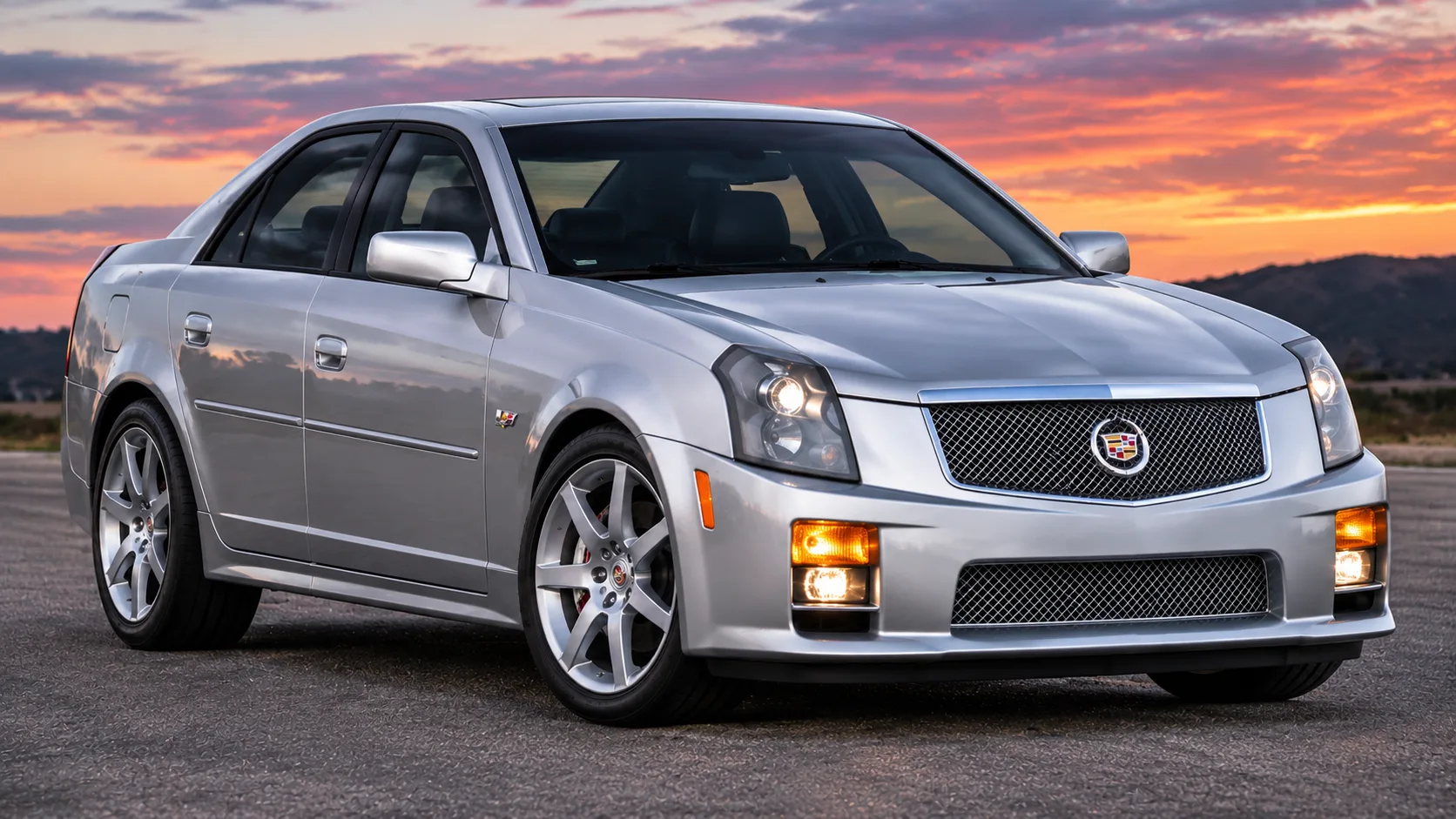
The 2004 Cadillac CTS-V launched Cadillac's modern V-Series performance legacy, combining bold American styling with a 5.7-liter LS6 V8 producing 400 horsepower and 395 lb-ft of torque.
2004–2007: The First-Generation CTS-V
The original CTS-V was based on the rear-wheel-drive Cadillac CTS platform, but its powertrain and chassis were developed for a much more demanding performance role.
Its headline component was a 5.7-liter LS6 naturally aspirated V8 related to the engine used in the Chevrolet Corvette Z06.
The original engine produced 400 horsepower and 395 lb-ft of torque. It was paired with a six-speed manual transmission and rear-wheel drive.
In 2006, Cadillac upgraded the engine to the 6.0-liter LS2 V8, which also produced 400 horsepower and 395 lb-ft of torque in the CTS-V application.
First-generation CTS-V specifications
| Specification | 2004–2005 | 2006–2007 |
|---|---|---|
| Engine | 5.7L LS6 V8 | 6.0L LS2 V8 |
| Horsepower | 400 hp | 400 hp |
| Torque | 395 lb-ft | 395 lb-ft |
| Transmission | 6-speed manual | 6-speed manual |
| Drivetrain | Rear-wheel drive | Rear-wheel drive |
The original CTS-V was about much more than engine displacement. Cadillac engineers revised the suspension with stiffer springs, dampers, stabilizer bars and bushings. Structural reinforcements, larger brakes, high-performance tires and a strengthened rear differential helped the chassis manage the additional power.
The engineering philosophy was often summarized around three fundamental priorities: stop, turn and go.
That approach helped distinguish the CTS-V from a conventional luxury sedan with a large engine. Cadillac wanted the vehicle to remain composed during braking, respond accurately through corners and deliver strong acceleration when exiting them.
The Nürburgring connection
The Nürburgring Nordschleife in Germany became an important part of Cadillac's performance-development story.
Its long, demanding layout combines high-speed sections, elevation changes, uneven surfaces and technical corners. Testing there gives engineers an opportunity to evaluate how a vehicle behaves under conditions that are difficult to reproduce on ordinary roads.
The original CTS-V benefited from the development philosophy established with the first-generation CTS. Cadillac's engineers used the track as a place to improve the fundamental vehicle rather than simply chase a headline lap time.
That approach became part of the V-Series identity.
XLR-V and STS-V: Expanding the performance family
Cadillac did not limit the first generation of V-Series to the CTS.
The XLR-V brought supercharged performance to Cadillac's luxury roadster. It used a 4.4-liter supercharged Northstar V8 producing 443 horsepower and 414 lb-ft of torque.
The STS-V took a different approach, using a supercharged 4.4-liter Northstar V8 producing 469 horsepower and 439 lb-ft of torque.
These vehicles demonstrated that Cadillac wanted V-Series to represent a wider performance family rather than a single sport sedan.
The CTS-V established the formula, while the XLR-V and STS-V extended that philosophy into different luxury-car categories.
3. Second-Generation Cadillac CTS-V: The Supercharged V8 Era
The second-generation CTS-V arrived for the 2009 model year and marked one of the most important turning points in Cadillac performance history.
The original naturally aspirated V8 formula was replaced by a 6.2-liter supercharged LSA V8. The result was a major increase in power and torque.
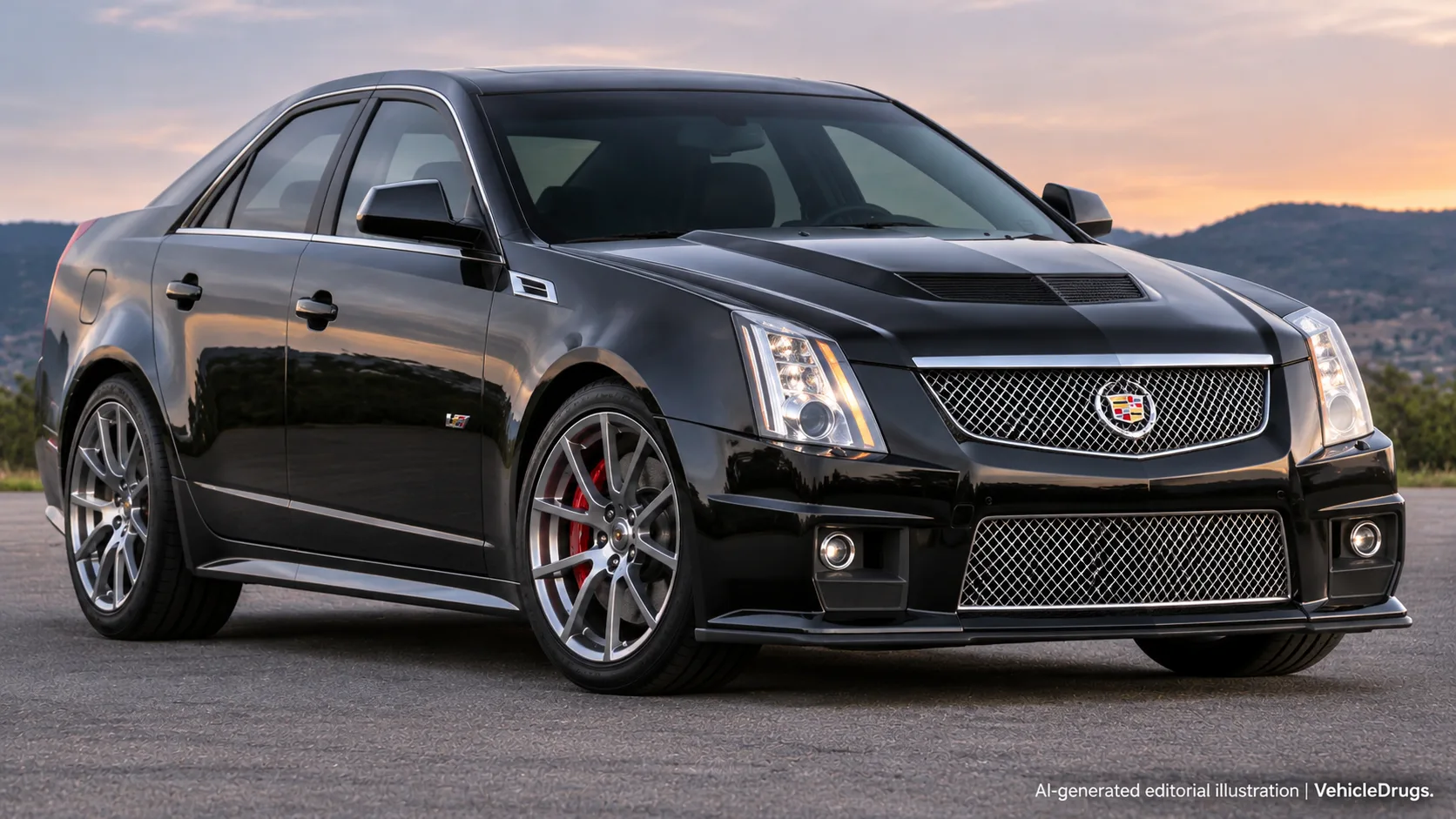
The second-generation Cadillac CTS-V raised the performance stakes with a supercharged 6.2-liter LSA V8 producing 556 horsepower and 551 lb-ft of torque, making it one of America's most formidable luxury performance sedans.
The 6.2-liter LSA supercharged V8
The LSA engine produced 556 horsepower and 551 lb-ft of torque in the second-generation CTS-V.
| Specification | 2009–2015 CTS-V |
|---|---|
| Engine | 6.2L supercharged LSA V8 |
| Horsepower | 556 hp |
| Torque | 551 lb-ft |
| Transmission | 6-speed manual or available 6-speed automatic |
| Drivetrain | Rear-wheel drive |
The supercharger was central to the car's character. Forced induction helped the engine deliver substantial torque and strong acceleration, giving the CTS-V the performance expected of a serious luxury sports sedan.
The engine was paired with either a six-speed manual or an available six-speed automatic transmission, allowing buyers to choose between a more involved driving experience and automatic convenience.
Magnetic Ride Control and chassis development
The second-generation CTS-V also demonstrated how important suspension technology was to Cadillac's performance ambitions.
Magnetic Ride Control uses magnetorheological fluid inside electronically controlled dampers. The fluid's resistance changes in response to a magnetic field, allowing the damping characteristics to be adjusted rapidly.
This technology helps the suspension respond to changing road conditions and driving demands. It can support a comfortable ride during normal driving while providing stronger body control when the vehicle is driven aggressively.
The CTS-V also received performance braking hardware, upgraded chassis components and other systems designed to make its supercharged power more manageable.
Three body styles: Sedan, Coupe and Sport Wagon
One of the most memorable aspects of the second-generation CTS-V was the availability of three body styles.
The sedan offered traditional four-door performance.
The coupe introduced a dramatic roofline and more distinctive two-door proportions.
The Sport Wagon combined the supercharged V8 with the practicality of a wagon body.
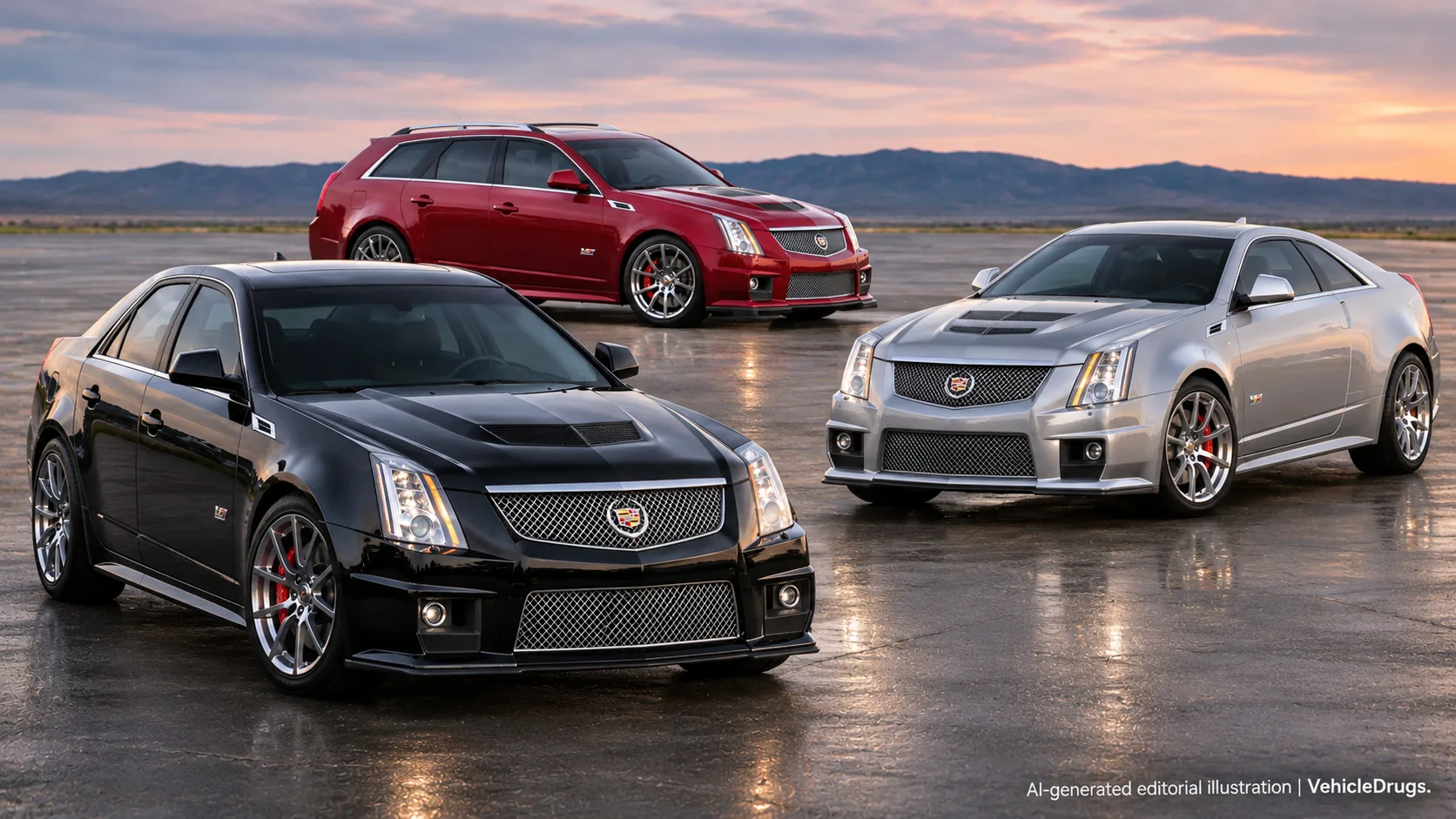
The second-generation Cadillac CTS-V expanded its appeal beyond the sedan, offering Coupe and Sport Wagon versions that combined supercharged V8 performance with three distinctive body styles.
The CTS-V Sport Wagon was especially unusual in the American market. It offered a combination of V8 performance and everyday cargo flexibility that few rivals could match.
Together, the three versions made the second-generation CTS-V one of the most recognizable chapters in Cadillac's performance history.
4. Third-Generation V-Series: The ATS-V and Final CTS-V
The third generation began in 2016 with two very different performance vehicles: the ATS-V and the redesigned CTS-V.
The ATS-V focused on a smaller, more agile luxury performance platform. The CTS-V continued the large supercharged V8 formula, but with a substantially more powerful engine.
Cadillac ATS-V: Twin-Turbocharged V6 Performance
The ATS-V used a 3.6-liter twin-turbocharged V6 engine producing 464 horsepower and 445 lb-ft of torque.
It was available as a sedan and a coupe, with a six-speed manual transmission or an available eight-speed automatic.
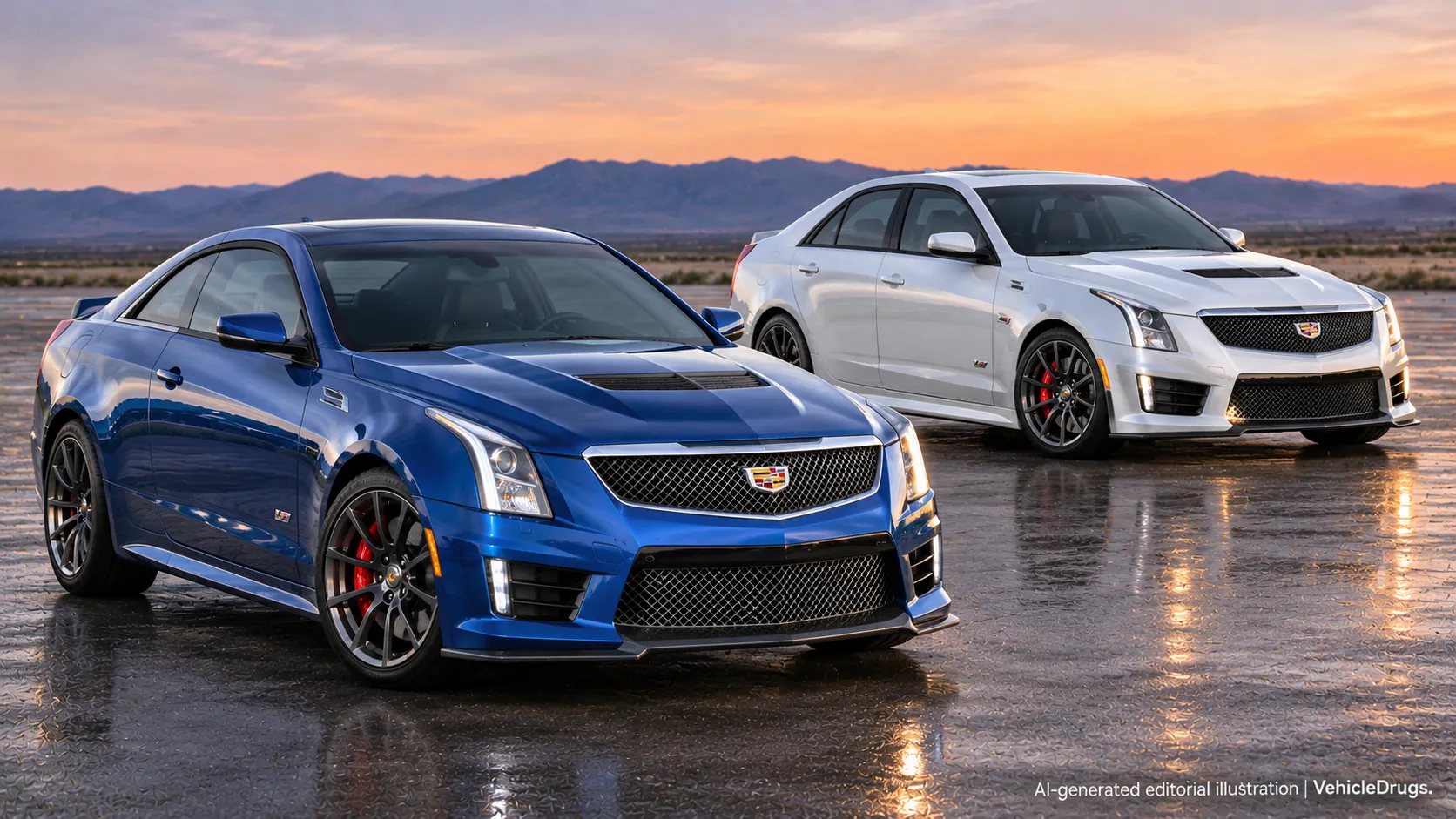
The Cadillac ATS-V brought twin-turbocharged V6 performance to the compact luxury segment, delivering 464 horsepower and 445 lb-ft of torque through a track-focused chassis available in both Coupe and Sedan forms.
ATS-V factory specifications
| Specification | Cadillac ATS-V |
|---|---|
| Engine | 3.6L twin-turbocharged V6 |
| Horsepower | 464 hp |
| Torque | 445 lb-ft |
| Transmission | 6-speed manual or 8-speed automatic |
| Drivetrain | Rear-wheel drive |
The twin-turbocharged V6 represented a different direction from the supercharged V8 formula.
Turbocharging allowed Cadillac to produce substantial output from a smaller-displacement engine, while the rear-wheel-drive layout and performance chassis helped give the ATS-V a focused driving character.
The car also featured performance suspension tuning, high-performance braking hardware and chassis systems designed to improve control under demanding conditions.
The ATS-V proved that Cadillac's performance identity was not dependent on large V8 engines alone.
The final CTS-V: 640 horsepower from the LT4
The third-generation CTS-V took the supercharged V8 formula to another level.
Its 6.2-liter supercharged LT4 V8 produced 640 horsepower and 630 lb-ft of torque.
| Specification | Third-generation CTS-V |
|---|---|
| Engine | 6.2L supercharged LT4 V8 |
| Horsepower | 640 hp |
| Torque | 630 lb-ft |
| Transmission | 6-speed manual or 8-speed automatic |
| Drivetrain | Rear-wheel drive |
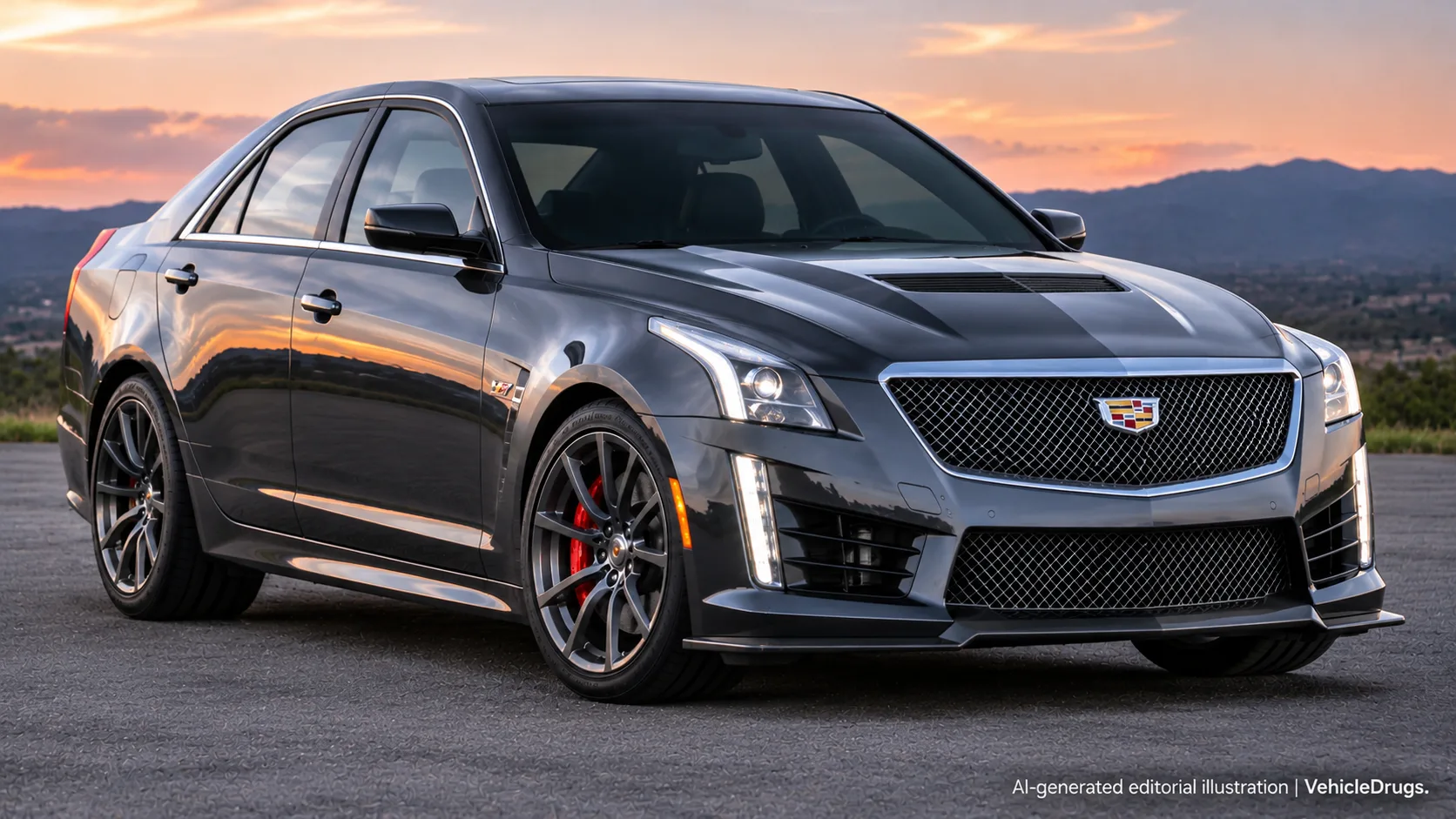
The third-generation Cadillac CTS-V delivered 640 horsepower and 630 lb-ft of torque from its supercharged 6.2-liter LT4 V8, establishing itself as one of the most powerful performance sedans of its era.
The LT4 engine gave the final CTS-V extraordinary performance. Its power was supported by Magnetic Ride Control, performance brakes, an electronically controlled limited-slip differential and a chassis developed to handle the increased output.
The third-generation CTS-V represented the culmination of the original CTS-V concept: a luxury sedan with a supercharged V8, rear-wheel drive and serious performance capability.
It also marked the end of the CTS-V name as Cadillac moved into a new generation of sedans and introduced the Blackwing models.
5. The Blackwing Era: Cadillac's Modern Performance Flagships
The Blackwing name became one of the most recognizable elements of modern Cadillac performance.
It is associated particularly with the CT4-V Blackwing and CT5-V Blackwing, two sedans that preserve a traditional enthusiast-focused approach while incorporating modern technology.
The Blackwing models are important because they combine high-output engines with advanced chassis systems and, unusually for modern performance sedans, available manual transmissions.
Cadillac CT4-V Blackwing: 472-hp Twin-Turbo V6
The CT4-V Blackwing uses a 3.6-liter twin-turbocharged V6 producing 472 horsepower and 445 lb-ft of torque.
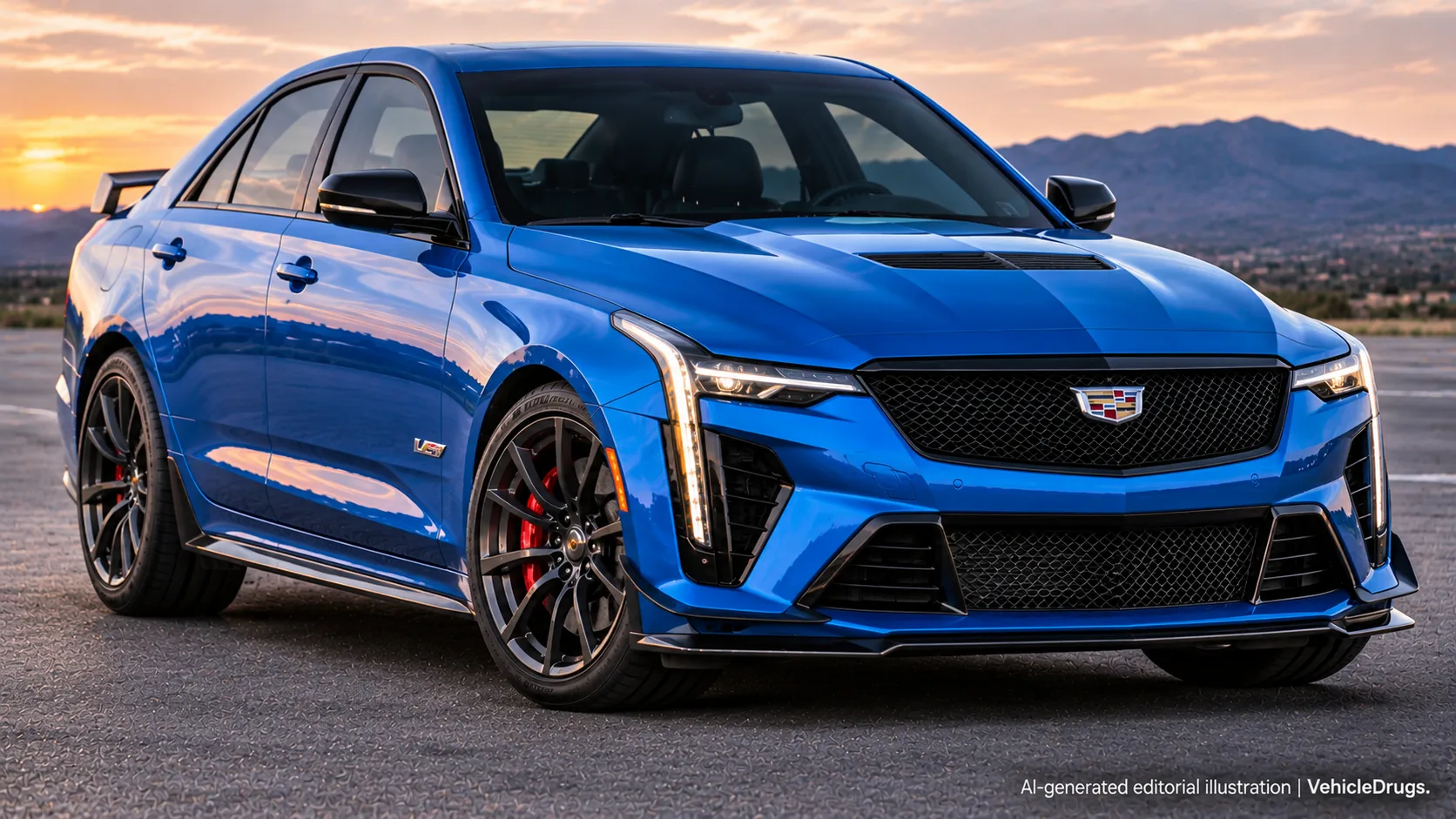
The Cadillac CT4-V Blackwing combines a 3.6-liter twin-turbocharged V6 with 472 horsepower and 445 lb-ft of torque, delivering rear-wheel-drive performance with a choice of a six-speed manual or ten-speed automatic transmission.
| Specification | CT4-V Blackwing |
|---|---|
| Engine | 3.6L twin-turbocharged V6 |
| Horsepower | 472 hp |
| Torque | 445 lb-ft |
| Standard transmission | 6-speed manual |
| Optional transmission | 10-speed automatic |
| Drivetrain | Rear-wheel drive |
| Cadillac-estimated 0–60 mph | 3.9 seconds |
The six-speed manual transmission is one of the car's defining features. Cadillac continues to offer drivers a traditional mechanical connection through a manual gearbox, even as many competitors have moved toward automatic-only performance models.
The CT4-V Blackwing also features technologies such as active rev matching and no-lift shifting, depending on configuration.
Active rev matching helps synchronize engine speed during downshifts. No-lift shifting allows the driver to keep the accelerator depressed during certain upshifts, helping maintain power delivery.
Chassis and handling technology
The CT4-V Blackwing uses Magnetic Ride Control, an electronic limited-slip differential and performance-focused braking hardware.
Its chassis and electronic systems are designed to help the driver manage the car's power through corners, during braking and under acceleration.
The CT4-V Blackwing is not simply a smaller CT5-V Blackwing. Its twin-turbocharged V6 and more compact dimensions give it a distinct character.
For drivers who want a rear-wheel-drive luxury performance sedan with a manual transmission, it remains one of Cadillac's most interesting modern models.
Cadillac CT5-V Blackwing: The 668-hp Supercharged V8
The CT5-V Blackwing represents the most powerful expression of Cadillac's modern combustion-powered sedan formula.
Its engine is a hand-built 6.2-liter supercharged V8 producing 668 horsepower and 659 lb-ft of torque.
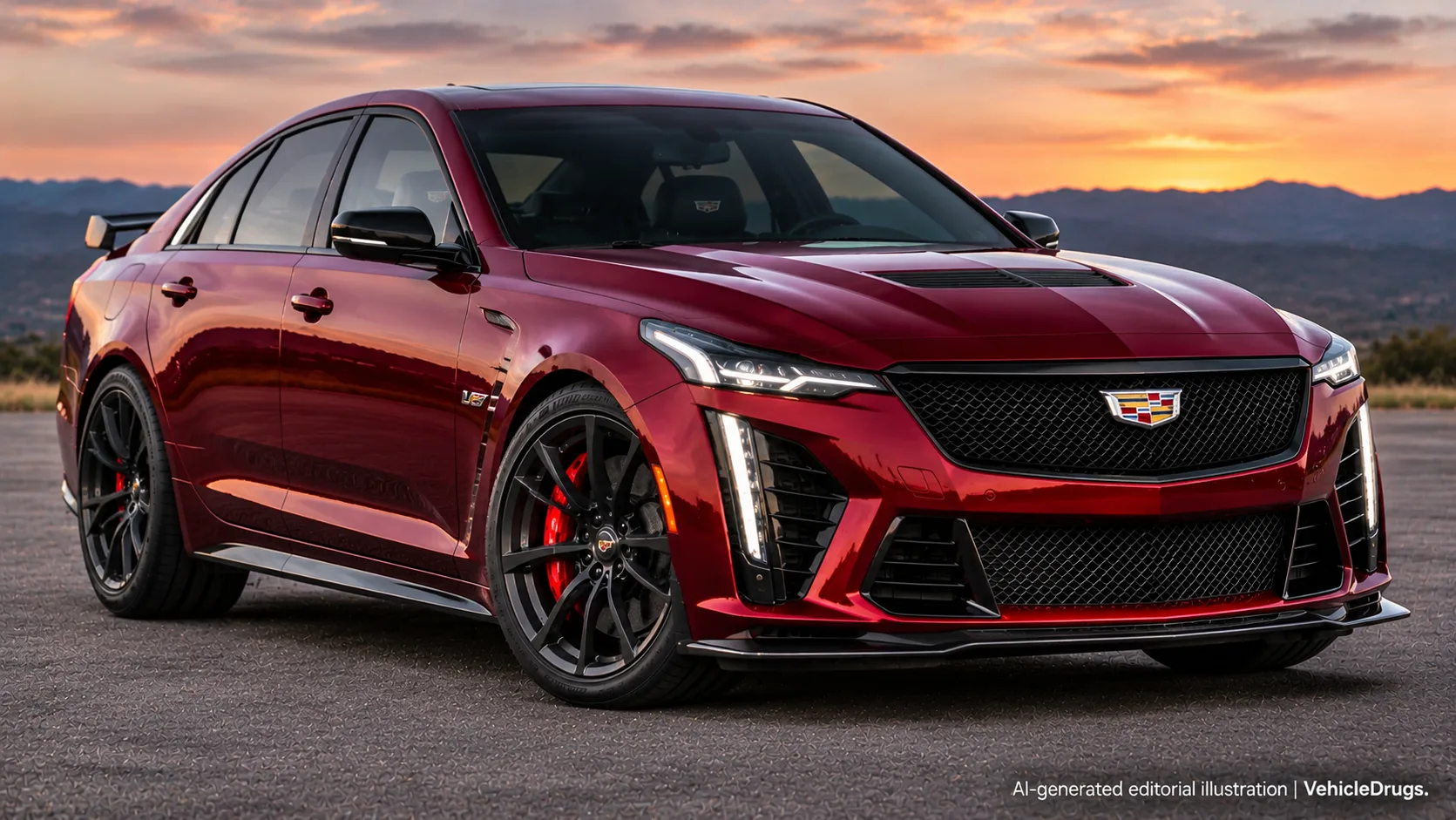
The Cadillac CT5-V Blackwing stands at the top of Cadillac's modern performance sedan lineup, powered by a supercharged 6.2-liter V8 producing 668 horsepower and 659 lb-ft of torque.
| Specification | CT5-V Blackwing |
|---|---|
| Engine | 6.2L supercharged V8 |
| Horsepower | 668 hp |
| Torque | 659 lb-ft |
| Standard transmission | 6-speed manual |
| Optional transmission | 10-speed automatic |
| Drivetrain | Rear-wheel drive |
| Cadillac-estimated 0–60 mph | 3.4 seconds |
The supercharged V8 delivers the unmistakable character associated with American high-performance engines: strong torque, rapid acceleration and a distinctive mechanical soundtrack.
The standard six-speed manual transmission makes the CT5-V Blackwing particularly appealing to enthusiasts. An available ten-speed automatic provides an alternative for drivers who prefer automatic shifting.
Performance engineering beyond the engine
The CT5-V Blackwing combines its powertrain with a sophisticated chassis package.
Depending on model year and equipment, its performance technology includes Magnetic Ride Control, Brembo braking hardware, electronic chassis systems, Performance Traction Management and an electronic limited-slip differential.
These systems work together to help manage acceleration, cornering, braking and traction.
The car also offers a performance-focused interior with specialized seating, steering-wheel controls and available Performance Data Recorder technology.
For the 2026 model year, Cadillac lists a 33-inch Horizon Display in the CT5-V family, bringing modern digital technology into the cabin.
The CT5-V Blackwing is designed to operate as both a luxury sedan and a serious performance vehicle. It can handle everyday driving while offering the engine, transmission and chassis capability expected from a track-focused machine.
Why the Blackwing models matter
The CT4-V Blackwing and CT5-V Blackwing demonstrate that Cadillac has not abandoned traditional driver-focused performance.
They combine modern electronics and advanced suspension systems with rear-wheel drive and manual transmission options.
At a time when performance vehicles are becoming increasingly software-driven and electrified, these sedans preserve an experience that remains important to many enthusiasts.
6. Cadillac CT4-V Blackwing vs. CT5-V Blackwing
Although both vehicles share the Blackwing name, they offer different performance personalities.
| Feature | CT4-V Blackwing | CT5-V Blackwing |
|---|---|---|
| Engine | 3.6L twin-turbo V6 | 6.2L supercharged V8 |
| Horsepower | 472 hp | 668 hp |
| Torque | 445 lb-ft | 659 lb-ft |
| Standard transmission | 6-speed manual | 6-speed manual |
| Optional transmission | 10-speed automatic | 10-speed automatic |
| Drivetrain | Rear-wheel drive | Rear-wheel drive |
| 0–60 mph estimate | 3.9 seconds | 3.4 seconds |
The CT4-V Blackwing offers a more compact package with a twin-turbocharged V6. Its appeal is based on agility, driver involvement and a smaller performance-sedan format.
The CT5-V Blackwing takes a more traditional American approach with a large supercharged V8 and significantly higher torque.
Neither car represents a lesser version of the V-Series philosophy. They simply deliver different interpretations of Cadillac performance.
For drivers who value a smaller, more agile sedan, the CT4-V Blackwing is an appealing option. For those who want the sound, response and torque of a supercharged V8, the CT5-V Blackwing occupies a special position.
7. Cadillac Escalade-V: Supercharged V8 Performance in a Luxury SUV
The V-Series badge eventually moved beyond sedans and coupes.
Introduced for the 2023 model year, the Escalade-V brought Cadillac's high-performance philosophy to its full-size luxury SUV.
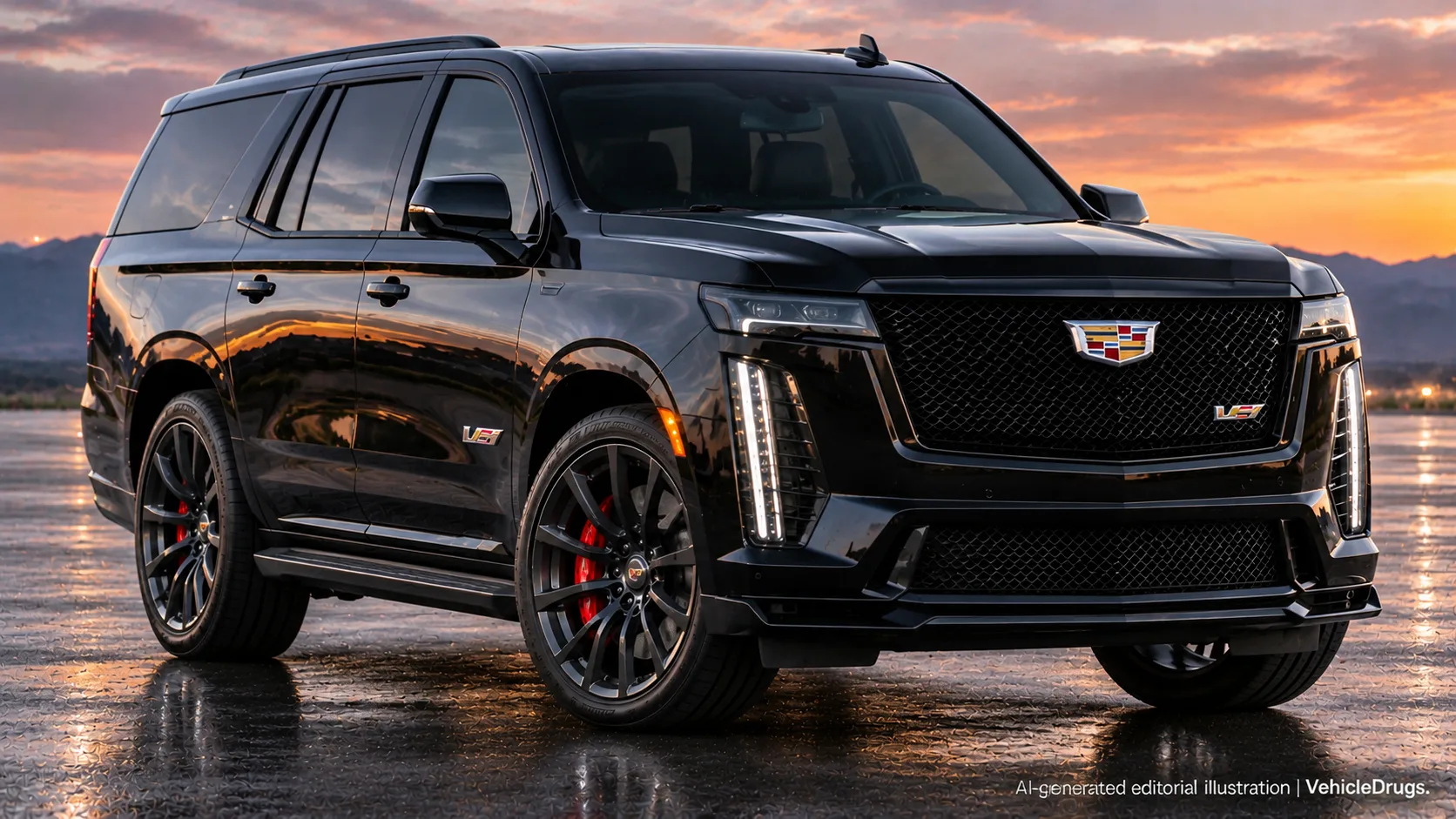
The Cadillac Escalade-V brings supercharged V8 performance to the full-size luxury SUV segment, producing 682 horsepower and 653 lb-ft of torque from its 6.2-liter supercharged V8.
The Escalade-V combines the size, comfort and presence of the Escalade with a hand-built supercharged V8 engine.
The 6.2-liter supercharged V8
Its factory powertrain specifications include:
| Specification | Escalade-V |
|---|---|
| Engine | 6.2L supercharged V8 |
| Horsepower | 682 hp |
| Torque | 653 lb-ft |
| Drivetrain | All-wheel drive |
| Cadillac-estimated 0–60 mph | 4.4 seconds |
The Escalade-V's engine makes it one of the most powerful production Cadillacs.
However, its engineering challenge is different from that of the CT5-V Blackwing.
The Escalade-V is a large luxury SUV designed to carry passengers and luggage while providing a premium driving environment. Its performance systems must manage the vehicle's size, weight and power without sacrificing the comfort expected from an Escalade.
Escalade-V and Escalade-V ESV
The standard Escalade-V offers the traditional full-size SUV configuration.
The Escalade-V ESV uses an extended body, providing additional passenger and cargo space.
Both versions bring the supercharged V8 performance concept into a large luxury SUV format.
The Escalade-V demonstrates that Cadillac's performance philosophy is no longer limited to sport sedans. It can also be applied to a full-size American luxury SUV.
8. Cadillac LYRIQ-V: The First Electric SUV to Wear the V-Series Badge
The automotive industry is changing, and Cadillac is extending its performance identity into electric propulsion.
The LYRIQ-V is a major milestone because it brings the V-Series badge to an all-electric Cadillac SUV.
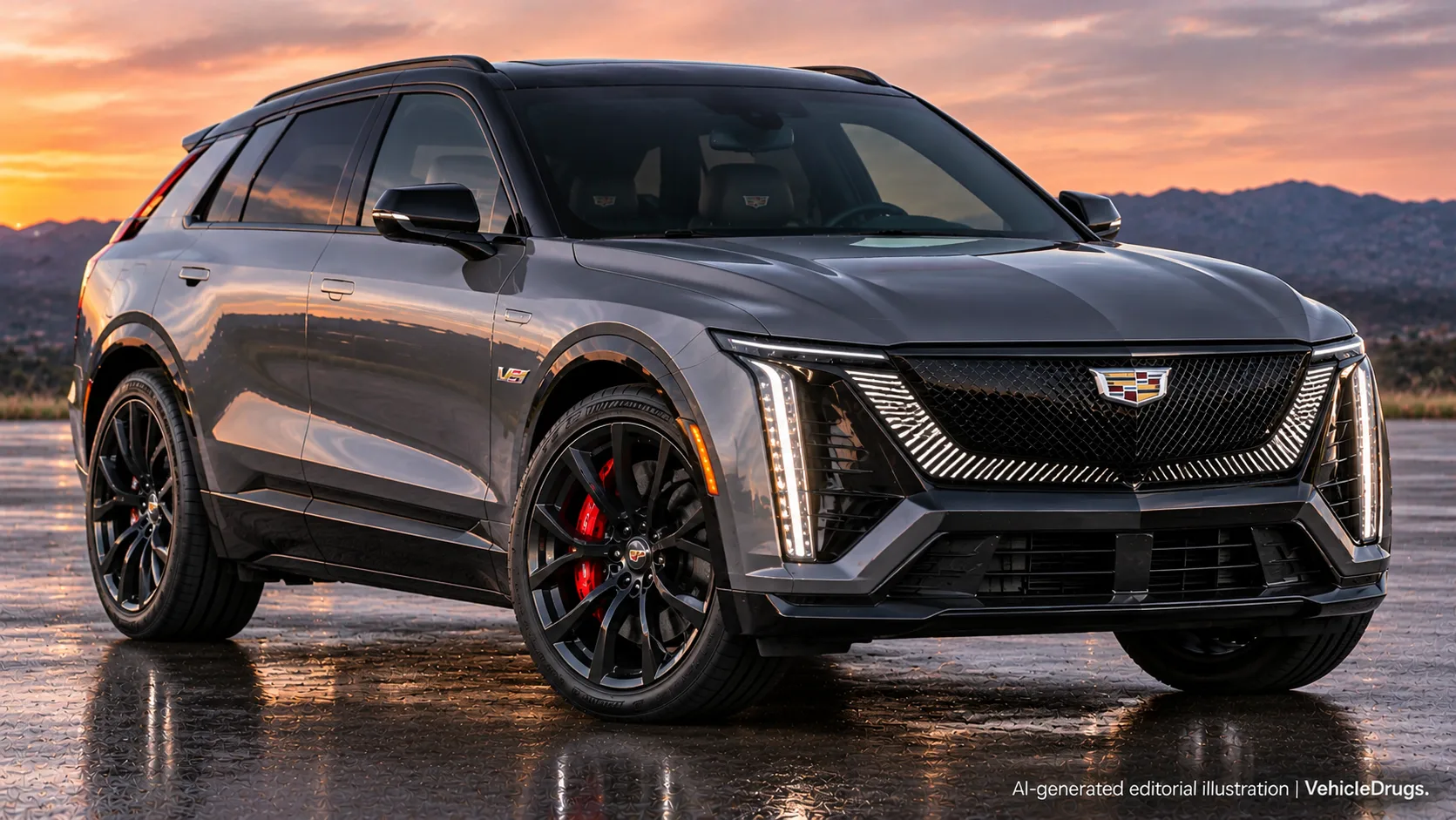
The Cadillac LYRIQ-V brings all-electric performance to the V-Series family, combining dual-motor all-wheel drive with up to 615 horsepower and 650 lb-ft of torque.
Dual-motor electric powertrain
The 2026 LYRIQ-V uses a dual-motor all-wheel-drive system.
Cadillac's published performance figures include:
| Specification | 2026 LYRIQ-V |
|---|---|
| Powertrain | Dual-motor electric AWD |
| Cadillac-estimated output | 615 hp |
| Cadillac-estimated torque | 650 lb-ft |
| Cadillac-estimated 0–60 mph | 3.3 seconds |
| EPA-estimated range | 285 miles |
The 615-horsepower figure is associated with Velocity Max mode. Cadillac also identifies the acceleration figure as a manufacturer estimate under the specified performance conditions.
Unlike a combustion-powered V-Series model, the LYRIQ-V does not use a traditional engine or multi-speed transmission.
Electric motors provide rapid torque delivery, while the dual-motor configuration sends power to both axles.
Performance chassis and braking
The LYRIQ-V is not simply a standard LYRIQ with a more powerful electric powertrain.
Cadillac lists performance-focused upgrades including Brembo front brakes, Continuous Damping Control, a lowered ride height, revised spring tuning and a quicker steering ratio.
The vehicle also includes V-Mode and other performance-oriented driving features.
These changes are intended to improve responsiveness and control while preserving the luxury and refinement expected from the LYRIQ platform.
A different interpretation of V-Series
The LYRIQ-V does not reproduce the sound or mechanical character of a supercharged V8.
Instead, it delivers performance through electric motors, all-wheel drive and advanced vehicle controls.
This represents an important change in Cadillac's performance philosophy.
The powertrain is different, but the objective remains familiar: combine luxury with strong acceleration, responsive handling and driver-focused engineering.
9. Cadillac OPTIQ-V: A Smaller Electric Performance SUV
The OPTIQ-V extends Cadillac's electric performance lineup into a smaller luxury SUV.
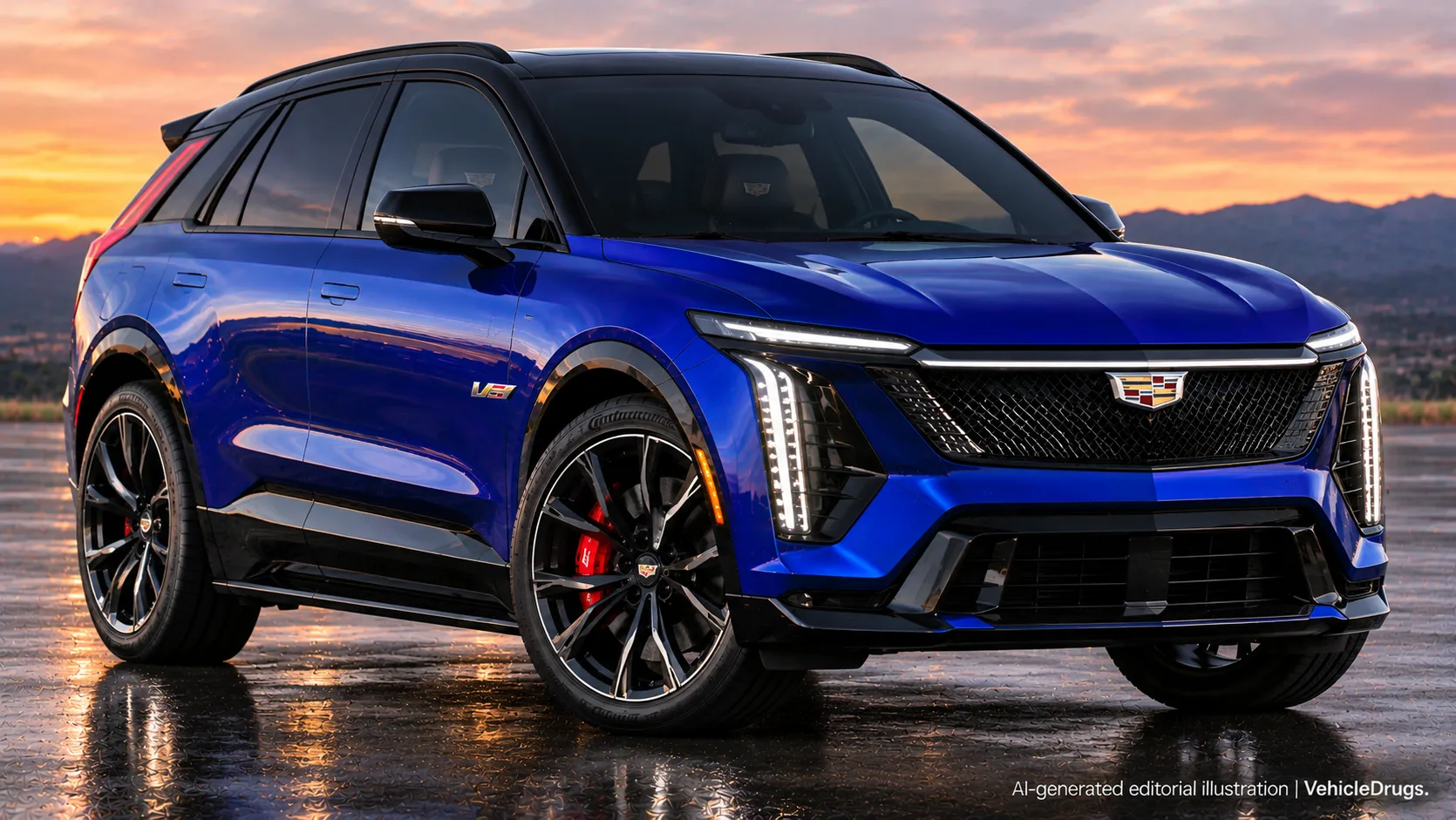
The Cadillac OPTIQ-V extends the V-Series into the electric compact luxury SUV segment, combining dual-motor all-wheel-drive performance with 519 horsepower and an aggressive performance-focused design.
The OPTIQ-V uses a dual-motor electric all-wheel-drive powertrain.
Cadillac's published figures include:
| Specification | OPTIQ-V |
|---|---|
| Powertrain | Dual-motor electric AWD |
| Cadillac-estimated output | 519 hp |
| Cadillac-estimated 0–60 mph | 3.5 seconds |
| EPA-estimated range | 278 miles |
The 519-horsepower and acceleration figures are manufacturer estimates in Velocity Max mode. Range is an EPA estimate and can vary with vehicle configuration and driving conditions.
The OPTIQ-V's smaller format gives buyers another choice within Cadillac's electric performance family.
It also demonstrates that V-Series is no longer limited to traditional engine configurations or large luxury sedans.
The OPTIQ-V and LYRIQ-V show how Cadillac is adapting its performance identity to electric vehicles while retaining the importance of chassis development, braking and driver control.
10. The Engineering That Makes Cadillac V-Series Special
Horsepower is one of the most visible performance figures, but it does not tell the complete story of a high-performance vehicle.
A Cadillac V-Series model needs to control its power, manage heat, stop consistently and remain predictable when driven aggressively.
Several technologies help make that possible.
Magnetic Ride Control
Magnetic Ride Control is one of Cadillac's best-known chassis technologies.
It uses magnetorheological fluid inside electronically controlled dampers. By changing the magnetic field, the system can adjust damping characteristics rapidly.
Cadillac states that its fourth-generation V-Series Magnetic Ride Control technology reads the road up to 1,000 times per second.
The objective is to provide a balance between ride comfort and body control.
Brembo performance brakes
Several V-Series vehicles use Brembo performance braking hardware.
The exact configuration varies by model. The Blackwing sedans receive more extensive performance braking equipment, while the electric V-Series SUVs use their own braking specifications.
The braking system must manage the vehicle's weight, speed and heat generated during repeated deceleration.
On a performance vehicle, consistent braking is just as important as acceleration.
Electronic limited-slip differential
An electronic limited-slip differential helps manage torque distribution between the driven rear wheels.
This can improve traction and vehicle balance during cornering, particularly in powerful rear-wheel-drive cars such as the CT4-V Blackwing and CT5-V Blackwing.
Performance Traction Management
Performance Traction Management helps the driver manage traction and stability under demanding conditions.
Different settings can provide different levels of electronic assistance.
The system is particularly relevant when a driver moves from normal road driving to closed-course performance driving.
Performance Data Recorder
Available Performance Data Recorder technology allows drivers to capture information about their driving sessions.
This can help enthusiasts review vehicle behavior and analyze performance on a closed circuit.
Together, these systems demonstrate why V-Series engineering involves much more than fitting a larger engine.
11. Cadillac Racing Heritage: From CTS-V.R to V-Series.R
Motorsport is part of the foundation of Cadillac V-Series.
The original CTS-V.R made its debut at Sebring in 2004, helping establish the performance division's connection to racing.
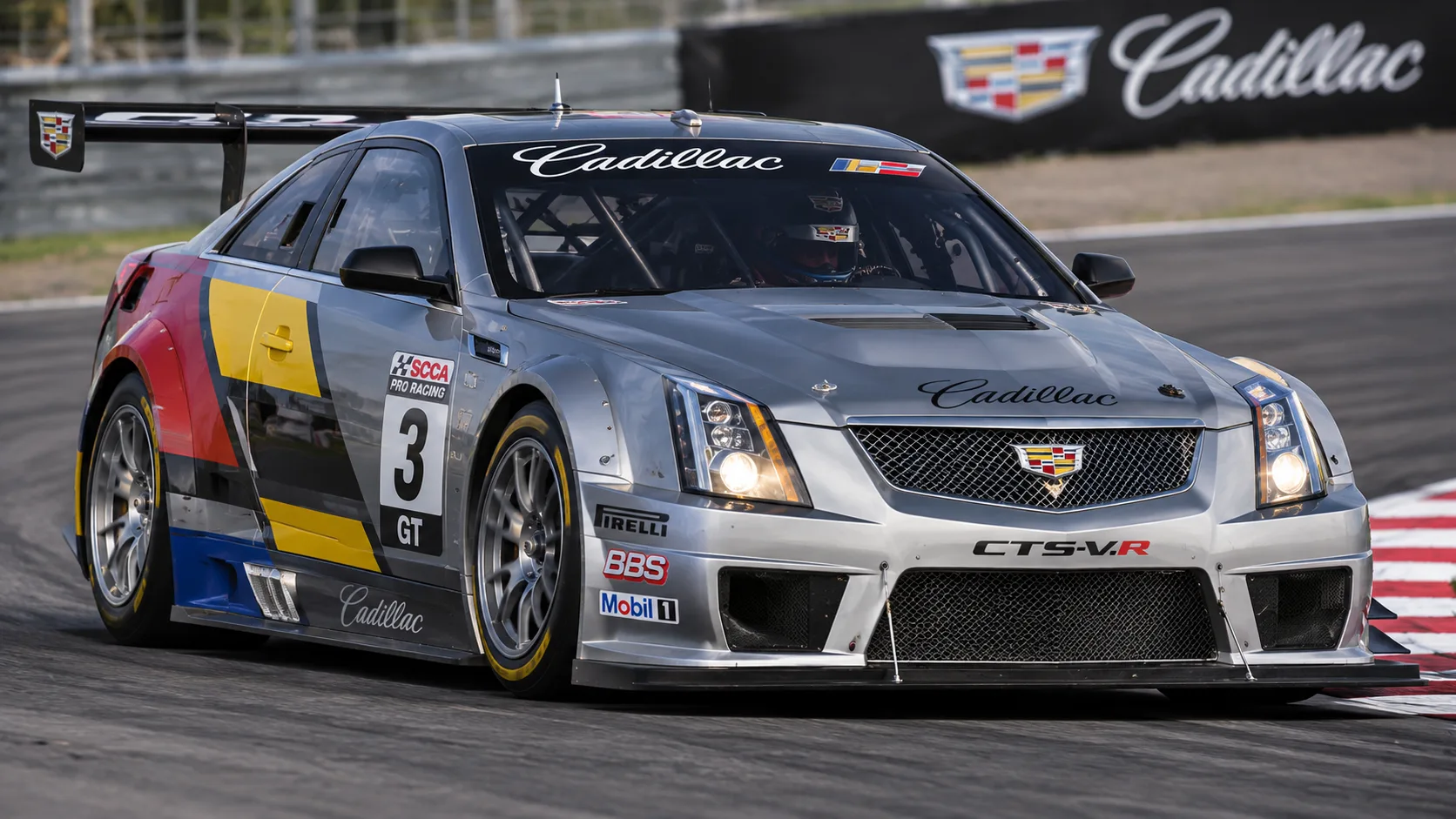
The Cadillac CTS-V.R brought Cadillac's V-Series performance philosophy onto the race track, competing in GT racing and helping establish the brand's modern motorsport identity.
The relationship between Cadillac Racing and production V-Series vehicles has continued through different racing programs and generations.
Cadillac has competed in major endurance and sports-car racing categories, using competition as an environment to develop engineering experience and demonstrate the brand's performance ambitions.
Cadillac V-Series.R
The Cadillac V-Series.R represents a newer chapter in the brand's racing history.
It is a purpose-built hybrid prototype developed for top-level endurance racing.
Its hybrid powertrain and racing-specific chassis make it fundamentally different from a road-going CTS-V or Blackwing sedan.
Cadillac identified the V-Series.R as the beginning of the fifth generation of V-Series in its racing-history context.
This distinction is important: Cadillac's four-generation production V-Series historical breakdown is separate from its fifth-generation racing prototype designation.
The V-Series.R demonstrates how Cadillac continues to connect its performance identity with international motorsport.
12. Cadillac V-Series vs. BMW M and Mercedes-AMG
Cadillac developed V-Series to compete in a market dominated by established European performance divisions.
BMW M is known for motorsport-derived performance sedans and coupes.
Mercedes-AMG is associated with powerful engines, distinctive exhaust character and high-performance luxury vehicles.
Cadillac approaches the same market from an American perspective.
Its performance identity has traditionally emphasized large-displacement V8 engines, rear-wheel-drive sedans, supercharged power and a combination of luxury and high-speed capability.
The CT5-V Blackwing is a clear example. Its 668-horsepower supercharged V8 and available six-speed manual transmission create a distinctive alternative to many modern European performance sedans.
The CT4-V Blackwing offers a different approach through its twin-turbocharged V6 and manual transmission option.
The Escalade-V takes the competition into the full-size luxury SUV category, while LYRIQ-V and OPTIQ-V demonstrate Cadillac's move toward electric performance.
There is no single specification that makes one performance division universally better than another. Each brand follows a different engineering philosophy.
Cadillac's contribution is its combination of American luxury, powerful engines, advanced chassis technology and an increasingly diverse powertrain lineup.
13. How Cadillac V-Series Has Evolved Over Four Generations
Cadillac officially divides its production V-Series history into four generations.
| Generation | Introduction | Important models |
|---|---|---|
| First | 2004 | CTS-V, XLR-V, STS-V |
| Second | 2009 | CTS-V Sedan, Coupe and Wagon |
| Third | 2016 | CTS-V and ATS-V |
| Fourth | 2019 | CT6-V, CT4-V, CT5-V, Blackwing models and Escalade-V |
The first generation established the V-Series identity with the original CTS-V and expanded the range with the XLR-V and STS-V.
The second generation introduced the supercharged LSA V8 and three CTS-V body styles.
The third generation brought the twin-turbocharged ATS-V and the 640-horsepower supercharged CTS-V.
The fourth generation introduced the modern CT4-V and CT5-V families, the Blackwing sedans and the Escalade-V.
The electric LYRIQ-V and OPTIQ-V represent the next stage of the performance division's development.
This history demonstrates that Cadillac V-Series has never been defined by one engine type. Its identity has evolved alongside changes in automotive technology.
14. The Future of Cadillac V-Series: Combustion and Electric Performance
The future of Cadillac V-Series will be shaped by electrification, emissions requirements, changing customer expectations and new vehicle technologies.
The CT4-V Blackwing and CT5-V Blackwing demonstrate that traditional combustion performance remains an important part of Cadillac's identity.
The Escalade-V extends that experience into a full-size SUV.
Meanwhile, LYRIQ-V and OPTIQ-V demonstrate how the brand can apply the same broad performance philosophy to electric vehicles.
These different powertrains offer different experiences.
A supercharged V8 delivers mechanical sound, strong torque and a traditional connection between engine and transmission.
A twin-turbocharged V6 offers a smaller-displacement approach to high output.
Electric motors provide immediate torque and the advantages of dual-motor all-wheel drive.
The challenge for Cadillac is to make sure future V-Series vehicles remain worthy of the badge, regardless of the technology used.
Performance must continue to involve more than straight-line acceleration. Handling, braking, driver confidence and vehicle refinement remain essential.
The future of V-Series may involve several powertrain technologies, but its fundamental objective is unlikely to change: build Cadillacs that combine luxury with serious performance.
15. Frequently Asked Questions About Cadillac V-Series
What is Cadillac V-Series?
Cadillac V-Series is the brand's high-performance vehicle family. It combines luxury with more powerful engines or electric powertrains, upgraded chassis systems, performance braking and motorsport-inspired engineering.
When did Cadillac V-Series begin?
Cadillac launched the V-Series performance sub-brand in March 2004 at Sebring International Raceway. The original production model was the 2004 Cadillac CTS-V.
What was the first Cadillac V-Series car?
The first production V-Series model was the 2004 Cadillac CTS-V. It used a 5.7-liter LS6 naturally aspirated V8 producing 400 horsepower and 395 lb-ft of torque.
What is the difference between CT4-V Blackwing and CT5-V Blackwing?
The CT4-V Blackwing uses a 3.6-liter twin-turbocharged V6 producing 472 horsepower and 445 lb-ft of torque. The CT5-V Blackwing uses a 6.2-liter supercharged V8 producing 668 horsepower and 659 lb-ft of torque.
Which Cadillac V-Series model has the most horsepower?
Among the current combustion-powered production models listed by Cadillac, the Escalade-V produces 682 horsepower. The CT5-V Blackwing produces 668 horsepower. The LYRIQ-V has a Cadillac-estimated 615 horsepower in Velocity Max mode.
Does Cadillac still offer a manual V-Series car?
Yes. The CT4-V Blackwing and CT5-V Blackwing offer six-speed manual transmissions. Both also have available automatic transmission options.
Is Cadillac V-Series available with electric power?
Yes. Cadillac has introduced the LYRIQ-V and OPTIQ-V electric performance SUVs. Both use dual-motor all-wheel-drive powertrains and offer manufacturer-estimated performance figures.
What does Blackwing mean in Cadillac?
Blackwing is a name associated with Cadillac's high-performance engineering. It is used for the CT4-V Blackwing and CT5-V Blackwing, which are specialized performance versions of the CT4-V and CT5-V.
Is Cadillac V-Series the same as Cadillac Racing?
No. V-Series is Cadillac's performance road-car family. Cadillac Racing operates competition vehicles such as the CTS-V.R and V-Series.R. The two are connected through the brand's motorsport and engineering heritage, but they are not the same vehicle program.
Final Verdict: The American Luxury Performance Legacy Continues
The Cadillac V-Series story began with an ambitious idea in 2004: prove that an American luxury brand could compete with the world's leading performance manufacturers.
The original CTS-V established the foundation with a naturally aspirated V8, rear-wheel drive and a manual transmission.
The second-generation CTS-V transformed the formula with a supercharged 6.2-liter V8 and expanded the range into sedan, coupe and wagon body styles.
The third generation introduced twin-turbocharged V6 performance through the ATS-V while taking the CTS-V to 640 horsepower.
The Blackwing models brought a new level of performance and driver involvement to Cadillac's modern sedans. The Escalade-V extended the philosophy into a full-size luxury SUV, while the LYRIQ-V and OPTIQ-V are carrying the performance badge into the electric era.
What makes Cadillac V-Series important is not simply the horsepower printed on a specification sheet.
It is the engineering philosophy behind every vehicle: power supported by suspension, braking, steering, traction and chassis development, all combined with the luxury expected from Cadillac.
More than two decades after its introduction, V-Series remains a distinctive part of American automotive performance.
From the sound of a supercharged V8 to the instant response of electric motors, the technology continues to evolve.
Cadillac V-Series is more than a performance badge. It is Cadillac's ongoing statement that American luxury and serious driving performance can belong in the same vehicle.
Editorial Note: This article covers multiple Cadillac model years and powertrain configurations. Specifications are identified by model and year where possible. Manufacturer-estimated performance figures are distinguished from EPA-estimated range. Equipment, availability and specifications may vary by model year and market.
Have thoughts, dyno data, or build feedback?
Join automotive enthusiasts in the paddock below to debate engineering, lap times, and modifications.
Community Pulse
How does this machine make you feel? Drop your reaction!

VehicleDrugs Editorial
VehicleDrugs Editorial Team
A passionate collective of automotive purists, track drivers, and mechanical engineers uncovering high-octane engineering breakthroughs worldwide.
🏁 Pit Crew Discussions
Drop your telemetry, debate the engineering, or talk track times with fellow petrolheads.
The Pit Lane is Quiet
Be the first driver to drop your opinion on this machine!