
1969 Ford Mustang Boss 429: NASCAR Complete History & Specs
Explore the 1969 Ford Mustang Boss 429's NASCAR origins, Kar Kraft engineering, 429 Shotgun V8, production numbers, specifications, and collector history.
HEAD-TO-HEAD MUSCLE CAR VS COMPARISON
Compare 0-60, peak horsepower, torque, and quarter-mile times across iconic builds.
1969 Ford Mustang Boss 429:
The Complete History of Ford's Legendary NASCAR Homologation Muscle Car
The 1969
Ford Mustang Boss 429 is one of the most extraordinary American muscle cars
ever built. Created to support Ford's NASCAR racing ambitions, the Boss 429
combined a specially engineered 429-cubic-inch V8 with extensive chassis
modifications and one of the most recognizable designs in Mustang history.
Unlike an
ordinary high-performance Mustang, the Boss 429 required a completely different
approach to production. Its massive engine was too wide to fit comfortably
inside the standard Mustang engine compartment. Ford therefore turned to Kar
Kraft, its specialist performance engineering partner, to modify the cars
before they reached customers.
The result was
a limited-production Mustang powered by Ford's famous 429 Shotgun V8. It
featured aluminum cylinder heads, a distinctive semi-hemispherical
combustion-chamber design, a functional ram-air hood scoop, a trunk-mounted
battery and a specialized suspension arrangement.
Ford
advertised the engine at 375 horsepower, while its racing-inspired engineering
gave it considerable performance potential beyond the ordinary Mustang lineup.
With only
857 examples commonly documented for the 1969 model year, the Boss 429 became
one of the rarest and most desirable classic Mustangs. Its connection to
NASCAR, Kar Kraft's specialized construction and its legendary big-block V8
continue to make it a centerpiece of American muscle-car history.
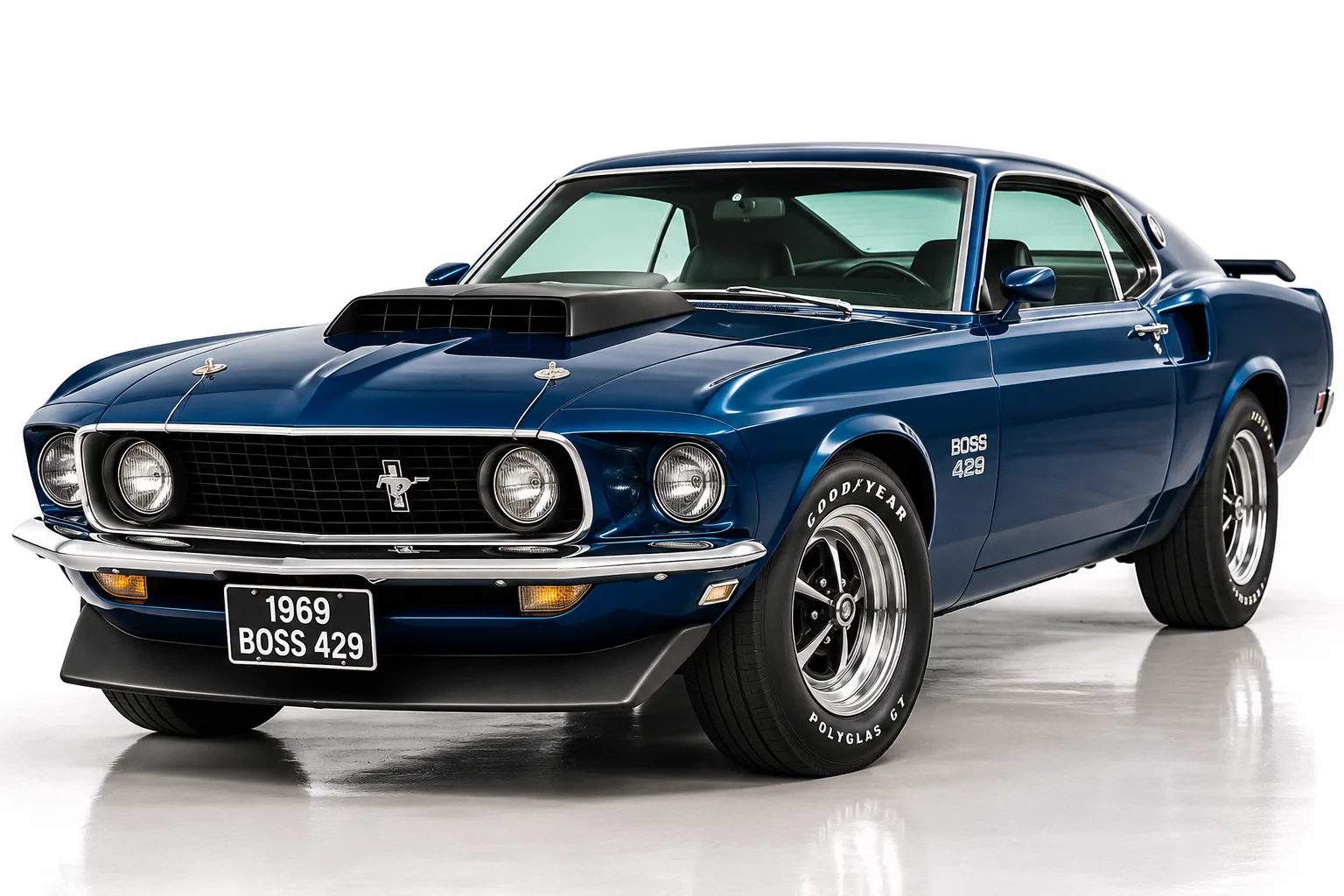
The 1969 Ford Mustang Boss 429 combined Ford's legendary 429 Shotgun V8 with specialized Kar Kraft engineering to create one of America's rarest NASCAR-inspired muscle cars.
1. Why Ford Created the Mustang Boss 429
The story of
the 1969 Mustang Boss 429 begins with NASCAR.
During the
late 1960s, American manufacturers were competing intensely in stock-car
racing. Ford wanted a powerful new engine capable of challenging the dominant
Chrysler 426 HEMI in NASCAR competition.
Ford's
answer was the 429 Boss V8, an engine developed with specialized cylinder-head
technology and racing-oriented engineering.
However,
NASCAR homologation requirements meant Ford needed to make a qualifying number
of production vehicles available with the competition-related engine.
The Mustang
became the selected platform for this project. It was already one of America's
most recognizable performance cars, but its engine compartment was not designed
for the unusually wide Boss 429 V8.
Ford
therefore needed a specialist engineering operation to transform the standard
Mustang into a vehicle capable of accommodating the new engine.
That
responsibility went to Kar Kraft.
The Boss 429
was not created simply to offer customers another large-displacement Mustang.
Its primary purpose was to help Ford establish the production-engine foundation
required for its NASCAR racing ambitions.
2. Kar Kraft: The Engineering Behind the Boss 429
Kar Kraft
was Ford's specialist performance engineering partner. Its Brighton, Michigan
operation handled the extensive modifications necessary to turn a regular
Mustang fastback into a Boss 429.
The 429
engine's large cylinder heads and exhaust components created significant
packaging challenges. The standard Mustang engine compartment required
substantial changes before the powerplant could be installed.
Kar Kraft
modified the front structure and engine-compartment areas, including the
shock-tower region. The front suspension arrangement was revised to accommodate
the engine and its associated components.
The modifications
also included:
- Modified front suspension
mounting arrangements
- Revised engine-compartment
structure
- Specialized front suspension
components
- Competition-oriented rear
suspension equipment
- Staggered rear shock absorbers
- A trunk-mounted battery
- A functional ram-air hood scoop
- A dedicated front spoiler
The battery
was moved to the trunk to help manage the weight distribution of the
large-engine installation.
The
completed vehicles also received Kar Kraft identification numbers, commonly
called KK numbers. These numbers became important reference points for
identifying and documenting original Boss 429 examples.
The
specialized construction process is one of the reasons genuine Boss 429
Mustangs are difficult to reproduce accurately.
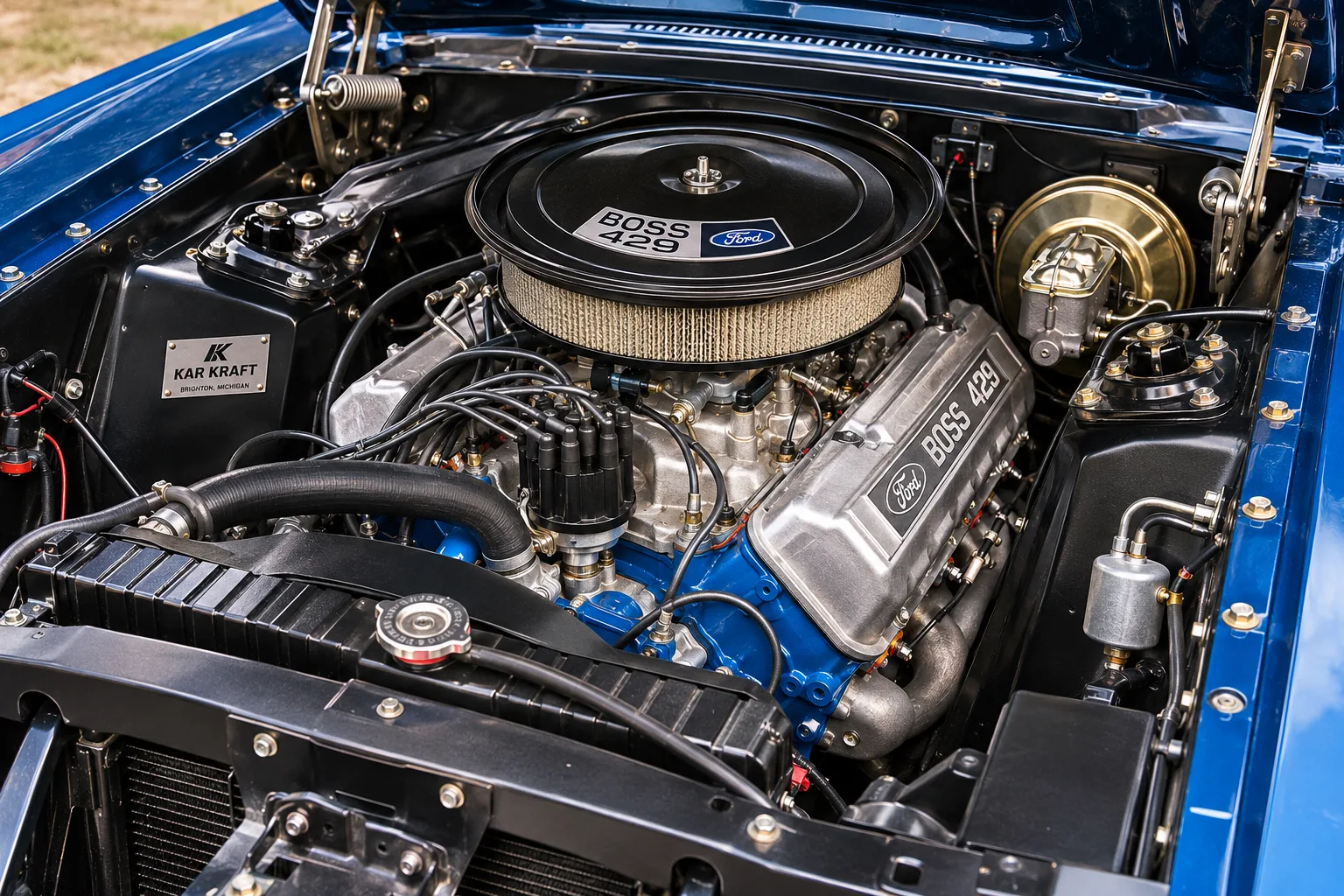
Kar Kraft carried out extensive engineering modifications to accommodate Ford's wide 429 Boss V8, transforming the standard Mustang into a specialized NASCAR homologation model.
3. The Legendary 429 Shotgun V8
The most
important feature of the 1969 Ford Mustang Boss 429 was its specially developed
429-cubic-inch V8.
Often called
the Shotgun engine, the Boss 429 featured a distinctive semi-hemispherical
combustion-chamber design. Ford also used the Blue Crescent name when
describing aspects of its combustion-chamber engineering.
The engine
was developed around a reinforced cast-iron block and specialized aluminum
cylinder heads.
Its large
ports and valves were designed to support substantial airflow, while the
combustion-chamber arrangement reflected Ford's racing ambitions.
Unlike an
ordinary production big-block V8, the Boss 429 incorporated several highly
specialized components.
1969 Ford Mustang Boss 429 Engine Specifications
|
Specification |
Factory specification |
|
Engine |
Ford Boss
429 V8 |
|
Displacement |
429 cubic
inches |
|
Metric
displacement |
Approximately
7.0 liters |
|
Horsepower |
375 hp |
|
Advertised
peak power |
5,200 rpm |
|
Factory
brochure torque |
410 lb-ft |
|
Advertised
peak torque |
3,400 rpm |
|
Compression
ratio |
10.5:1 |
|
Cylinder
block |
Cast iron |
|
Cylinder
heads |
Aluminum |
|
Carburetor |
Holley
four-barrel |
|
Carburetor
rating |
735 CFM |
|
Transmission |
Four-speed
manual |
|
Drivetrain |
Rear-wheel
drive |
These are
period factory gross-output figures. They should not be compared directly with
modern SAE net horsepower ratings.
The original
Ford Boss 429 specifications document lists 375 horsepower and 410 lb-ft of
torque. Some later secondary publications quote different torque figures, so
the original factory documentation is the preferred reference for this article.
The engine's
large cylinder heads, specialized valve arrangement and unique intake system
made it one of the most distinctive American V8 designs of its generation.
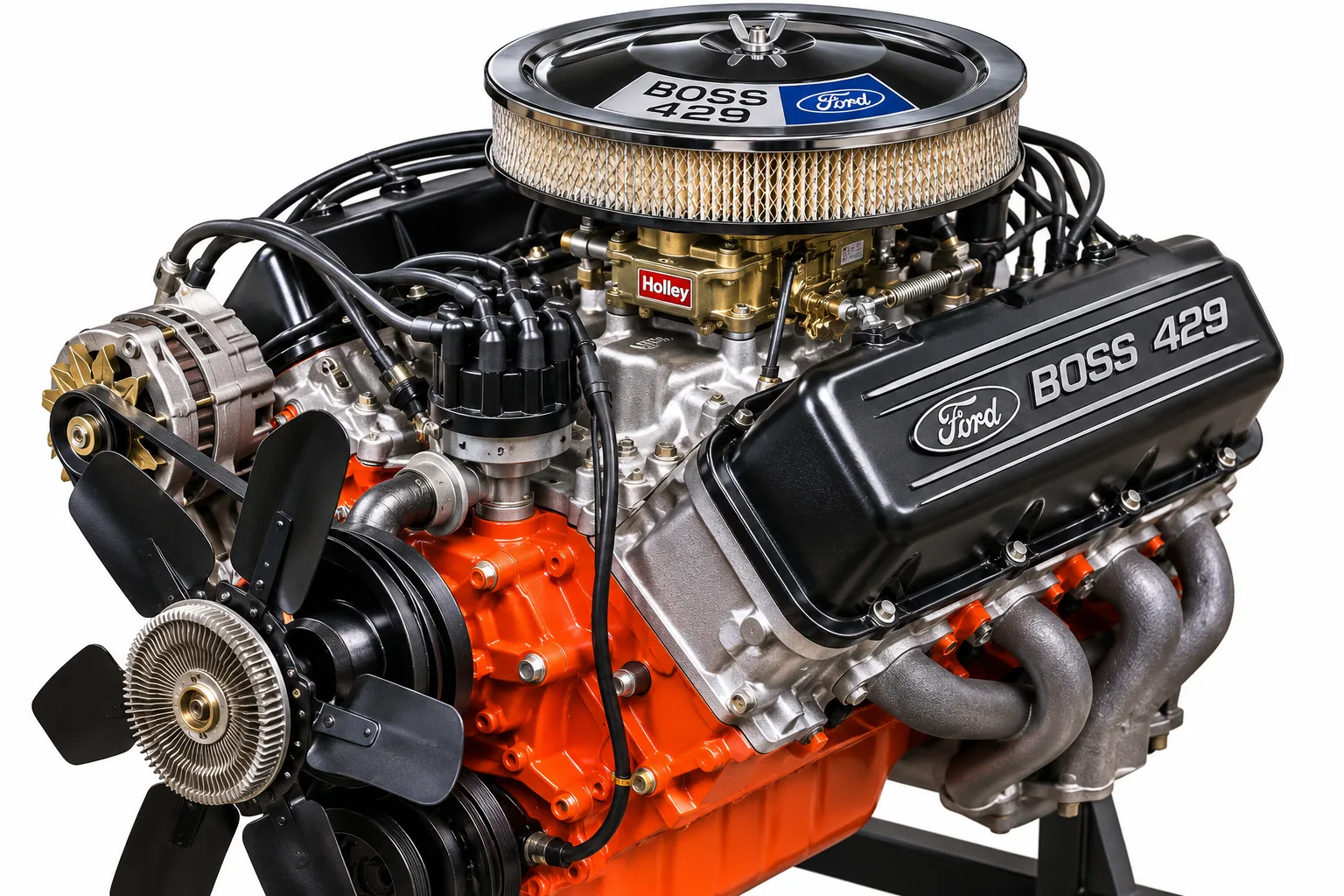
The legendary 429 Shotgun V8 powered the 1969 Mustang Boss 429, combining specialized aluminum cylinder heads and racing-inspired engineering with Ford's factory-rated 375 horsepower.
4. Boss 429 S-Code and T-Code Engine Differences
The 1969
Boss 429 production run included different internal engine configurations.
The two most
frequently discussed versions are the S-code and T-code engines.
Early S-Code Engine
The earliest
production Boss 429 Mustangs received the S-code engine.
Specialist
historical references commonly identify the first 279 cars as having this
configuration.
The S-code
engine featured heavy-duty connecting rods associated with the original
NASCAR-oriented engineering program. It also used a hydraulic-lifter camshaft
and distinctive magnesium valve covers.
These early
components are particularly interesting to collectors because they represent
the first version of Ford's production Boss 429 engine.
Later T-Code Engine
Later
production cars received the T-code engine configuration.
The T-code
version introduced revised internal components, including different connecting
rods and pistons.
The early
T-code engines retained several features associated with the S-code configuration,
but changes were made during production. These included revisions to valve
covers and camshaft arrangements.
The
differences are important when authenticating and restoring a Boss 429.
A genuine
original engine should be examined through its identification markings, casting
information and supporting documentation. The engine's production version
should match the history of the individual vehicle.
Both
configurations were part of the same Boss 429 performance program and carried
Ford's advertised 375-horsepower rating.
5. Functional Ram-Air Hood Scoop and Exterior Design
The 1969
Mustang Boss 429 had an aggressive appearance, but its exterior design was
relatively restrained compared with some other muscle cars of the period.
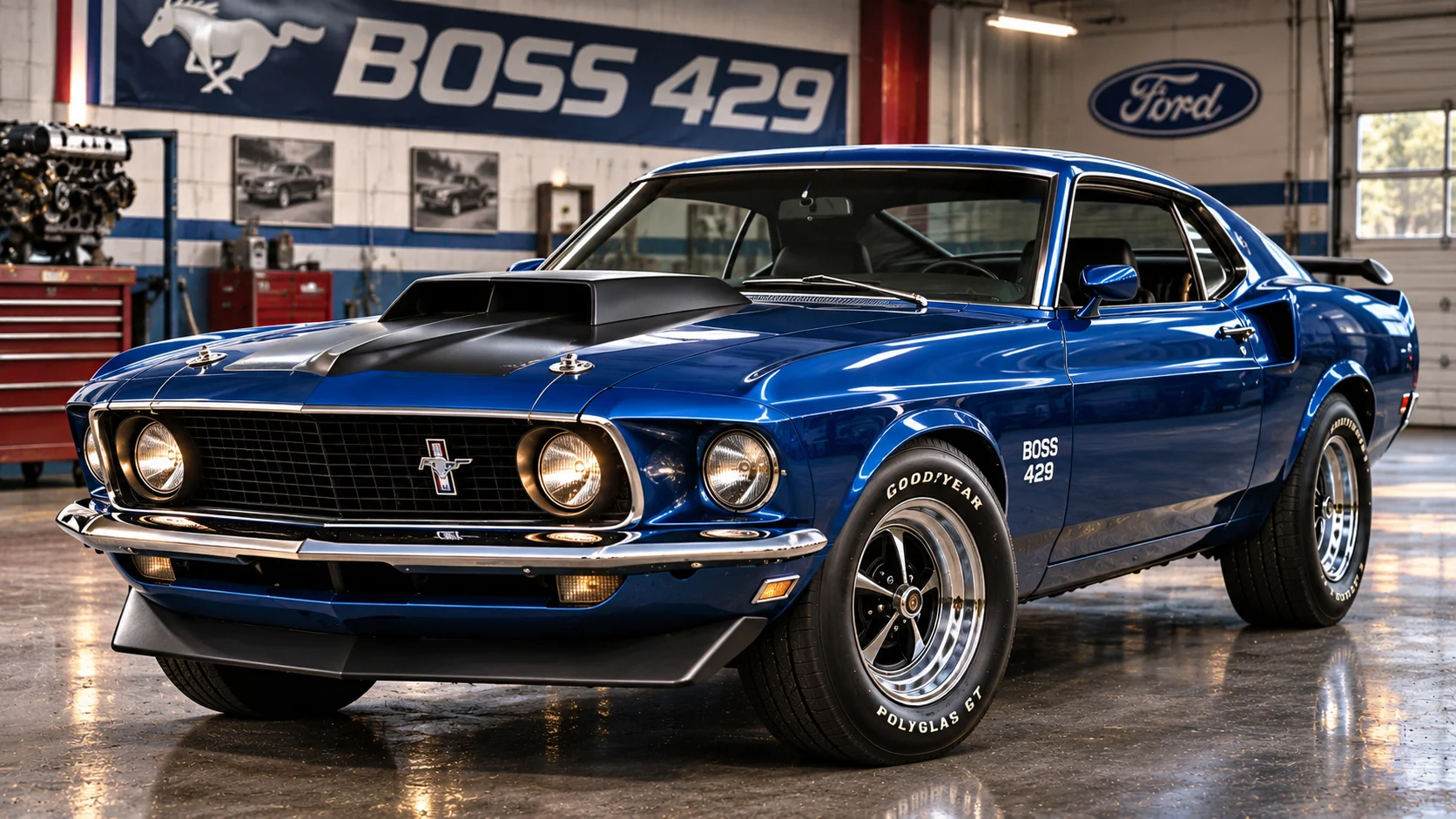
Its most
recognizable feature was the enormous functional hood scoop.
Unlike a
purely decorative hood accessory, the Boss 429 scoop incorporated a
driver-controlled ram-air arrangement. The system allowed outside air to enter
the intake system through the hood opening when activated.
The scoop
was necessary because of the specialized intake and engine installation.
Other
distinctive exterior features included:
- Unique Boss 429 fender
identification
- Specially designed front
spoiler
- Functional ram-air hood scoop
- 15-inch Magnum 500 wheels
- F60 x 15 Goodyear Wide-Oval
tires
- Dual racing-style side mirrors
- Traditional 1969 Mustang grille
and headlights
- Classic fastback roofline and
rear body design
The
combination created a recognizable Mustang without relying on excessive
exterior decoration.
The front
spoiler and functional hood scoop were particularly important parts of the Boss
429 identity.
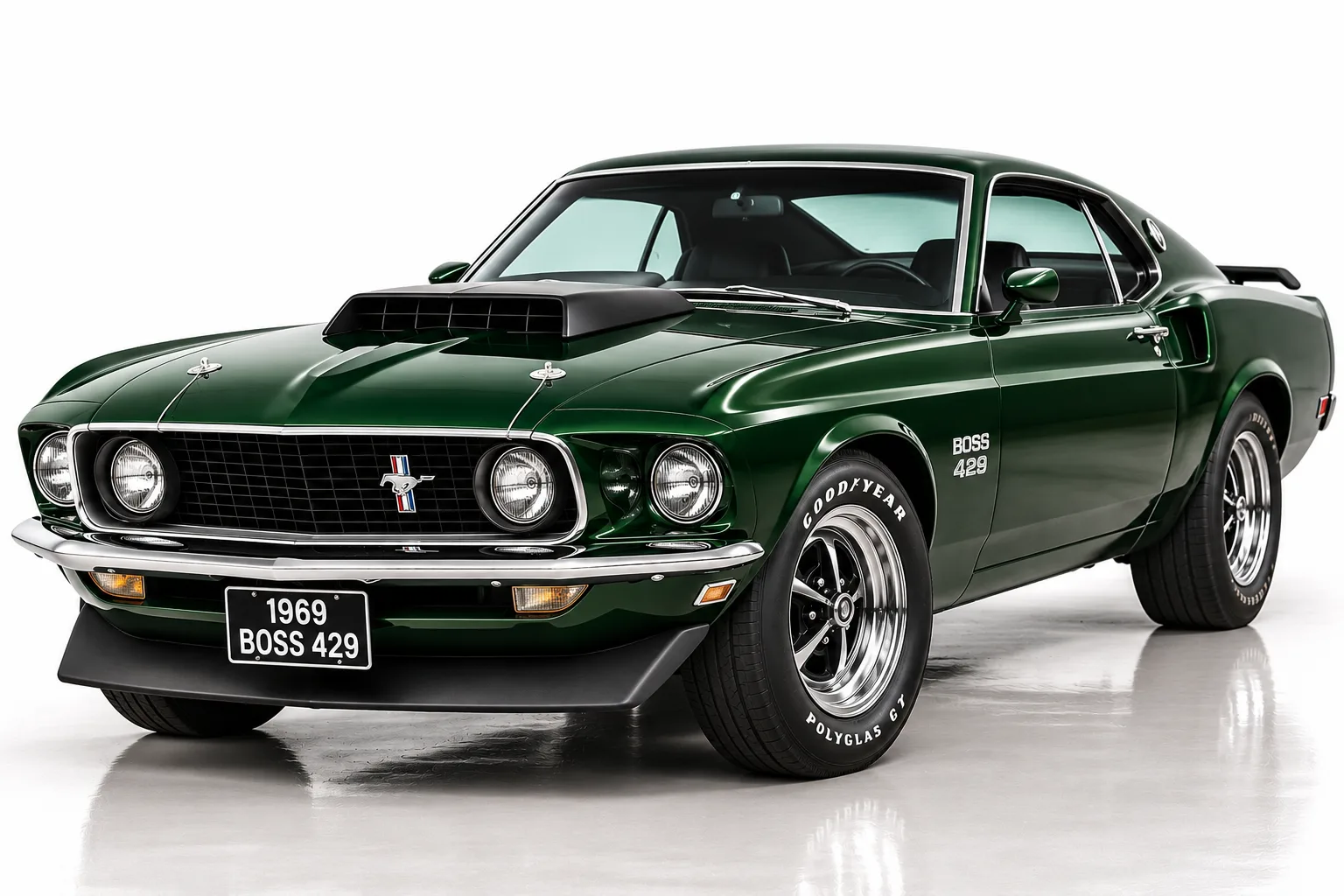
The 1969 Mustang Boss 429 combined its distinctive functional hood scoop and front spoiler with classic fastback styling and specialized performance details.
6. Transmission, Rear-Wheel Drive and Suspension
The 1969
Ford Mustang Boss 429 was equipped with a four-speed manual transmission.
Ford paired
the large V8 with a heavy-duty drivetrain intended to handle the engine's
substantial torque.
Power was
delivered to the rear wheels through a performance-oriented rear axle and
differential arrangement.
The factory
Boss 429 specification included a Traction-Lok differential. A 3.91:1 axle
ratio is commonly associated with the model's standard configuration.
The car also
received specialized suspension equipment, including staggered rear shock
absorbers.
The rear
suspension arrangement helped distinguish the Boss 429 from ordinary Mustang
models. Its front suspension and chassis had also been modified as part of Kar
Kraft's engine-installation process.
The factory
equipment package included competition-oriented components designed around the
vehicle's large engine and performance purpose.
The Boss 429
was therefore more than a powerful engine placed inside a Mustang body. Its
transmission, rear axle and suspension were important parts of the overall
engineering package.
7. Interior: A Performance-Focused 1969 Mustang Cabin
Inside, the
Boss 429 retained the familiar design of the 1969 Mustang fastback.
The driver
faced the traditional Mustang instrument panel, with its period-style gauges,
steering wheel and center-console arrangement.
Ford
equipped the Boss 429 with high-back bucket seats and a performance-oriented
interior specification.
The factory
equipment included an 8,000-rpm tachometer and AM radio, according to
historical model references.
The interior
was designed around the Mustang's existing cabin rather than a completely
separate racing-style cockpit.
This
contrast made the Boss 429 particularly interesting. Its exterior and cabin
looked like a recognizable production Mustang, while its engine compartment
contained an unusually specialized racing-inspired powerplant.
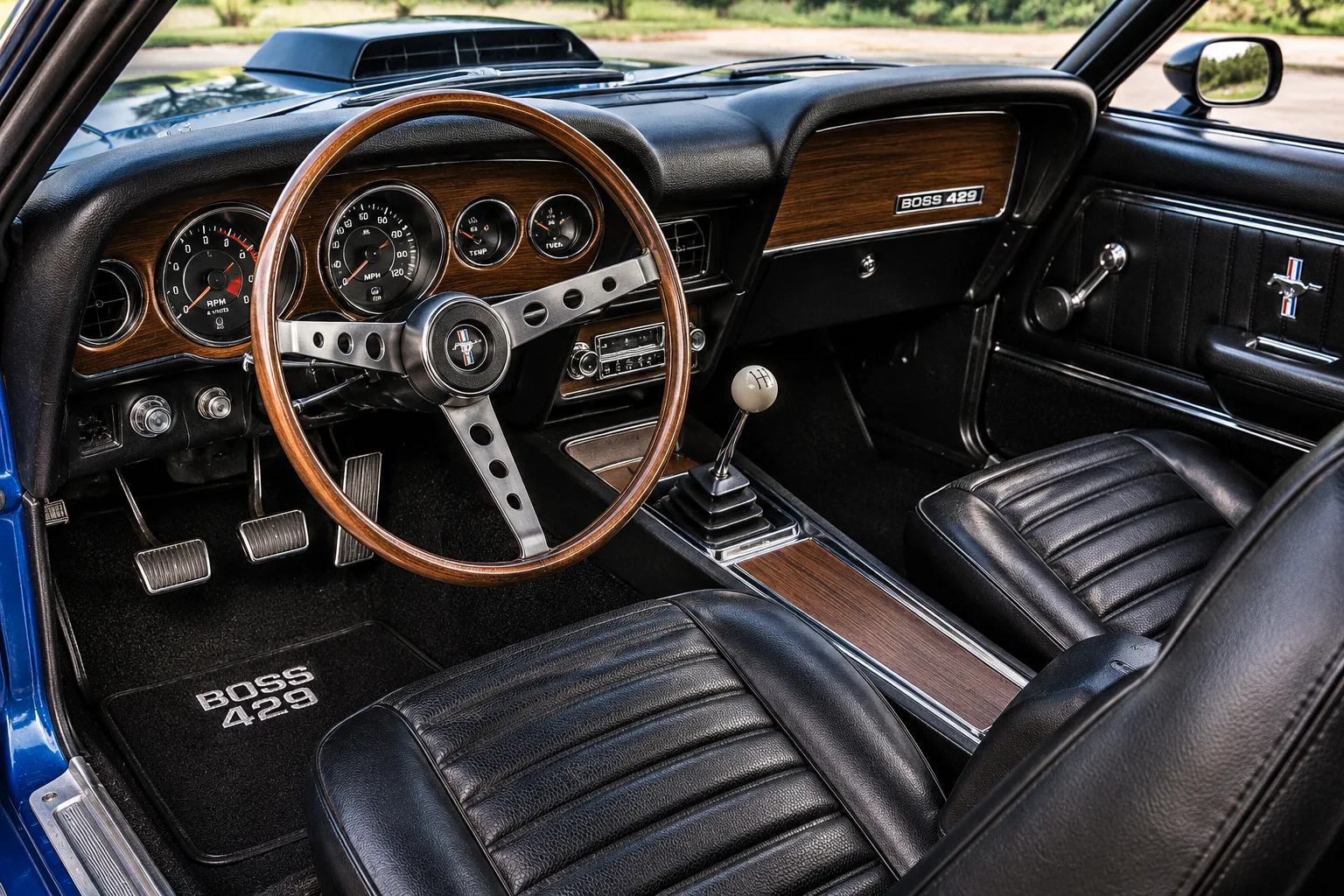
The Boss 429 retained the classic 1969 Mustang cabin, combining its traditional interior design with a four-speed manual transmission and performance-focused instrumentation.
8. Production Numbers: How Rare Was the 1969 Boss 429?
The limited
production of the Boss 429 is one of the main reasons it became such an
important collector Mustang.
The commonly
cited production figure for the 1969 Mustang Boss 429 is 857 cars.
For the 1970
model year, production continued with another 499 Mustang examples.
|
Model year |
Commonly cited Mustang production |
|
1969 Boss
429 |
857 |
|
1970 Boss
429 |
499 |
|
Combined
total |
1,356 |
Some
historical and auction references quote 859 for 1969. Figures can differ
according to how related Boss 429 Mercury Cougar production is counted.
For clarity,
the 857 figure is used here as the commonly cited 1969 Mustang-only production
total.
The cars
were built through Kar Kraft's specialized operation rather than through an
ordinary Mustang production process.
The limited
numbers, special engine and extensive modifications helped establish the Boss
429 as one of the rarest factory-built Mustangs of its generation.
9. Factory Colors and Identification Details
The 1969
Boss 429 was offered in a selection of Ford's period exterior colors.
Examples
include:
- Raven Black
- Wimbledon White
- Candyapple Red
- Royal Maroon
- Black Jade
Exact
factory color availability and production totals should be verified against the
individual vehicle's original documentation.
Collectors
often pay close attention to original paint, interior trim and factory
equipment because these details can help establish a car's authenticity.
The VIN is
one of the first places to begin an inspection.
The Boss 429
used the Z engine designation in the Mustang VIN. However, a VIN alone is not
enough to establish that every major component is original.
The Kar
Kraft KK number, engine identification, factory documentation and other
identifying details should also be examined.
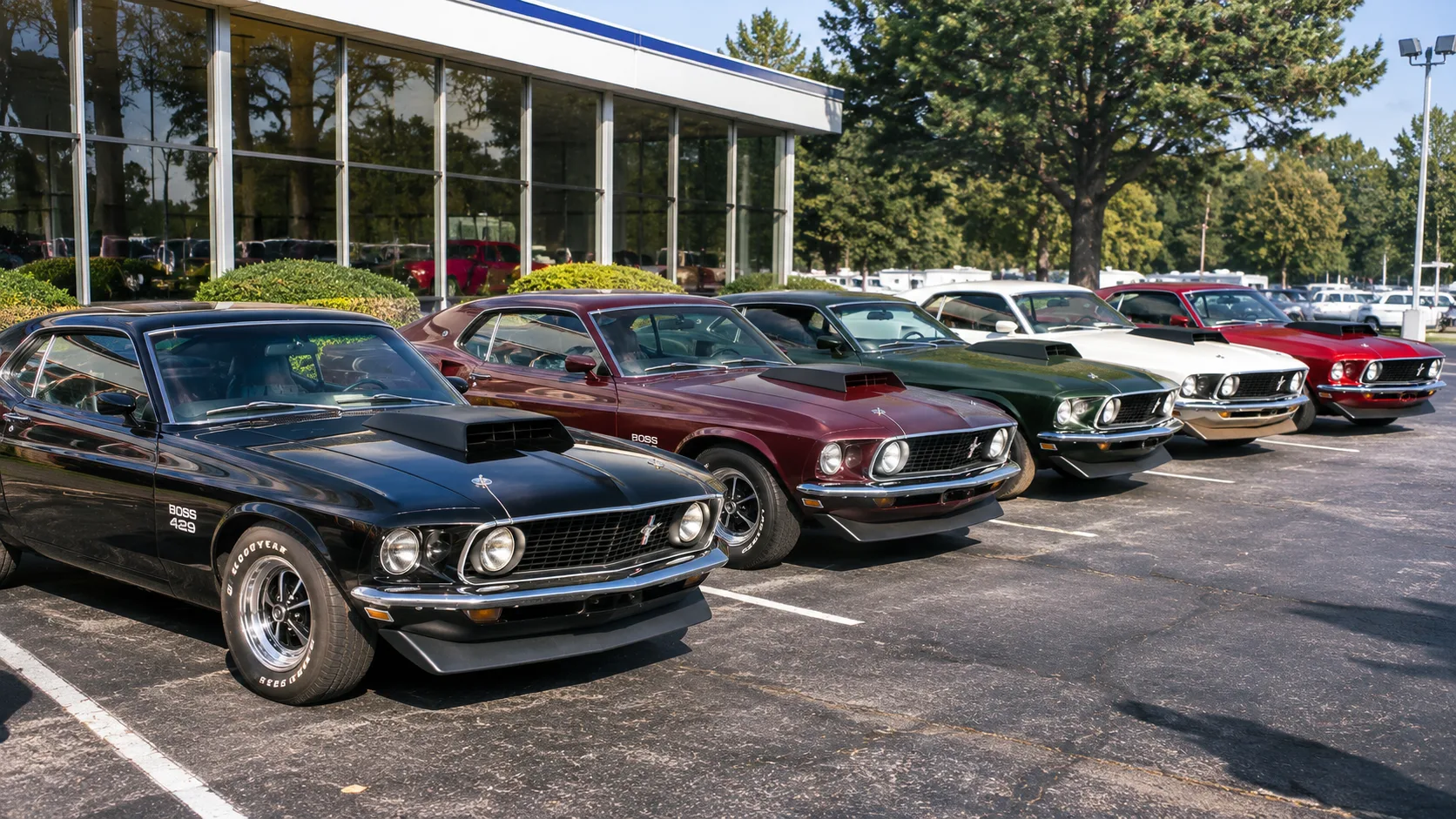
The 1969 Ford Mustang Boss 429 was offered in a distinctive selection of factory colors, including Raven Black, Royal Maroon, Black Jade, Wimbledon White and Candyapple Red.
10. Performance: What Made the Boss 429 Special?
Ford
advertised the Boss 429 at 375 horsepower, but its reputation was built on more
than its published output figure.
The engine
was designed around large airflow capacity, specialized cylinder heads and a
performance-oriented intake system.
Its
semi-hemispherical combustion-chamber design and large valves gave the engine a
distinctive character compared with other Ford V8s of the period.
The
four-speed manual transmission allowed the driver to control power delivery
directly, while the rear-wheel-drive arrangement preserved the traditional
muscle-car driving experience.
The Boss 429
was also a relatively heavy vehicle because of its large engine and additional
structural modifications.
Its
performance depended on several factors, including gearing, tire condition,
engine specification and vehicle setup.
Period
road-test results vary, and modern performance comparisons should take into
account the testing methods used during the late 1960s.
Rather than
treating one acceleration figure as universal, the Boss 429 is best understood
as a specialized high-performance Mustang built around a racing-inspired
engine.
11. Boss 429 vs. Boss 302: Two Different Ford Racing Mustangs
The 1969
Mustang Boss 429 and Boss 302 were developed around different motorsport
objectives.
The Boss 302
used a 302-cubic-inch small-block V8 and was associated with Ford's Trans-Am
racing program.
The Boss 429
used a much larger 429-cubic-inch V8 developed for NASCAR homologation.
Their
engineering priorities were therefore different.
The Boss 302
focused on a smaller-displacement engine and a performance package suited to
road racing requirements.
The Boss 429
required extensive engine-compartment modifications to accommodate its large
V8.
Both models
became important parts of Ford's performance history, but the Boss 429 stood
apart because of its unique engine and specialized Kar Kraft construction.
12. The 1970 Boss 429: The Final Production Year
The Boss 429
continued into the 1970 model year, marking the second and final year of
production.
The 1970
model retained the basic mechanical identity of the 1969 version, including the
429 V8 and four-speed manual transmission.
Exterior
details and factory color availability changed for the new model year. The 1970
cars also featured their own production and equipment variations.
A commonly
cited production figure is 499 Mustang examples for 1970.
After this
model year, Ford ended Boss 429 Mustang production.
The
relatively short production period helped establish the Boss 429 as one of the
most important limited-production Mustangs ever built.
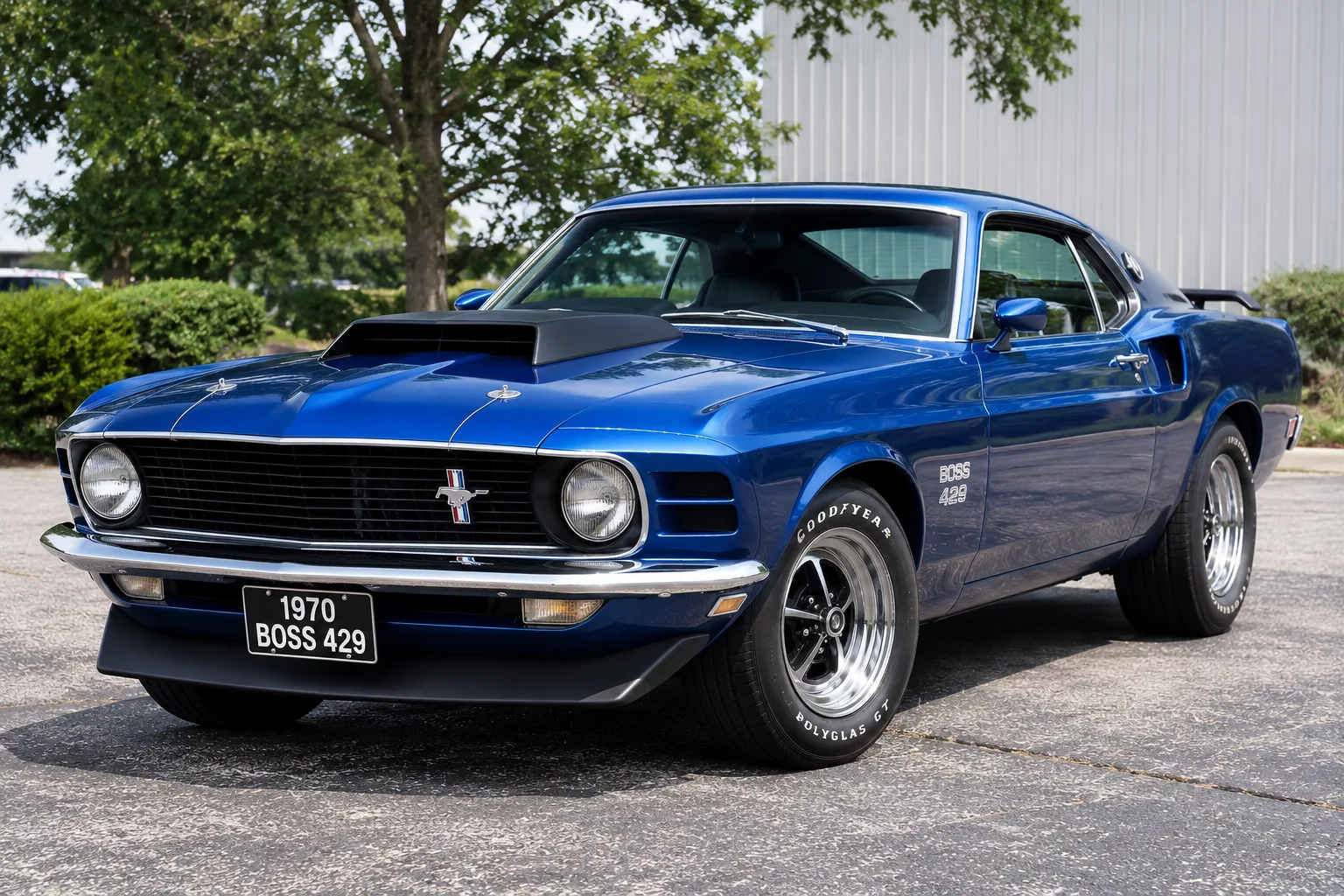
The 1970 Ford Mustang Boss 429 marked the final production year of Ford's legendary NASCAR homologation muscle car, retaining its powerful 429 V8 and distinctive performance styling.
13. Authenticity: How to Identify a Genuine Boss 429
The Boss
429's collector value makes authentication particularly important.
Many
standard Mustangs have been modified with Boss-style hood scoops, badges,
wheels and engine components. These modifications can create a convincing
appearance, but they do not establish factory authenticity.
A genuine
Boss 429 should be evaluated through several identification points.
VIN and
engine code: The Z
engine designation is an important starting point.
Kar Kraft KK
number: Original
cars received a Kar Kraft production identification number.
Engine
identification: The engine
block, cylinder heads and related components should be checked against the
correct production specification.
Factory
data: Original
documentation, warranty information, invoices and historical reports can help
confirm the car's identity.
Structural
details: The
modified engine compartment, suspension arrangements and trunk-mounted battery
installation should be examined.
A qualified
Boss 429 specialist should inspect any vehicle being purchased as an original
example.
A
reproduction or tribute Mustang may still be an attractive classic car, but it
should never be represented as a genuine factory Boss 429 without supporting
evidence.
14. Restoration and Collector Value
Restoring a
1969 Ford Mustang Boss 429 requires specialist knowledge.
Its engine,
Kar Kraft modifications, suspension components and identification details make
it more complicated than an ordinary Mustang restoration.
Important
areas include the engine block and cylinder heads, original carburetor, intake
manifold, transmission, rear differential, suspension, engine compartment and
factory body components.
Original
paint and trim can also have a major influence on collector interest.
The value of
a Boss 429 depends on its originality, condition, engine configuration,
documentation, restoration quality and ownership history.
A genuine,
well-documented example with its original engine and important factory
components can command a substantial premium.
However, no
single market value applies to every Boss 429. Buyers should compare recent
completed auction sales and obtain specialist valuations before making a
purchase.
The model's
rarity and NASCAR connection give it a strong historical identity, but future
investment performance is never guaranteed.
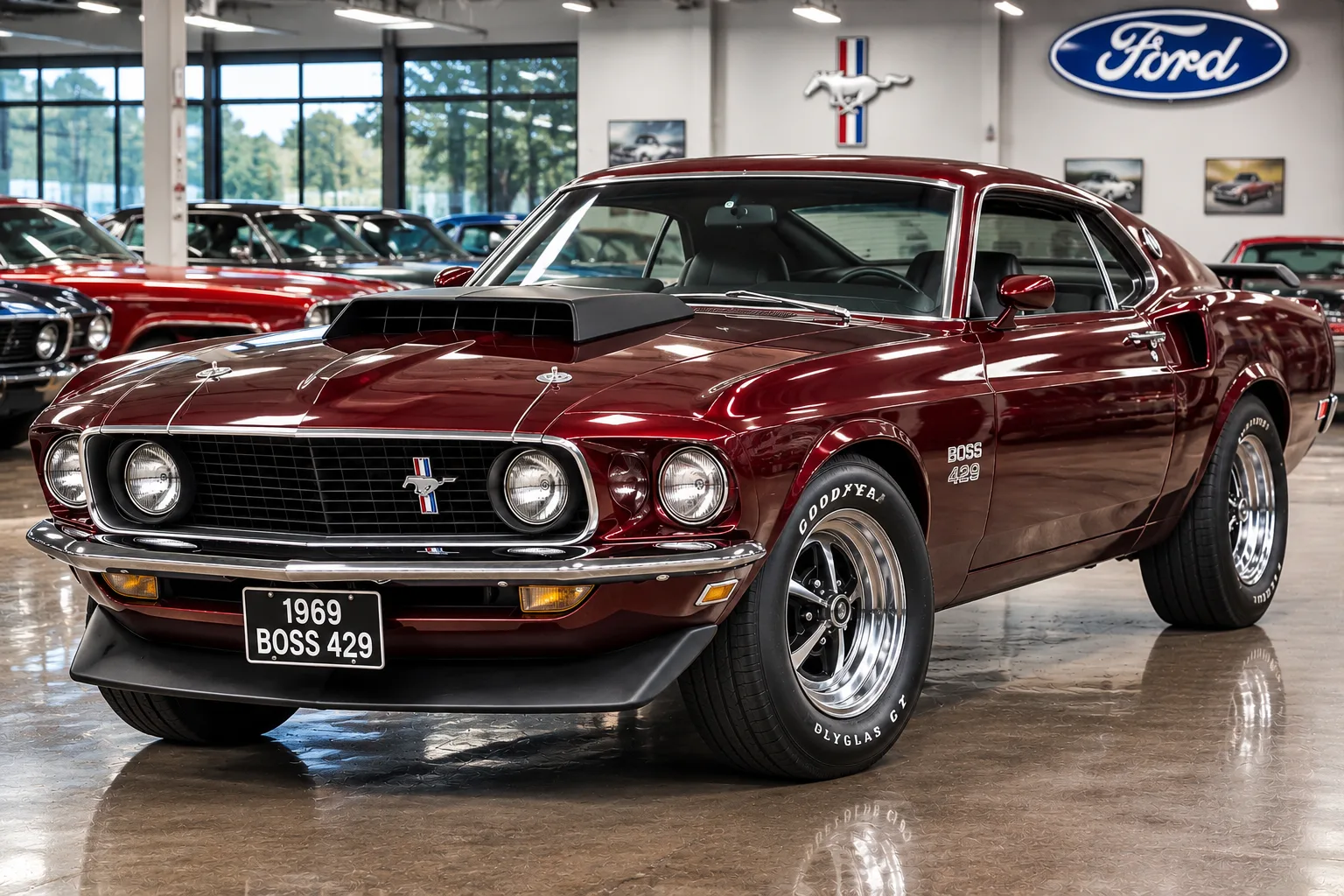
The rarity, specialized Kar Kraft engineering and legendary 429 V8 make the 1969 Ford Mustang Boss 429 one of the most desirable collectible Mustangs.
Why the 1969 Ford Mustang Boss 429 Still Matters
The 1969
Ford Mustang Boss 429 represents one of the most ambitious chapters in Ford's
performance history.
It was
created to support NASCAR competition, but its engineering made it an
extraordinary production Mustang in its own right.
The 429
Shotgun V8, extensive Kar Kraft modifications, functional ram-air system and
specialized suspension made it fundamentally different from an ordinary Mustang
fastback.
Its limited
production numbers helped establish its rarity, while its connection to Ford's
racing ambitions gave it a lasting place in American motorsport history.
Today, the
Boss 429 remains one of the most respected classic Mustangs among collectors
and enthusiasts.
It was a
Mustang built around a specific engineering challenge — and that is precisely
what makes it legendary.
Frequently Asked Questions
How much horsepower did the 1969 Ford Mustang Boss 429
have?
Ford
advertised the 429 Boss V8 at 375 horsepower at 5,200 rpm using period factory
gross ratings.
How much torque did the 1969 Boss 429 produce?
The original
Ford specification document lists 410 lb-ft at 3,400 rpm. Some secondary
references quote different figures.
What engine was in the 1969 Mustang Boss 429?
It used a
429-cubic-inch, approximately 7.0-liter Ford Boss V8 with specialized aluminum
cylinder heads and a Holley four-barrel carburetor.
Why did Ford build the Boss 429?
Ford
developed the Boss 429 Mustang to support its NASCAR homologation program for
the new 429 racing engine.
Who built the 1969 Boss 429 Mustang?
Ford worked
with Kar Kraft, its specialist performance engineering partner, to modify and
complete the cars.
How many 1969 Boss 429 Mustangs were built?
The commonly
cited 1969 Mustang-only production figure is 857 cars.
What transmission did the Boss 429 use?
The 1969
Boss 429 used a four-speed manual transmission and rear-wheel drive.
What is the difference between the S-code and T-code
Boss 429?
The S-code
was used in the earliest production engines, while the later T-code version
introduced revised internal components. The first 279 cars are commonly
identified as S-code examples.
How many 1970 Boss 429 Mustangs were produced?
The commonly
cited production figure for the 1970 model year is 499 cars.
How can you identify a genuine Boss 429?
Check the
VIN engine code, Kar Kraft KK identification, engine components, factory
records and supporting documentation. A specialist inspection is strongly
recommended.
Final Verdict
The 1969
Ford Mustang Boss 429 was not just another powerful Mustang. It was a
limited-production homologation car created to support Ford's NASCAR ambitions.
Its
legendary 429 Shotgun V8, specialized Kar Kraft construction, functional hood
scoop and performance-oriented chassis made it one of the most distinctive
American muscle cars of the late 1960s.
With only
857 commonly documented 1969 Mustang examples, it remains a rare and highly
desirable part of Ford's performance heritage.
For Mustang
enthusiasts, the Boss 429 represents the era when racing requirements pushed
manufacturers to create extraordinary road-going machines.
It remains
one of the greatest examples of American muscle-car engineering.
Sources & References
- Ford Motor Company – 1969 Boss
429 Mustang Factory Brochure
https://over-drive-magazine.com/wp-content/uploads/2023/04/1969-Boss-429-Mustang-Foldout-Brochure-1-4C.pdf - Mecum Auctions – Original 1969
Mustang Boss 429 Window Sticker and Equipment Documentation
https://cdn1.mecum.com/assets/images/media_group/lots/sc0517-283080/documentation_642251.pdf - Hot Rod – Vintage Road Test:
1969 Ford Mustang Boss 429
https://www.hotrod.com/features/muscle-car-rewind-2 - Sports Car Market – 1969 Ford
Mustang Boss 429 Production and Collector History
https://www.sportscarmarket.com/profile/1969-ford-mustang-boss-429s
Editorial
note: Horsepower and torque figures are period factory ratings. Production
figures are commonly cited historical totals and should be distinguished from
combined Mustang and related Cougar production.
Have thoughts, dyno data, or build feedback?
Join automotive enthusiasts in the paddock below to debate engineering, lap times, and modifications.
Community Pulse
How does this machine make you feel? Drop your reaction!

VehicleDrugs Editorial
VehicleDrugs Editorial Team
A passionate collective of automotive purists, track drivers, and mechanical engineers uncovering high-octane engineering breakthroughs worldwide.
🏁 Pit Crew Discussions
Drop your telemetry, debate the engineering, or talk track times with fellow petrolheads.
The Pit Lane is Quiet
Be the first driver to drop your opinion on this machine!