
BMW History (1916–2026): From Aircraft Engines to Electric Cars
Explore BMW's history from its 1916 Munich origins to the R 32, BMW M, 3 Series, MINI, Rolls-Royce and the Neue Klasse electric era.
HEAD-TO-HEAD MUSCLE CAR VS COMPARISON
Compare 0-60, peak horsepower, torque, and quarter-mile times across iconic builds.
BMW History (1916–2026): From Aircraft Engines to the Electric M3
More than a century of engineering, racing victories, commercial
challenges and reinvention shaped BMW into one of the world's most recognisable
automotive brands. Its story began with aircraft engines in Munich, long before
the company became known for the 3 Series, M cars and luxury SUVs.
BMW is widely recognised for its inline-six engines, rear-wheel-drive
sedans, M performance models and distinctive kidney grille. But the company did
not begin as a car manufacturer.
Its origins date back to 1916 and two aviation-related businesses in Munich.
It entered motorcycle production in 1923, became an automobile manufacturer in
1928, and built its reputation through a combination of engineering development,
motorsport and premium passenger cars.
The company's history also includes serious difficulties. BMW became a major
supplier to Nazi Germany's armaments industry and used forced labour during the
Second World War. After the conflict, its factories were dismantled and the
company had to rebuild. In 1959, a proposed takeover by Daimler-Benz threatened
BMW's independence.
The Neue Klasse helped change its direction. Later, the 3 Series, 5 Series
and 7 Series established a recognisable model range, while BMW M connected
racing technology with road-going performance cars.
By November 2026, BMW is entering another major transition. The Neue Klasse
is moving into series production, the new electric BMW i3 has joined the 3
Series family, and BMW has revealed further details about its forthcoming fully
electric M3.
This is the story of how BMW developed from an aircraft-engine business into
a global automotive group.
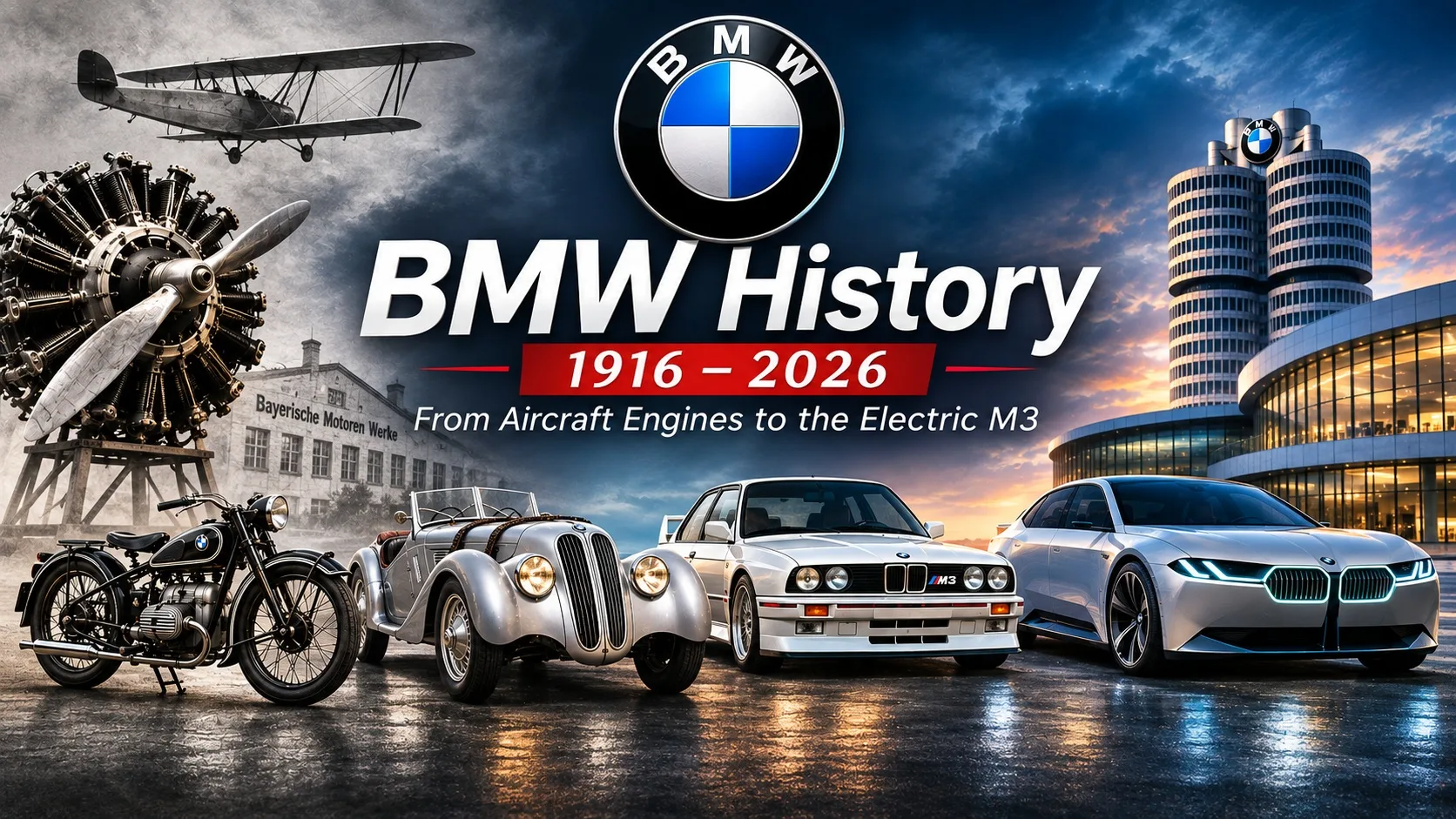
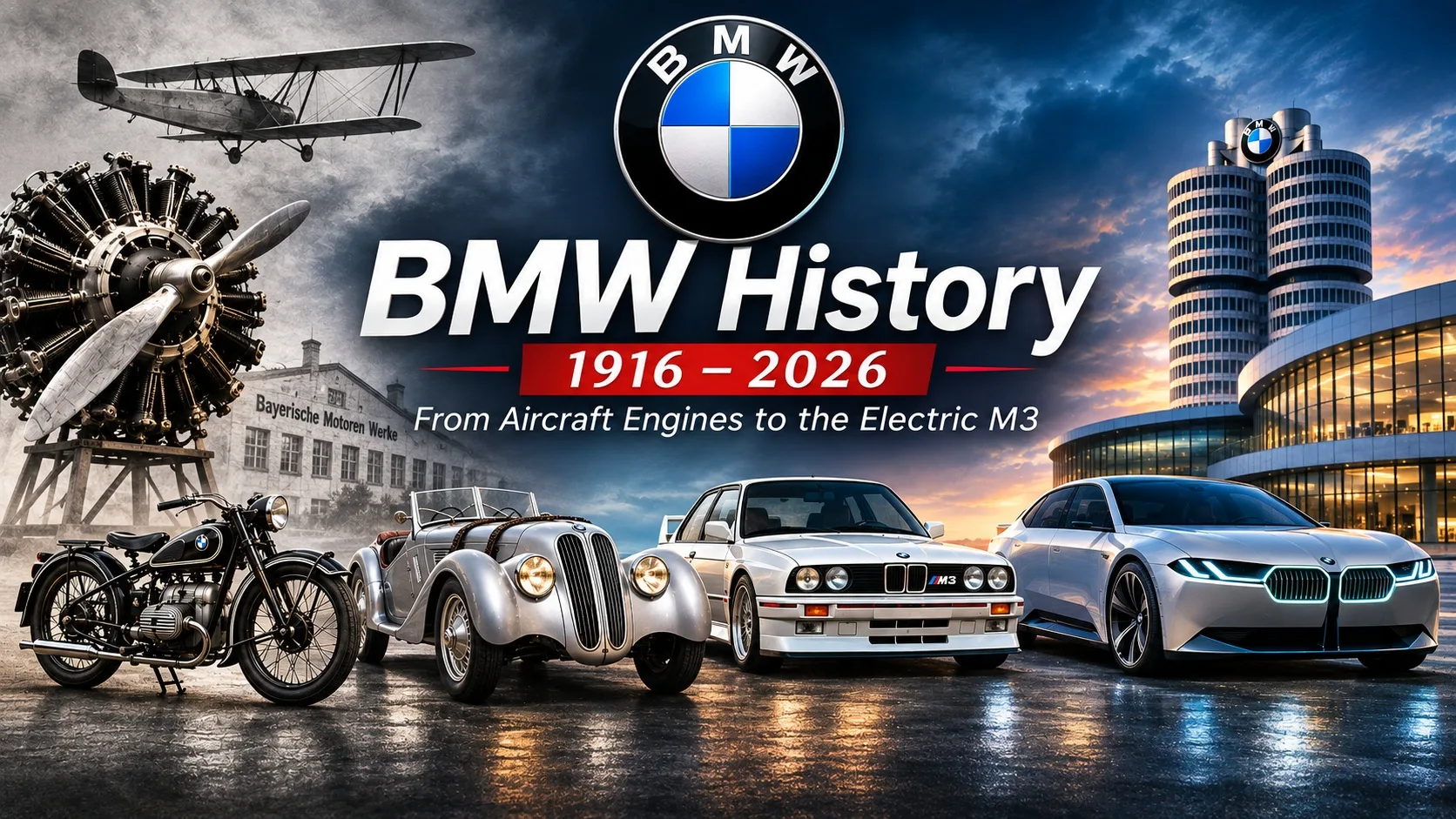 BMW's journey from its aircraft-engine origins in 1916 to motorcycles, iconic sports cars, M performance models and the Neue Klasse electric era in 2026.
BMW History at a Glance
|
Year |
Major milestone |
|
1916 |
Bayerische Flugzeugwerke is established on March 7 |
|
1917 |
Rapp Motorenwerke becomes Bayerische Motoren Werke GmbH |
|
1923 |
BMW introduces its first motorcycle, the R 32 |
|
1928 |
BMW acquires Fahrzeugfabrik Eisenach and enters automobile
manufacturing |
|
1933 |
BMW 303 introduces the brand's first inline-six mid-range
car and kidney grille |
|
1936 |
BMW 328 makes its debut |
|
1945 |
BMW faces post-war dismantling and reconstruction |
|
1948 |
BMW R 24 marks the return to motorcycle production |
|
1955 |
BMW Isetta production begins; BMW 507 is introduced |
|
1959 |
BMW avoids a takeover and presents the BMW 700 |
|
1961 |
BMW 1500 launches the Neue Klasse |
|
1972 |
BMW Motorsport GmbH is founded |
|
1975 |
First BMW 3 Series is introduced |
|
1977 |
First BMW 7 Series enters the market |
|
1983 |
Nelson Piquet wins the Formula One Drivers' Championship
with a BMW turbo engine |
|
1984 |
First BMW M5 is introduced |
|
1985 |
Original BMW M3 is presented |
|
1994 |
BMW acquires the Rover Group and opens its Spartanburg
plant |
|
1998 |
BMW secures the Rolls-Royce Motor Cars brand and naming
rights |
|
1999 |
BMW X5 is unveiled |
|
2001 |
Modern MINI launches under BMW Group ownership |
|
2003 |
BMW takes full responsibility for Rolls-Royce Motor Cars |
|
2013 |
BMW i3 becomes the group's first series-production fully
electric vehicle |
|
2025 |
First production Neue Klasse model, the BMW iX3, is
unveiled |
|
2026 |
Neue Klasse production expands with the electric BMW i3
and the next-generation M3 development programme |
1. The Origins of BMW: Two Companies and an Aviation Beginning (1916–1922)
BMW's origins are connected to two separate Munich businesses:
Flugmaschinenfabrik Gustav Otto, an aircraft manufacturer, and Rapp
Motorenwerke, an aero-engine producer.
On March 7, 1916, Flugmaschinenfabrik Gustav Otto was reorganised and
renamed Bayerische Flugzeugwerke AG, commonly abbreviated as BFW. A year later,
Rapp Motorenwerke also changed its name, becoming Bayerische Motoren Werke
GmbH.
The newly named BMW became a public limited company in 1918 under the
designation BMW AG.
However, the company's official founding date requires a little historical
context. BMW GmbH was not established under that exact name on March 7, 1916.
The BMW Group recognises that date because BFW was founded then, and BMW AG
transferred its name, assets and engine operations to BFW in 1922.
This transfer connected BFW's 1916 foundation with the organisation that
developed into the modern BMW Group.
The distinction matters: BMW's roots go back to 1916, but the BMW name
itself emerged in 1917.
The early aircraft-engine business
BMW's early engineering work centred on aircraft engines. The company
developed powerplants for aviation during a period when engine performance,
reliability and weight were critical to aircraft development.
The experience gained through aero-engine design and manufacturing provided
an early technical foundation for BMW. Precision engineering, combustion
development and mechanical reliability would remain important themes as the
company expanded into motorcycles and passenger cars.
The transition from aviation to road vehicles was not an overnight change.
It happened as BMW adapted its manufacturing capabilities to new commercial
opportunities and changing political and industrial conditions after the First
World War.
The BMW logo: The real meaning behind the blue and white
BMW registered its circular emblem in 1917. Its blue-and-white centre uses
the colours of Bavaria, the German state where the company originated.
A familiar story claims that the logo was designed to represent a spinning
aircraft propeller. However, BMW's own historical explanation says this was not
the original meaning of the emblem.
The propeller interpretation became associated with BMW through advertising
imagery in the late 1920s. It appeared more than a decade after the emblem was first
registered and gradually became part of the brand's popular identity.
The blue and white colours of Bavaria are the historical basis of the logo;
the propeller story developed later.
2. BMW R 32: The Motorcycle That Established BMW Motorrad (1923)
BMW introduced its first motorcycle at the Berlin Motor Show on September
28, 1923. The model was called the BMW R 32.
The R 32 was developed under the direction of technical director Max Friz.
Its engineering was built around an air-cooled, horizontally opposed
two-cylinder boxer engine, with the cylinders mounted transversely across the
motorcycle.
The design also used shaft drive rather than a conventional chain or belt.
BMW positioned the engine and drivetrain as the central elements of the
motorcycle rather than treating them as components added to a conventional
bicycle-style frame.
This arrangement offered practical advantages. The enclosed shaft-drive
system required less routine maintenance than exposed chain systems, while the
boxer engine became a defining part of BMW's motorcycle identity.
The R 32 established a technical direction that BMW Motorrad continued to
develop across touring and adventure motorcycles.
Its significance was not limited to the motorcycle itself. The model
demonstrated that BMW could turn its engine-development experience into a
complete vehicle with a distinctive engineering layout.
Today, the horizontally opposed boxer engine remains one of the most
recognisable features associated with BMW's heritage motorcycles.
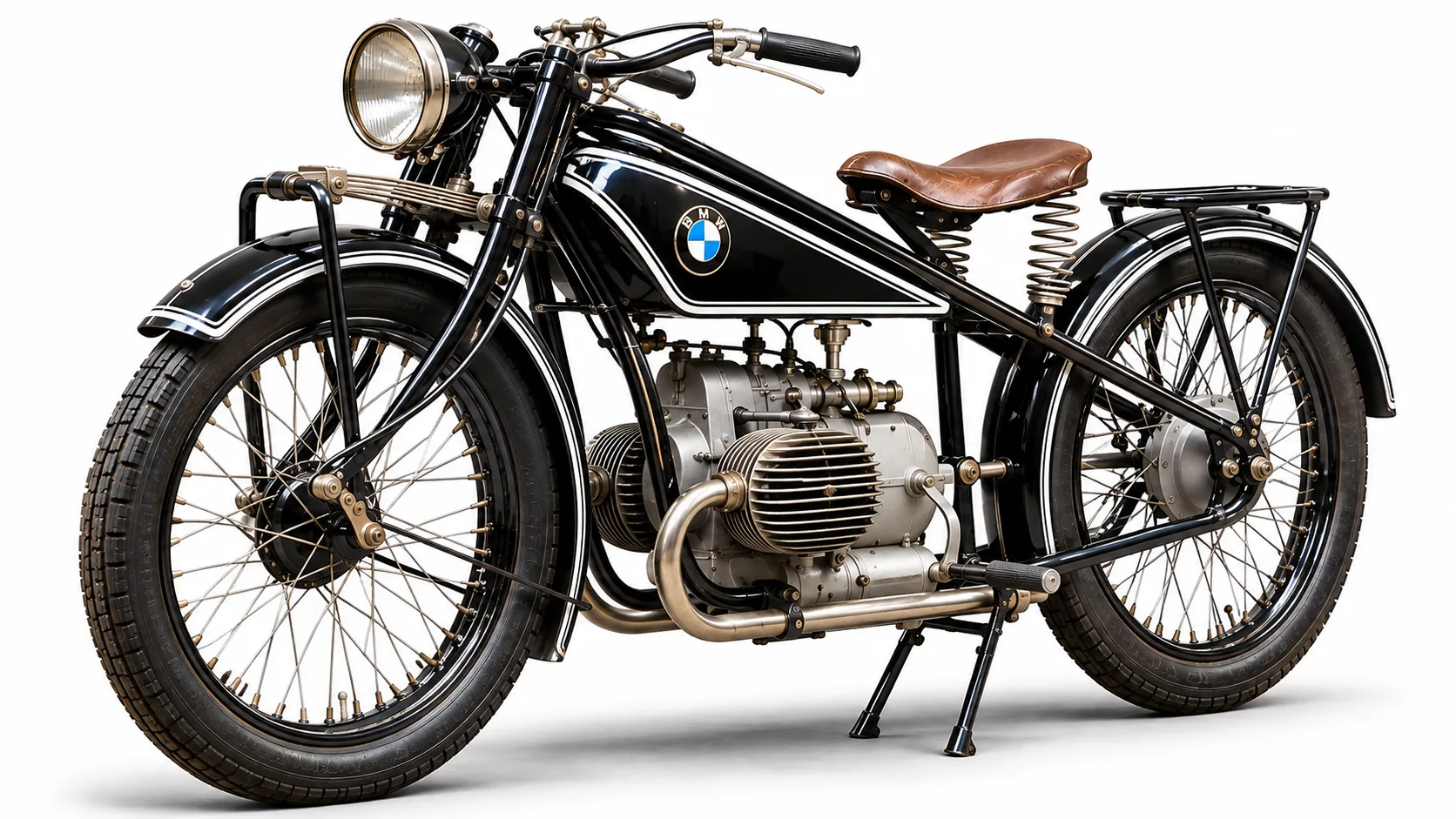 Introduced on September 28, 1923, the BMW R 32 was BMW's first motorcycle. Designed under Max Friz, it established the boxer-twin engine and shaft-drive layout that became defining features of BMW Motorrad.
3. BMW Enters Automobile Manufacturing (1928–1939)
BMW's entry into automobile production came through an acquisition rather
than the development of a completely new car from the beginning.
In 1928, BMW took over Fahrzeugfabrik Eisenach, a German vehicle
manufacturer producing the Dixi, a small car based on the British Austin Seven.
The acquisition gave BMW a route into passenger-car manufacturing. The
company initially continued with a licensed Austin-derived design, adapting it
for production under the BMW name.
The BMW 3/15: The first BMW-badged car
The BMW 3/15 entered production in 1929. It was based on the Dixi and used
the Austin Seven-derived small-car concept.
It was not an entirely independent BMW design. That distinction came later.
In 1932, BMW introduced the 3/20 PS, its first in-house automobile design,
with a new four-cylinder engine and a two-door all-steel body.
The move from licensed production towards original vehicle development
marked an important stage in BMW's transition into an independent car
manufacturer.
The BMW 303 and the kidney grille
In 1933, BMW introduced the BMW 303, a mid-range automobile powered by an
inline-six engine.
The 303 was an important milestone for two reasons. It established BMW's use
of the inline-six engine in this market segment, and it introduced the
kidney-shaped radiator grille that became one of the company's most
recognisable design features.
The kidney grille has changed considerably over the decades. Its size,
proportions and integration with the front bodywork have been reinterpreted
through different generations, but the twin-opening layout remains closely
associated with the brand.
BMW 326 and the expansion of its model range
The BMW 326 arrived in 1936 as a larger mid-range vehicle with a
six-cylinder engine. It represented BMW's growing ambitions in the
passenger-car market and added a more substantial family-oriented model to its
range.
The 326 also formed part of the technical and design foundation that
influenced BMW's later pre-war and post-war cars.
BMW 328: The sports car that built an early racing reputation
The BMW 328 Roadster became one of the most important early sporting models
in BMW's history.
Introduced in 1936, the 328 was developed with an emphasis on low weight,
handling and mechanical efficiency. Its 2.0-litre inline-six engine produced
approximately 80 horsepower in standard production form, while the lightweight
roadster body helped it compete against more powerful rivals.
BMW produced 464 examples between 1936 and 1940.
The 328 quickly established itself in competition. Its achievements included
success at the Nürburgring and in the Mille Miglia.
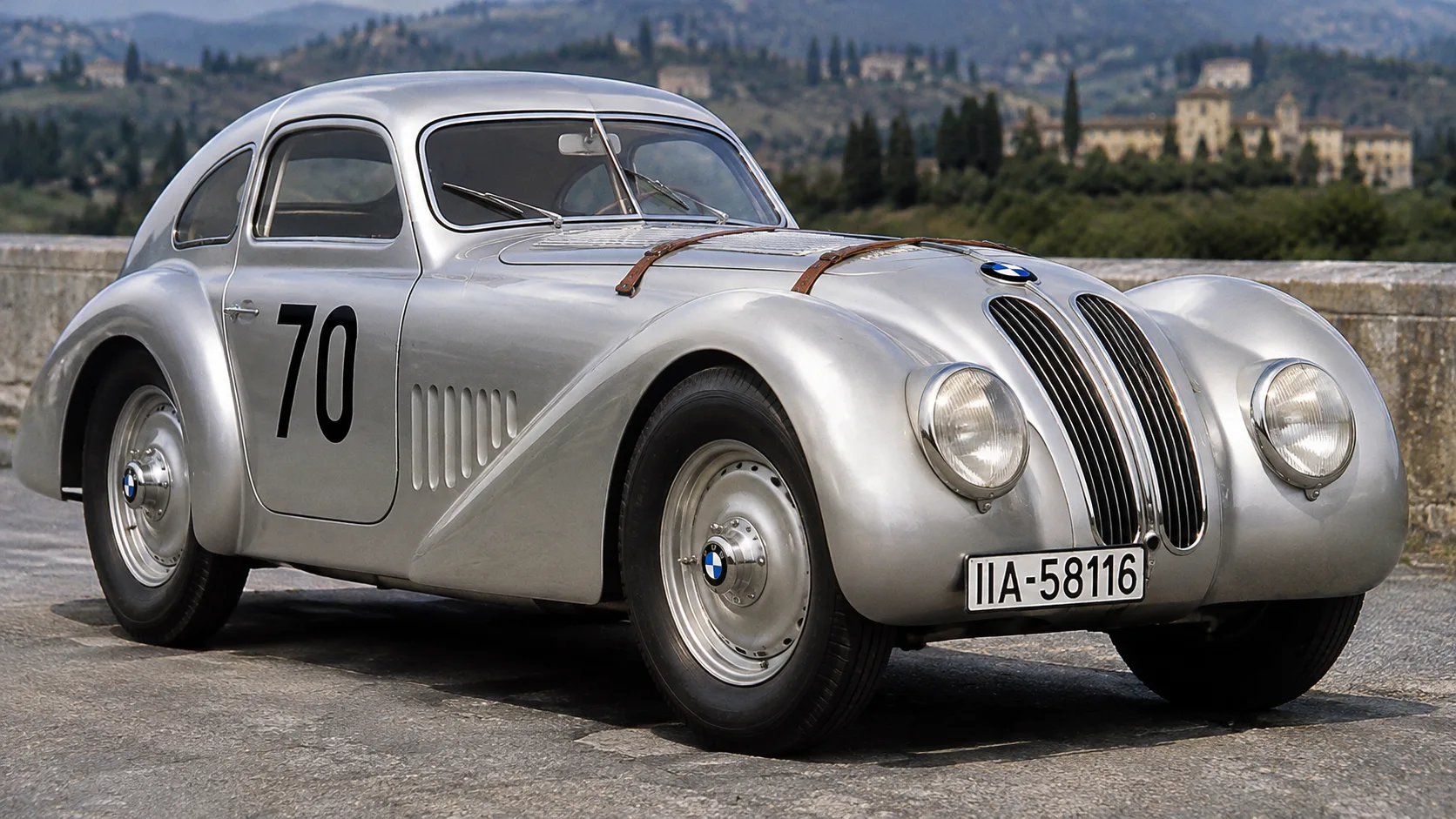
One of its most famous competition versions was the BMW 328 Touring Coupé,
which used a lightweight aerodynamic body built by Carrozzeria Touring of
Milan. The car won the overall Mille Miglia in April 1940, driven by Fritz
Huschke von Hanstein and Walter Bäumer.
The victory strengthened BMW's early international motorsport reputation and
helped establish the company's long relationship with sports-car competition.
4. BMW During the Nazi Era and World War II (1933–1945)
BMW's involvement in Germany's National Socialist era is one of the most
important and difficult chapters of its history.
As Nazi Germany expanded its rearmament programme, BMW developed into a
major supplier to the country's military economy. Aircraft-engine production
became increasingly important, while motorcycle and automobile manufacturing
continued under the changing priorities of the regime.
BMW expanded manufacturing capacity to meet military demand. Its
aircraft-engine business generated the largest share of company revenue during
the war.
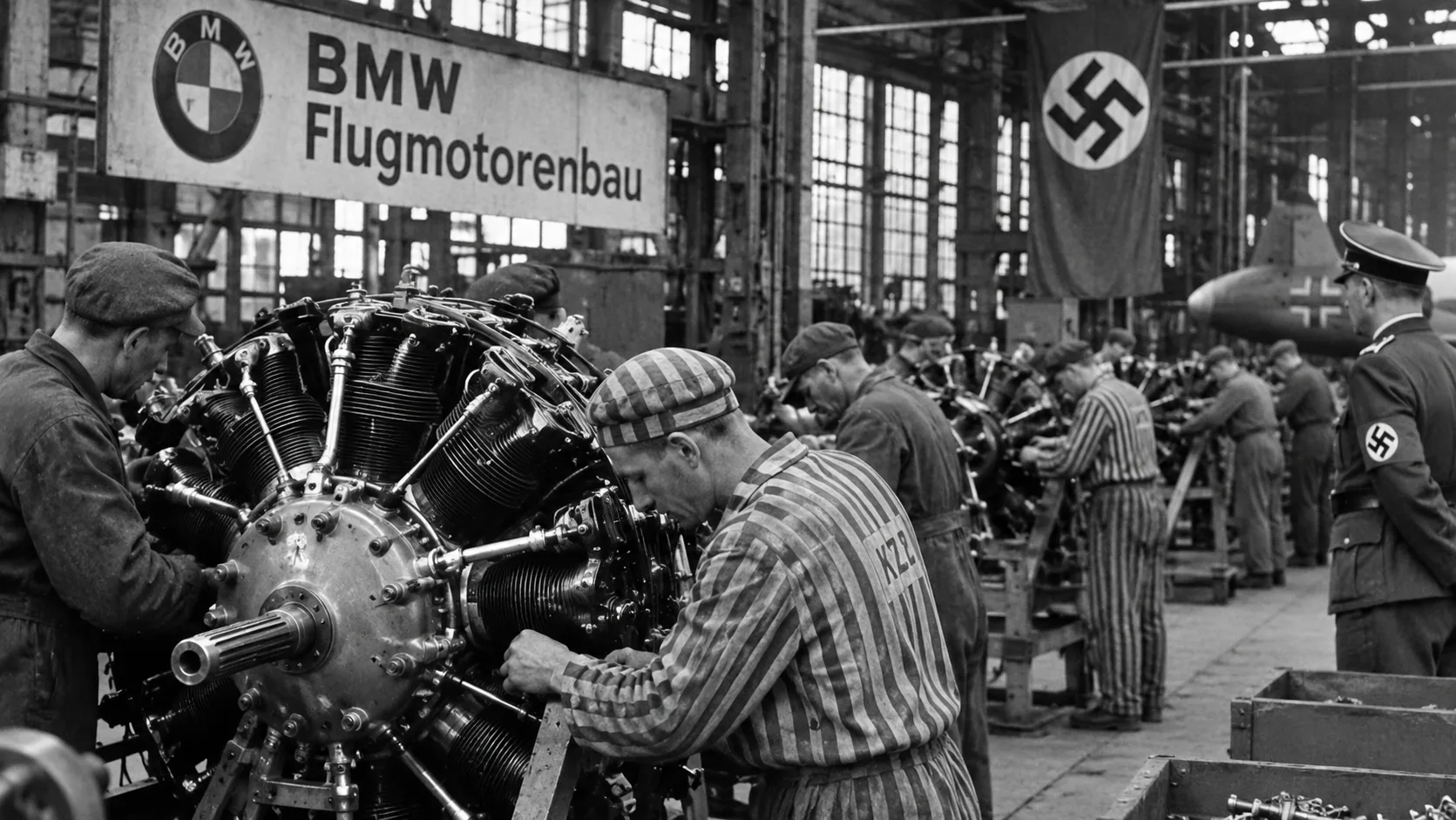
Forced labour and concentration-camp prisoners
BMW used forced labour during the Nazi period. Its management also used
prisoners of war and concentration-camp prisoners in its industrial operations.
According to BMW's own historical account, the company recruited prisoners
from the SS from 1941 and concentration-camp prisoners from 1942. Its
facilities at Allach and Dürrerhof had their own satellite camps.
By the end of 1944, approximately 29,000 forced labourers were working for
BMW, representing more than half of the company's workforce at the time. BMW
states that some of these people were forced to work for up to 12 hours a day.
Workers suffered from inadequate food, poor accommodation, violence and
other forms of abuse. The conditions faced by different groups varied, but
concentration-camp prisoners and workers brought from occupied Eastern Europe
experienced particularly severe treatment.
The Museum of Forced Labor under National Socialism also documents BMW's use
of forced labour. Its historical account describes the camp system around the
Allach aircraft-engine plant and the presence of concentration-camp prisoners
in BMW production facilities.
BMW has acknowledged its responsibility for its role in these crimes. The
company later supported academic research into its wartime activities and
became a founding member of the German industry's Remembrance, Responsibility
and Future initiative.
This history should not be separated from the company's engineering
achievements. BMW's wartime manufacturing growth was tied directly to Nazi
rearmament and the exploitation of people who were deprived of their freedom.
A complete history of the BMW Group must acknowledge both its technological
development and its responsibility for this period.
5. Post-War BMW: Rebuilding After 1945
Germany's defeat in 1945 created a major industrial crisis for BMW.
Because of its role in armaments manufacturing, Allied forces occupied BMW
facilities and dismantled significant parts of its production infrastructure.
In October 1945, the US military government ordered the dismantling of BMW's
Munich plant and the Allach facility.
The company temporarily turned to other products, including household
appliances, while it tried to rebuild its industrial operations.
BMW's recovery began with motorcycles rather than passenger cars.
BMW R 24: The first post-war product
BMW unveiled the R 24 motorcycle in March 1948. The single-cylinder
motorcycle was developed from the pre-war R 23 and adapted to the restrictions
and production conditions of the post-war period.
Material and machinery shortages delayed production. Series manufacturing
finally began in December 1948.
The R 24 became a success for the recovering business. BMW sold 9,144
examples in 1949 alone, demonstrating that demand for its motorcycles remained
strong.
BMW 501: The return to passenger cars
BMW unveiled the 501 in 1951, with production beginning in 1952.
It was the company's first post-war passenger car, positioned as a large and
luxurious sedan. The 501 used an improved version of the pre-war six-cylinder
engine associated with the BMW 326.
The vehicle helped restore BMW's position as a manufacturer of technically
sophisticated automobiles, but it did not achieve the commercial success needed
to secure the company's future.
BMW had returned to luxury-car production, yet the market and its cost
structure created difficult conditions.
6. The Isetta, BMW 507 and the Crisis of the 1950s
BMW entered the 1950s with a broad but financially challenging product
range. Its large luxury cars were expensive, and the motorcycle market was
changing as more customers moved towards affordable passenger cars.
The company needed products that could reach a wider market without
abandoning its engineering identity.
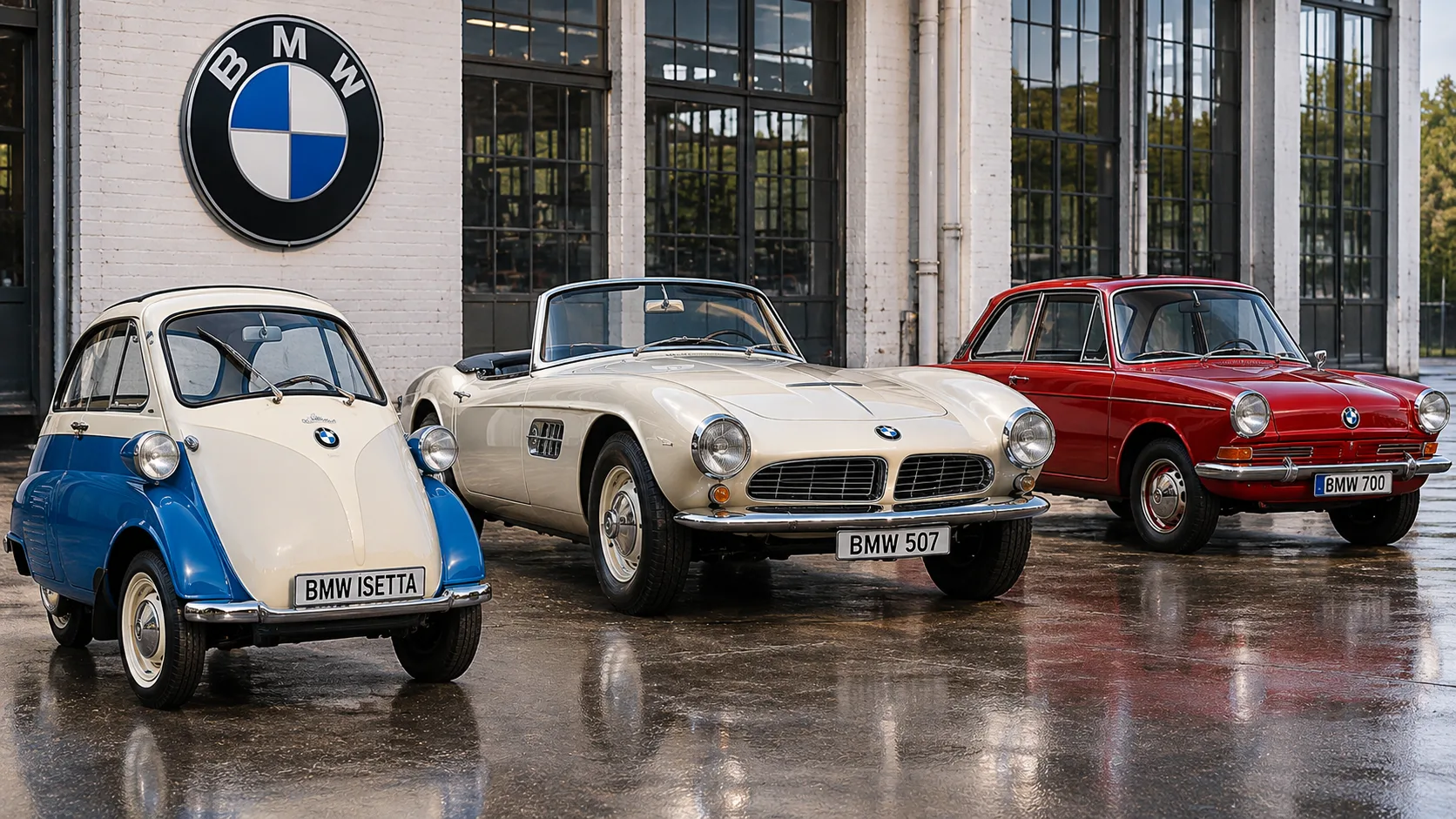
BMW Isetta: A small car with an unusual design
In 1954, BMW acquired a licence from Italian manufacturer Iso to build a
two-seat microcar with a front-opening door.
The BMW Isetta entered production in 1955. It used a BMW motorcycle engine
and was marketed as a Motocoupé.
Its compact size, economical operation and unusual front-opening body made
it suitable for a market where affordable personal transport was increasingly
important.
BMW eventually produced 161,728 Isettas. The model became one of the
company's most successful products of the 1950s and helped support employment
at its Munich factory.
BMW 507: The luxury roadster
At the opposite end of the market, BMW introduced the 507 Roadster at the
Frankfurt Motor Show in September 1955.
Designed by Albrecht Graf Goertz, the 507 featured flowing bodywork and a
3.2-litre V8 engine producing 150 horsepower.
It became one of BMW's most admired classic roadsters. However, it was an
exclusive and expensive car, built in small numbers. Its importance to BMW's
image was greater than its contribution to large-scale production.
The contrast between the Isetta and 507 highlighted BMW's position at the
time: it was trying to serve customers with very different expectations while
managing a difficult financial situation.
BMW 700: A critical step towards survival
BMW introduced the 700 Coupé to international motoring journalists on June
9, 1959.
The compact model used a rear-mounted, air-cooled flat-twin engine derived
from BMW motorcycle engineering. It offered a more conventional small-car
format than the Isetta and became commercially successful.
Additional body styles helped expand the range. By 1965, BMW 700 sales had
reached approximately 190,000 units.
The 700 gave BMW important commercial momentum during one of the most
difficult periods in its history.
December 9, 1959: BMW avoids a takeover
BMW's financial position became increasingly precarious during the second
half of the 1950s. A takeover proposal from Daimler-Benz threatened the
company's independence.
At the annual general meeting on December 9, 1959, small shareholders and
members of the workforce rejected the proposed sale.
Major shareholder Herbert Quandt subsequently increased his commitment to
BMW and supported a restructuring plan. Temporary government financial support
also helped the company move through the crisis.
The BMW 700 helped stabilise the business, but the company's longer-term
recovery depended on a broader restructuring programme and a new generation of
passenger cars.
That next major change would arrive with the Neue Klasse.
7. Neue Klasse: The Turning Point That Changed BMW (1961–1970)
The Neue Klasse was more than a new group of passenger cars. It changed the
direction of BMW's business.
BMW unveiled the 1500 at the Frankfurt International Motor Show in September
1961. The four-door mid-size sedan was developed to fill a gap between small
cars and larger luxury vehicles.
It combined a modern body design, a sporty chassis character and a more
practical passenger-car format. It also established an approach that allowed
BMW to compete in a growing market for compact executive sedans.
Demand for the BMW 1500 exceeded production capacity, making it an important
commercial breakthrough.
A new definition of the BMW sedan
The Neue Klasse helped establish the balance that would become central to
BMW's passenger-car identity:
·
Sporting handling combined with everyday
usability.
·
Mid-size bodies with practical passenger space.
·
Engines and chassis developed around performance
as well as comfort.
·
A clear separation between compact executive
cars and larger luxury models.
The Neue Klasse became the foundation for the later 3 Series and 5 Series
families.
BMW 02 Series and the 2002
BMW expanded the Neue Klasse concept into smaller two-door cars through the
02 Series.
The BMW 1602 and BMW 2002 became particularly important. The 2002 combined
compact dimensions with a larger four-cylinder engine and sporty road
behaviour.
In 1973, BMW introduced the 2002 Turbo. BMW describes it as the first
series-production vehicle in Europe to use turbocharging technology.
The turbocharged 2002 demonstrated how forced induction could be applied to
a relatively compact production car. It also helped build a technical
foundation that would later influence BMW's turbocharged performance engines
and motorsport programmes.
8. BMW Creates the Modern 3, 5 and 7 Series (1972–1977)
The 1970s were a defining period for BMW's product structure.
The company began establishing the numbered model families that became
central to its international identity.
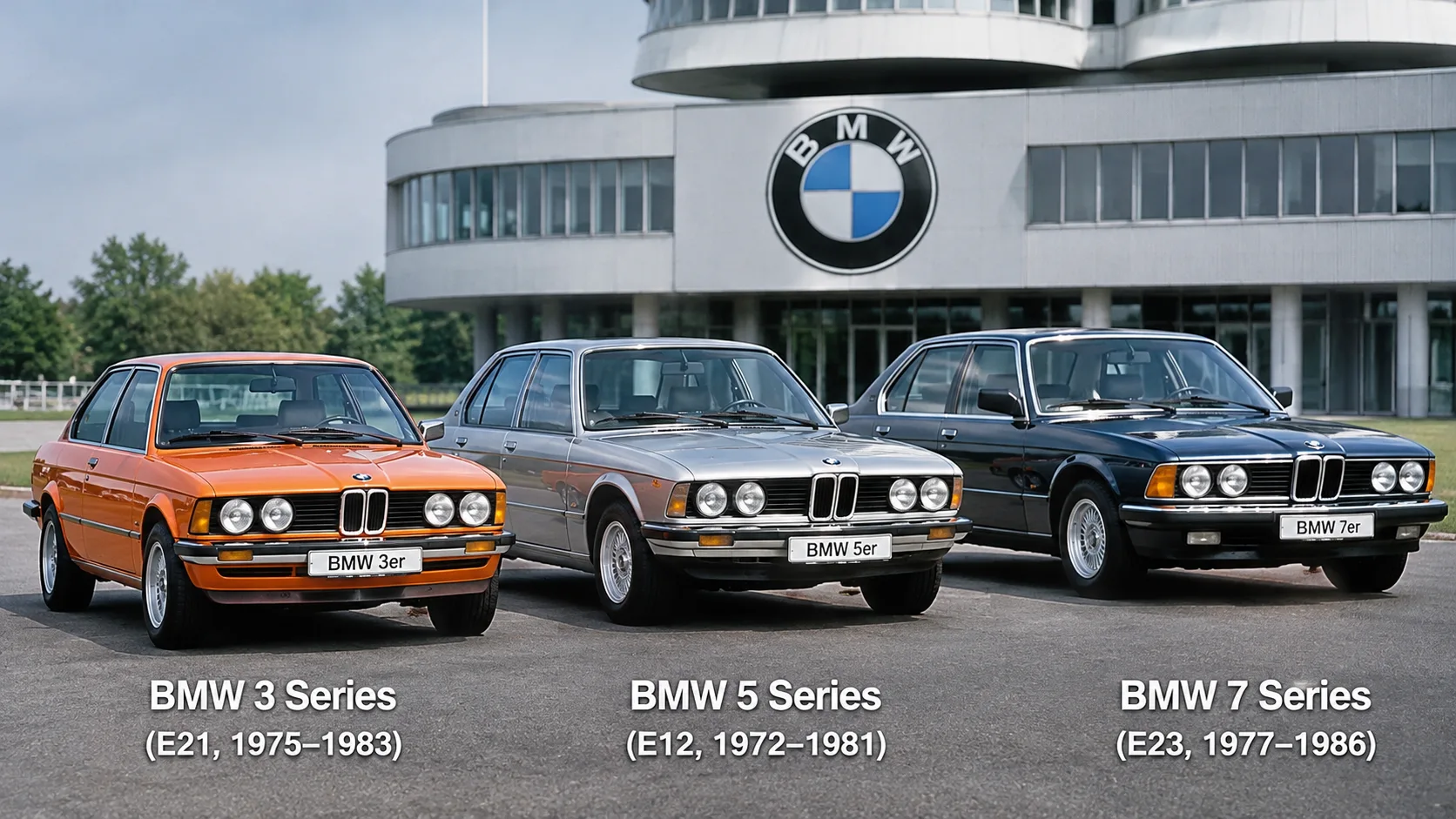
1972: The BMW 5 Series
The first BMW 5 Series was introduced in 1972 as the successor to the Neue
Klasse.
It introduced the three-digit naming structure that became one of BMW's most
recognisable model-designation systems.
The first-generation E12 5 Series brought more space and comfort to the
mid-size executive sedan segment while retaining the sporting character
associated with BMW.
1975: The BMW 3 Series
BMW introduced the first 3 Series in July 1975.
The E21 was a compact two-door sedan designed around a sporting driving
experience. It replaced the 02 Series and began a model history that would
eventually make the 3 Series one of the most successful vehicles in BMW's
history.
The 3 Series expanded into different body styles and powertrain
configurations through later generations. It also became the basis for some of
BMW M's most important performance models.
By December 2025, BMW reported that more than 18 million 3 Series vehicles
had been produced worldwide since 1975, across 18 plants in 13 countries.
1977: The BMW 7 Series
The first BMW 7 Series entered the market in 1977.
As BMW's flagship luxury sedan, it provided more advanced equipment, higher
levels of comfort and technology aimed at the premium full-size segment.
The 3 Series, 5 Series and 7 Series gave BMW a clear product hierarchy that
could serve customers seeking compact sporting sedans, executive cars and
flagship luxury vehicles.
That basic structure remains central to the BMW brand today.
9. BMW M: From Motorsport Organisation to Performance-Car Icon
BMW created BMW Motorsport GmbH in 1972 to bring its racing programmes
together under a dedicated organisation.
The company was formed with an experienced team of racing specialists and
quickly became involved in competition engineering and the development of
high-performance BMW models.
Its work eventually evolved into BMW M GmbH, the performance division
responsible for some of the most recognisable cars in BMW history.
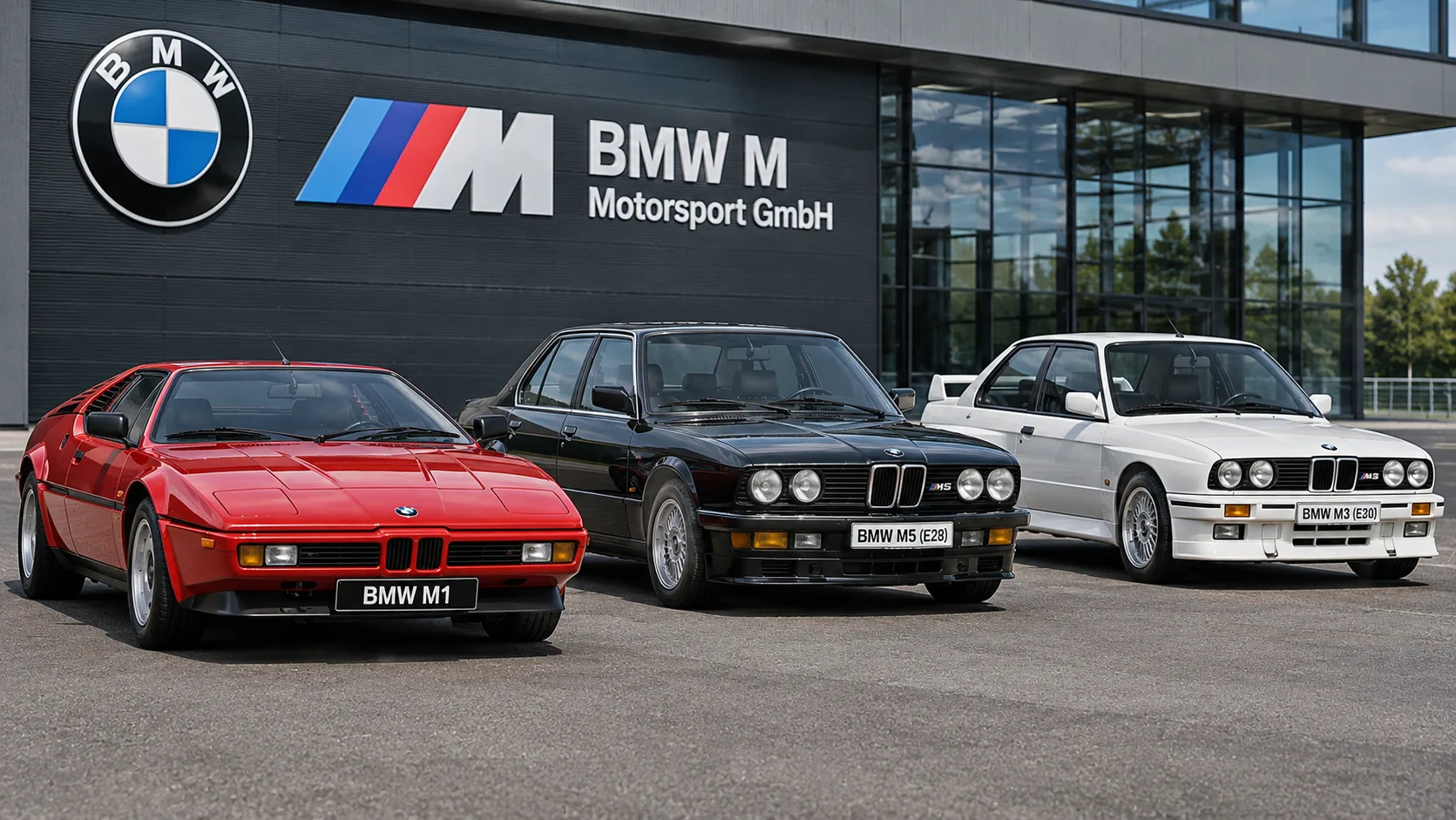
BMW M1: The first road-going M model
The BMW M1 made its public debut in 1978.
Developed as a mid-engined sports car, it was unlike the conventional BMW
sedans of the period. The car used a longitudinally mounted inline-six engine
and a design shaped around the requirements of competition.
Its development involved several specialist companies. Lamborghini was
originally expected to contribute to the chassis and body programme, but
financial difficulties disrupted the project. BMW ultimately organised
production through a network of suppliers and specialist manufacturers.
The M1 also became the basis for the BMW Procar Championship, which ran
alongside selected Formula One events in 1979 and 1980.
The M1 was a major milestone because it demonstrated how BMW Motorsport
could develop a dedicated road-going performance car rather than simply
modifying an existing passenger model.
BMW M5: The high-performance executive sedan
The first BMW M5 arrived in 1984.
Based on the E28 5 Series, the original M5 combined a four-door
executive-sedan body with a 3.5-litre inline-six engine derived from the M1's
powerplant.
BMW quoted an output of 286 horsepower for the original European
specification. Its performance made it one of the fastest four-door production
sedans of its time.
The M5 concept became influential because it combined sports-car performance
with the practicality of a conventional executive sedan.
BMW M3: A racing car developed for the road
BMW introduced the original M3 at the Frankfurt Motor Show in September
1985, with the market launch following in the summer of 1986.
The E30 M3 was developed for Group A touring-car competition. Its road-going
version was necessary to satisfy the homologation requirements of the racing
category.
The first M3 used a naturally aspirated 2.3-litre four-cylinder engine
producing around 195 horsepower in its original European specification.
Its competition versions achieved major touring-car success, helping turn
the M3 into one of BMW's most recognised performance nameplates.
The M3's importance was not simply its engine output. It demonstrated how
motorsport requirements could influence the body, suspension and engineering of
a production BMW.
10. BMW's Motorsport Achievements: Formula One and Le Mans
BMW's motorsport history extends beyond M road cars. Its engine-development
programmes also delivered major results in international racing.
1983: Nelson Piquet wins the Formula One World Championship
BMW entered Formula One as an engine supplier to the Brabham team.
Its turbocharged 1.5-litre four-cylinder engine became one of the defining
technical developments of the period. The engine was based on BMW's
production-engine experience but was extensively developed for the extreme
demands of Formula One.
In 1983, Nelson Piquet won the Formula One Drivers' Championship with the
Brabham-BMW team.
It was the first Drivers' Championship won by a turbocharged Formula One
car, marking a major achievement for BMW's engine-development programme.
1999: BMW wins the 24 Hours of Le Mans
BMW achieved an overall victory at the 24 Hours of Le Mans in 1999 with the
BMW V12 LMR prototype.
The winning car, number 15, was driven by Yannick Dalmas, Pierluigi Martini
and Joachim Winkelhock.
The result demonstrated BMW's ability to compete at the highest level of
endurance racing and added a major international victory to the company's
motorsport history.
BMW's racing achievements have helped strengthen the engineering image
associated with its production models, although a competition car and a
road-going BMW should not be treated as mechanically identical simply because
they share a badge or engine family.
11. BMW Becomes a Global Manufacturer (1980s–2000s)
As BMW's model range expanded, the company began investing more heavily in
international manufacturing and sales operations.
BMW Spartanburg: The United States becomes a production centre
BMW decided in 1989 to build a manufacturing plant in the United States.
Plant Spartanburg in South Carolina opened in 1994.
The site initially assembled the BMW 318i, and production of the BMW Z3
Roadster began in 1995.
Spartanburg later developed into one of BMW's most important international
factories. By the late 1990s, production had expanded, and the facility became
especially important to BMW's growing X-model portfolio.
The decision to manufacture vehicles in the United States gave BMW a
stronger production base in one of its most important markets.
The Rover Group acquisition
In 1994, BMW acquired the British Rover Group.
The group included established British marques such as Rover, Land Rover,
MG, Triumph and MINI. BMW expected the acquisition to strengthen its
international position and expand the range of vehicles available to the
business.
However, the integration proved more difficult than expected. The financial
and operational challenges became increasingly serious, and BMW sold most of
the Rover Group in 2000.
The MINI brand was retained.
The Rover acquisition is an important example of a strategic expansion that
did not deliver the expected results. It also shows why the development of MINI
under BMW ownership must be separated from the later sale of most of the
original Rover Group.
The modern MINI
BMW relaunched the modern MINI in 2001.
The new MINI combined the familiar design character of the original British
car with modern safety engineering, contemporary manufacturing and a more
premium position in the small-car market.
Production began at Oxford in the United Kingdom, and MINI became a distinct
brand within the BMW Group.
Rolls-Royce Motor Cars: The 1998 agreement and 2003 handover
BMW's involvement with Rolls-Royce also requires an important historical
distinction.
In July 1998, BMW secured the brand and naming rights for Rolls-Royce motor
cars from Rolls-Royce plc. Volkswagen continued to operate the existing
Rolls-Royce car business until the end of 2002.
BMW took full responsibility for Rolls-Royce Motor Cars in 2003 and
established a new headquarters and manufacturing facility at Goodwood in West
Sussex, England.
The first new Rolls-Royce model from the relaunched operation was the
Phantom, which entered production in 2003.
BMW did not simply buy the entire Rolls-Royce aerospace-engine business. Its
agreement concerned the rights and operations needed to establish the modern
Rolls-Royce Motor Cars company.
12. BMW X5: The Beginning of the Sports Activity Vehicle Era (1999)
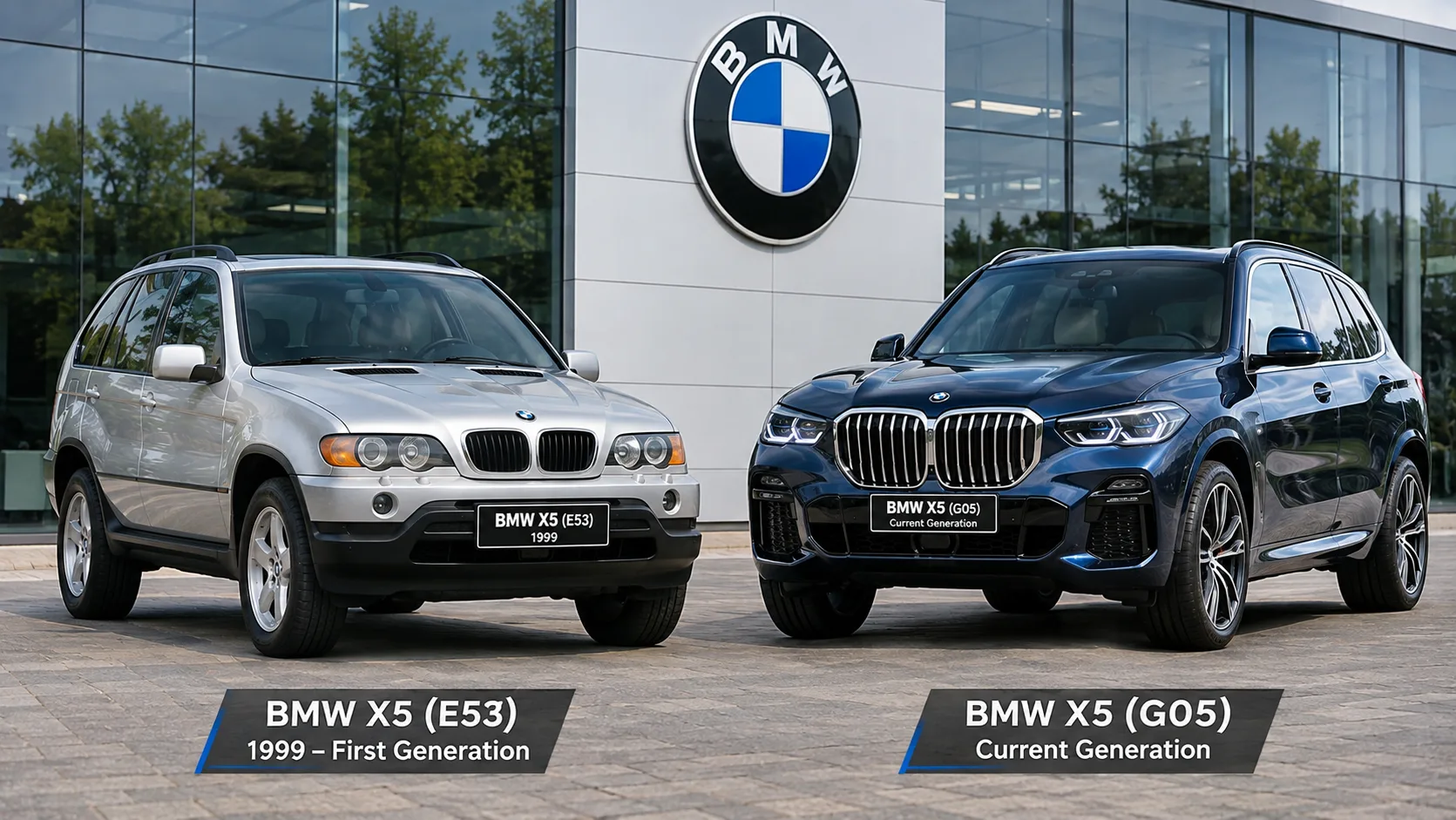
BMW revealed the X5 at the Detroit Auto Show on January 10, 1999.
The company described the model as a Sports Activity Vehicle, or SAV. The
concept combined the higher seating position and practicality associated with
four-wheel-drive vehicles with the road dynamics and sporting character BMW
wanted to preserve.
The X5 was an important strategic move. BMW was entering a part of the
market that would become increasingly important to premium manufacturers over
the following decades.
Rather than simply converting an existing sedan into a taller vehicle, BMW
developed a model intended to create a different balance of road behaviour,
space and utility.
The X5 was followed by additional models in the X family, including the X3,
X6 and X7. SUVs would eventually become a major part of BMW's global product range.
The success of the X5 helped transform BMW from a company strongly
associated with passenger sedans into a manufacturer with a much broader
premium-vehicle portfolio.
13. BMW's Electric Transition: From the i3 to Neue Klasse
BMW began moving towards electric mobility long before the current Neue
Klasse programme.
The company had experimented with alternative powertrains and electric
vehicle concepts in earlier decades, but the modern BMW i sub-brand made
electrification a central part of its product strategy.
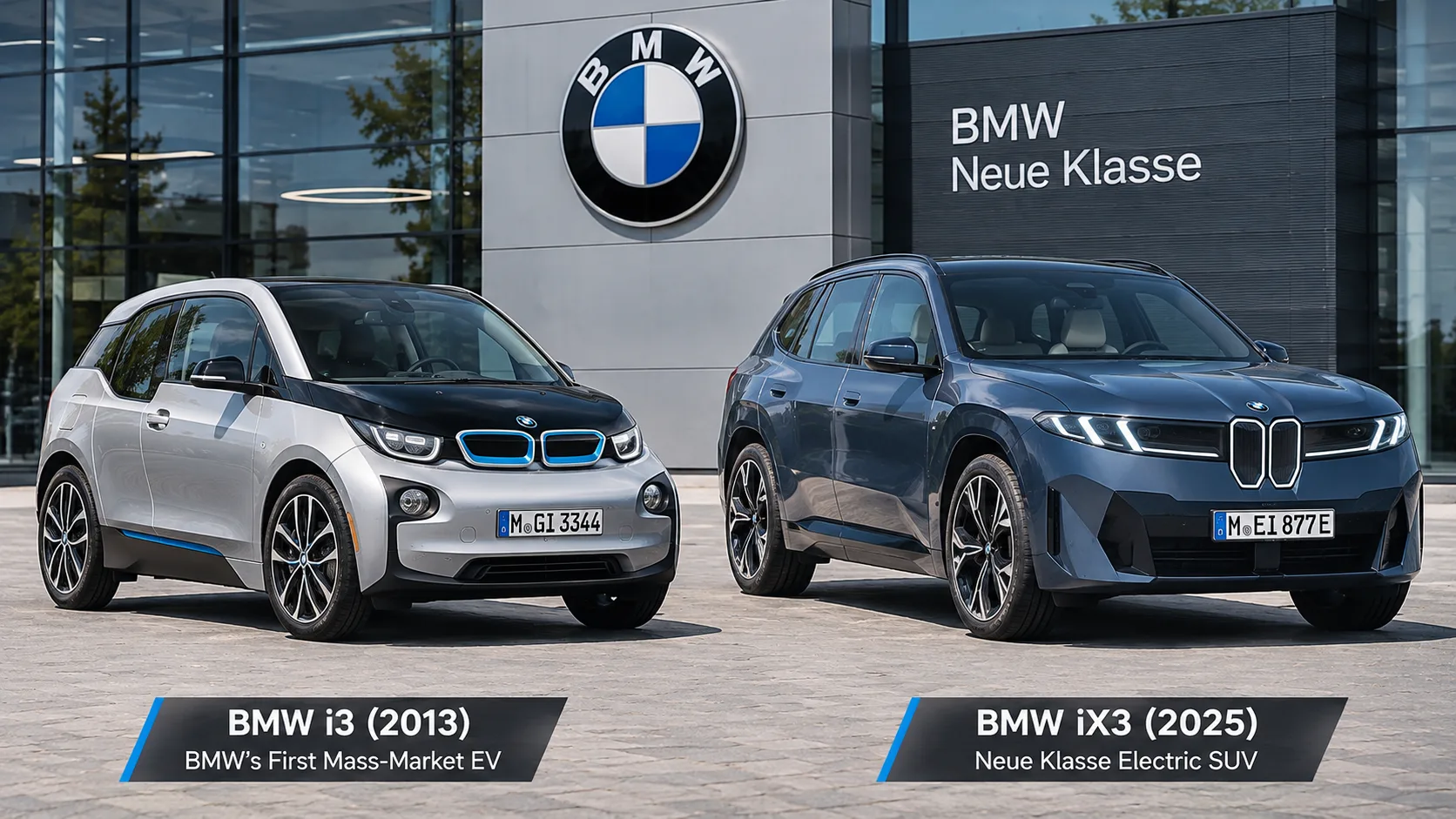
BMW i3: The first fully electric series-production BMW Group model
The BMW i3 entered series production in 2013.
Unlike many early electric cars that were based on existing
combustion-engine vehicles, the i3 was designed specifically for electric
propulsion.
Its architecture used a passenger cell made from carbon-fibre-reinforced
plastic, paired with an aluminium chassis structure. The approach focused on
reducing weight and creating a dedicated electric vehicle platform.
The i3 became the first fully electric series-production model from the BMW
Group and established an important technical foundation for the company's later
electric vehicles.
BMW i8: A plug-in hybrid sports car
BMW followed the i3 with the i8, a plug-in hybrid sports car that entered
customer deliveries in 2014.
The i8 combined a combustion engine with electric drive and used a
lightweight carbon-fibre passenger structure.
It was not a fully electric vehicle. Instead, it demonstrated how BMW could
use electrification to deliver a different kind of performance car while
retaining a combustion engine.
Together, the i3 and i8 represented two different approaches to the
company's emerging electric strategy.
BMW iX3 and BMW iX
BMW later expanded its electric portfolio with the iX3 and iX.
The iX3 brought electric propulsion into the X-model family, while the iX
became a dedicated electric flagship with a focus on digital systems, interior
technology and long-distance mobility.
These models helped BMW broaden its electric range while continuing to offer
combustion-engine and plug-in hybrid vehicles.
The Neue Klasse returns
In 2022, BMW announced the modern Neue Klasse programme.
The name deliberately connected the new electric-vehicle architecture with
the original Neue Klasse models of the 1960s. However, the new project was much
broader than a styling exercise.
BMW described it as a new technological platform incorporating electric
drive systems, battery technology, electronics, software and manufacturing
processes.
The aim was to use the new architecture as the basis for a generation of
future BMW vehicles rather than creating only one electric model.
2025: The first production Neue Klasse model — BMW iX3
BMW unveiled the first series-production Neue Klasse model, the new BMW iX3,
on September 5, 2025.
The iX3 introduced BMW's sixth-generation eDrive technology, a new
high-voltage battery architecture and an 800-volt electrical system.
BMW announced peak charging capability of up to 400 kW. For the US market,
the company estimated a range of up to 400 miles based on preliminary testing
using EPA test-procedure standards.
That figure was a manufacturer estimate, not a final EPA-certified rating in
the original announcement.
The iX3 also introduced BMW's new electronic and software architecture,
including four high-performance computers that the company calls Superbrains.
One of these systems, the Heart of Joy, manages key drivetrain and
driving-dynamics functions.
The new iX3 marked the transition from BMW's earlier electric vehicle
generation to the Neue Klasse platform.
14. BMW in 2026: The Neue Klasse Reaches the Core Model Range
By 2026, the Neue Klasse had moved from an announced future programme into
series production.
The new iX3 entered production at BMW Group Plant Debrecen in Hungary. In
March 2026, BMW confirmed that production had ramped up and that the first
customers had received their vehicles.
The iX3 was the first production Neue Klasse model. The next major step was
bringing the same technology direction into one of BMW's most important model
families: the 3 Series.
The new BMW i3: A different car from the 2013 i3
BMW introduced the eighth-generation 3 Series in September 2026, bringing
Neue Klasse technology into the heart of its core sedan range.
The new generation includes a fully electric BMW i3 alongside
combustion-engine models with 48-volt mild-hybrid technology.
For the US market, BMW announced the i3 50 xDrive with 463 horsepower,
dual-motor all-wheel drive and an estimated range of 446 to 468 miles, based on
preliminary BMW AG testing using EPA test procedures.
The company also announced the M350 xDrive, a 437-horsepower six-cylinder
gasoline model.
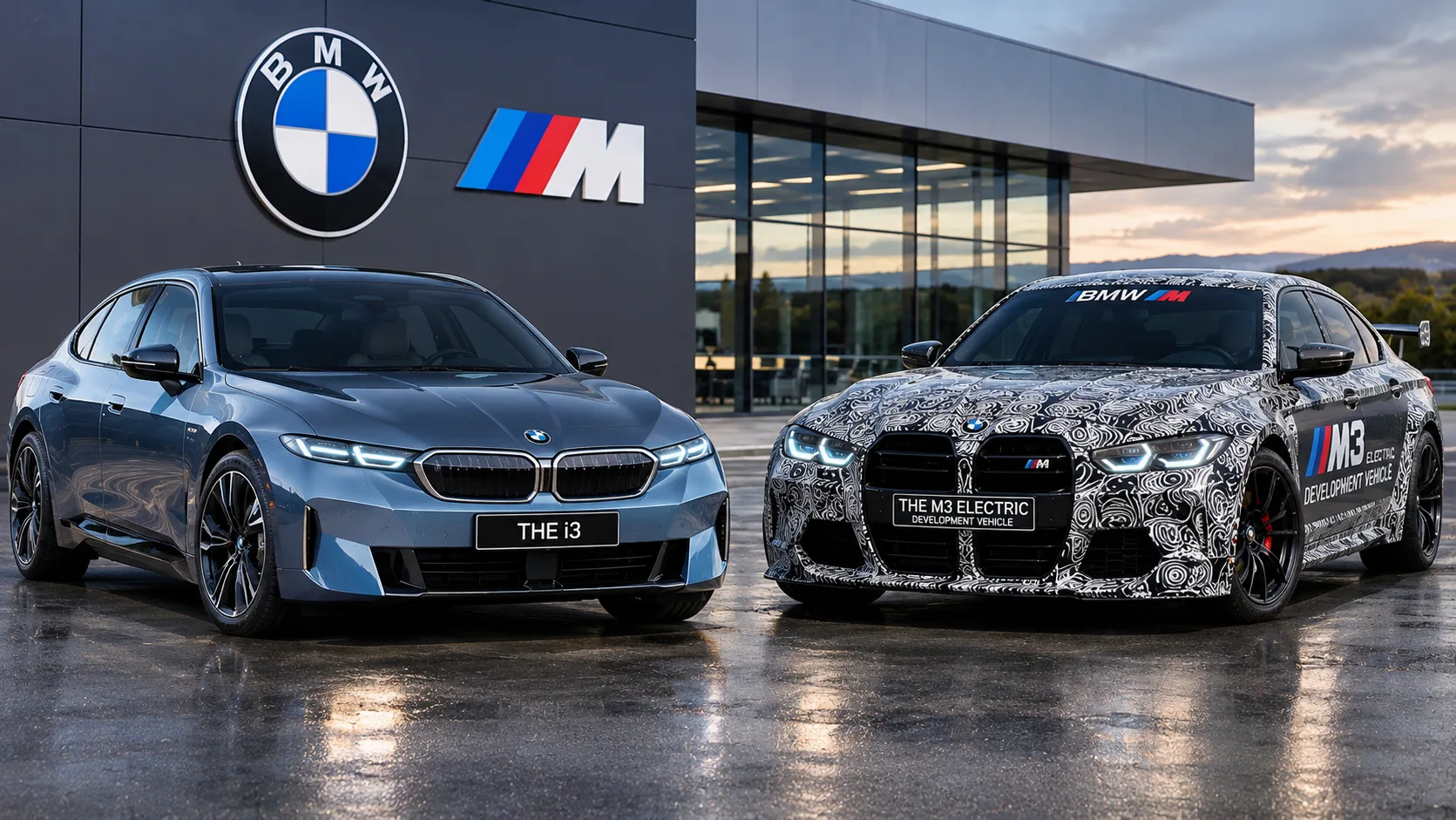
One point deserves particular attention: the 2026 BMW i3 is not the same
type of vehicle as the original 2013 BMW i3.
The earlier i3 was a compact electric hatchback. The new i3 is a fully
electric sedan within the eighth-generation 3 Series family. BMW has reused the
i3 name for a new model with a different body style, platform and market
position.
The new electric BMW i3 entered series production at BMW's Munich plant in
August 2026. BMW also announced that the Munich facility is scheduled to
produce only fully electric vehicles from 2027.
The fully electric BMW M3: Four motors and a new performance architecture
In November 2026, BMW provided a major update on its forthcoming fully
electric M3.
The developing model uses four electric motors, with one motor driving each
wheel. The system is called BMW M eDrive and represents a new development of
the company's all-wheel-drive performance technology.
BMW has described the system as rear-biased, with the front axle capable of
being decoupled when the driving situation allows it.
The company also announced an M-specific sixth-generation high-voltage
battery with a capacity of more than 100 kWh and an 800-volt electrical
architecture.
BMW's provisional figures include:
·
Estimated system output of approximately 625 kW,
or 850 horsepower.
·
Estimated range of around 650 kilometres.
·
Charging power of more than 400 kW.
·
Up to approximately 350 kilometres of added
range in ten minutes under suitable fast-charging conditions.
These are provisional manufacturer targets, not final production
specifications or confirmed EPA figures.
The electric M3 is a significant development because BMW is attempting to
translate its performance-car identity into a new drivetrain architecture.
Instead of relying on a high-revving combustion engine, the project uses
independently controlled electric motors and software-based torque distribution
to create a different form of M performance.
As of November 22, 2026, BMW has not published final production
specifications for the car. It should therefore be described as a forthcoming
electric M3 in development, not as a fully launched retail model.
15. What Makes BMW's History Different?
BMW's development is not simply a sequence of successful cars. It is a
history of repeated changes in technology, production and business strategy.
Several themes help explain the company's long-term position.
Engineering identity beyond one type of vehicle
BMW began with aviation-related manufacturing, moved into motorcycles and
then entered passenger-car production. Its later development covered sports
cars, luxury sedans, SUVs, hybrids and fully electric models.
The company's identity has changed as its products have evolved, but
engineering remains central to the brand.
A model structure that created continuity
The 3 Series, 5 Series and 7 Series gave BMW a long-term product hierarchy.
These model families allowed the company to address different parts of the
premium market while maintaining a recognisable brand identity.
The 3 Series became a central sporting sedan. The 5 Series established its
place in the executive-car market, and the 7 Series served as its luxury
flagship.
Motorsport helped build the performance reputation
BMW's racing history influenced the development of its M road cars. The M1,
M3 and M5 established different interpretations of high-performance
engineering.
Formula One and endurance-racing successes also helped demonstrate the
company's engine and vehicle-development capabilities.
Expansion brought both success and setbacks
The X5 helped BMW enter a rapidly expanding SUV market. MINI and Rolls-Royce
expanded the group's brand portfolio.
The Rover acquisition, however, demonstrated that large international
acquisitions could create challenges as well as opportunities.
BMW's later restructuring and brand strategy were shaped partly by the
lessons of that experience.
The company has repeatedly had to reinvent itself
BMW survived post-war dismantling, the financial crisis of the 1950s, the
difficulties of the Rover acquisition and the transition towards electric
mobility.
The original Neue Klasse helped secure its future in the 1960s. The modern
Neue Klasse represents another attempt to reshape the company's technology and
manufacturing base.
Conclusion: From Munich Aircraft Engines to the Electric BMW M3
BMW's history from 1916 to 2026 is a story of engineering ambition,
industrial growth, serious historical responsibility and repeated reinvention.
The company began with aviation-related businesses in Munich, moved into
motorcycle manufacturing with the R 32 and entered the automobile industry
through the acquisition of Fahrzeugfabrik Eisenach.
Its early cars, particularly the BMW 303 and 328, helped establish its
identity. The Second World War brought a dark chapter in which BMW became a
major armaments manufacturer and used forced labour. The post-war dismantling
of its factories then forced the company to rebuild through motorcycles and
passenger cars.
The Isetta, BMW 700 and 1959 restructuring helped it survive a financial
crisis. The Neue Klasse established a new direction, while the 3 Series, 5
Series and 7 Series created the model structure that would define the modern
BMW range.
BMW M connected the company's engineering with motorsport, producing cars
such as the M1, M3 and M5. International expansion, the X5, MINI and
Rolls-Royce broadened the business beyond its traditional sedan range.
The electric transition began with models such as the i3 and i8, and it has
now reached a new stage with the Neue Klasse.
In 2026, the iX3 and new electric i3 demonstrate how BMW is moving its core
products towards new electric architecture. The forthcoming electric M3 shows
how the company is also exploring the future of high-performance vehicles.
BMW's history is therefore not only about the cars it has built. It is about
how a company repeatedly changed its engineering, manufacturing and business
direction to remain relevant through more than a century of automotive
development.
Frequently Asked Questions About BMW History
When was BMW founded?
BMW officially recognises March 7, 1916, as its founding date. The date
comes from the establishment of Bayerische Flugzeugwerke AG (BFW). The BMW name
was adopted by Rapp Motorenwerke in 1917, and BMW AG transferred its name,
assets and engine operations to BFW in 1922.
What does BMW stand for?
BMW stands for Bayerische Motoren Werke, which translates into English as
Bavarian Motor Works.
Did BMW originally make aircraft engines?
Yes. BMW's origins are connected to aircraft-related manufacturing and
aero-engine development in Munich. Its early engineering experience in aviation
provided a foundation for its later motorcycles and automobiles.
Was the BMW logo designed to look like a spinning propeller?
No. The blue-and-white centre represents the colours of Bavaria. The
propeller interpretation became associated with BMW through advertising imagery
in the late 1920s.
What was the first BMW motorcycle?
The BMW R 32 was introduced at the Berlin Motor Show on September 28, 1923.
It used a horizontally opposed boxer engine and shaft drive, two features that
became closely associated with BMW Motorrad.
What was the first BMW car?
BMW entered automobile manufacturing in 1928 after acquiring Fahrzeugfabrik
Eisenach. The BMW 3/15, which entered production in 1929, was based on the
Austin Seven-derived Dixi. BMW introduced its first in-house automobile design,
the 3/20 PS, in 1932.
Why did BMW nearly lose its independence in 1959?
BMW faced serious financial difficulties during the 1950s. A proposed
takeover by Daimler-Benz was rejected at the December 9, 1959, annual general
meeting. Herbert Quandt increased his commitment to the company and supported
its restructuring.
What was the BMW Neue Klasse?
The original Neue Klasse was a family of mid-size BMW cars introduced in the
early 1960s, beginning with the BMW 1500. It helped BMW recover commercially
and established the sporting executive-sedan formula that influenced later 3
Series and 5 Series models. The name was later reused for BMW's modern
electric-vehicle technology generation.
When was BMW M founded?
BMW Motorsport GmbH was founded in 1972. It later evolved into BMW M GmbH,
the organisation responsible for BMW's M performance cars and motorsport
activities.
What was the first BMW M car?
The BMW M1, introduced in the late 1970s, was the first road-going model
developed under the BMW M identity. It used a mid-mounted inline-six engine.
When was the first BMW M3 introduced?
The original E30 BMW M3 made its public debut at the Frankfurt Motor Show in
September 1985. Its market launch followed in summer 1986. It was developed as
a road-going homologation model for Group A touring-car competition.
When did BMW acquire MINI?
MINI became part of BMW through the 1994 Rover Group acquisition. BMW sold
most of the Rover Group in 2000 but retained the MINI brand. The modern MINI
was launched in 2001.
When did BMW take over Rolls-Royce Motor Cars?
BMW secured the Rolls-Royce motor-car brand and naming rights in July 1998.
Volkswagen continued to operate the existing Rolls-Royce car business until the
end of 2002. BMW took full responsibility for Rolls-Royce Motor Cars in 2003,
with production at Goodwood.
What was BMW's first fully electric production car?
The BMW i3, introduced in 2013, was the BMW Group's first fully electric
series-production model.
What is the first production Neue Klasse vehicle?
The BMW iX3, unveiled in September 2025, was the first series-production
model of the modern Neue Klasse generation.
Is the 2026 BMW i3 the same car as the original 2013 BMW i3?
No. The 2013 i3 was a compact electric hatchback. The 2026 i3 is a fully
electric sedan in the eighth-generation BMW 3 Series family, developed around
the Neue Klasse architecture.
Is the new electric BMW M3 already on sale?
As of November 22, 2026, BMW has published technical information and
provisional performance targets for the forthcoming fully electric M3. Final
production specifications have not yet been confirmed.
Editorial Sources and Further Reading
1. BMW Group – Official
Company History
2. BMW
Group – BMW During the Era of National Socialism
3. Museum
of Forced Labor under National Socialism – Work at BMW
4. BMW
Group – The BMW 328 Turns 75
5. BMW
Group – The BMW 700: The Car That Saved the Company
6. BMW
Group – The Original BMW Neue Klasse
7. BMW
Group – 50 Years of BMW 3 Series Production
8. BMW
Group – The BMW M Story
9. BMW
Group – The All-New BMW iX3
10. BMW
Group – The New BMW 3 Series, September 2026
11. BMW Group –
The New Fully Electric BMW M3, November 2026
Editorial note: Historical images should be sourced from BMW Group, BMW
PressClub, BMW Group Classic or other appropriately licensed archives. Any
AI-generated editorial illustration must be clearly identified as AI-generated
and must not be presented as an official BMW photograph.
Have thoughts, dyno data, or build feedback?
Join automotive enthusiasts in the paddock below to debate engineering, lap times, and modifications.
Community Pulse
How does this machine make you feel? Drop your reaction!

VehicleDrugs Editorial
VehicleDrugs Editorial Team
A passionate collective of automotive purists, track drivers, and mechanical engineers uncovering high-octane engineering breakthroughs worldwide.
🏁 Pit Crew Discussions
Drop your telemetry, debate the engineering, or talk track times with fellow petrolheads.
The Pit Lane is Quiet
Be the first driver to drop your opinion on this machine!