
2023 Dodge Demon 170: 1,025-HP Supercharged HEMI V8
Explore the 2023 Dodge Challenger SRT Demon 170, featuring a 1,025-hp supercharged HEMI V8, E85 technology, drag-strip engineering and 8.91-second quarter-mile performance.
HEAD-TO-HEAD MUSCLE CAR VS COMPARISON
Compare 0-60, peak horsepower, torque, and quarter-mile times across iconic builds.
2023 Dodge Challenger SRT Demon 170: Inside the 1,025-HP Supercharged HEMI V8 That Defined American Muscle
A 6.2-Liter Supercharged HEMI V8, E85 Ethanol Technology and Drag-Racing Engineering Made the Dodge Demon 170 One of the Most Extreme Factory-Built American Muscle Cars Ever Created.
There are powerful American muscle cars, and then there is the 2023 Dodge Challenger SRT Demon 170.
Built as the ultimate farewell to Dodge's HEMI-powered Challenger era, the Demon 170 represents an extraordinary combination of supercharged V8 engineering, drag-strip technology and raw American performance.
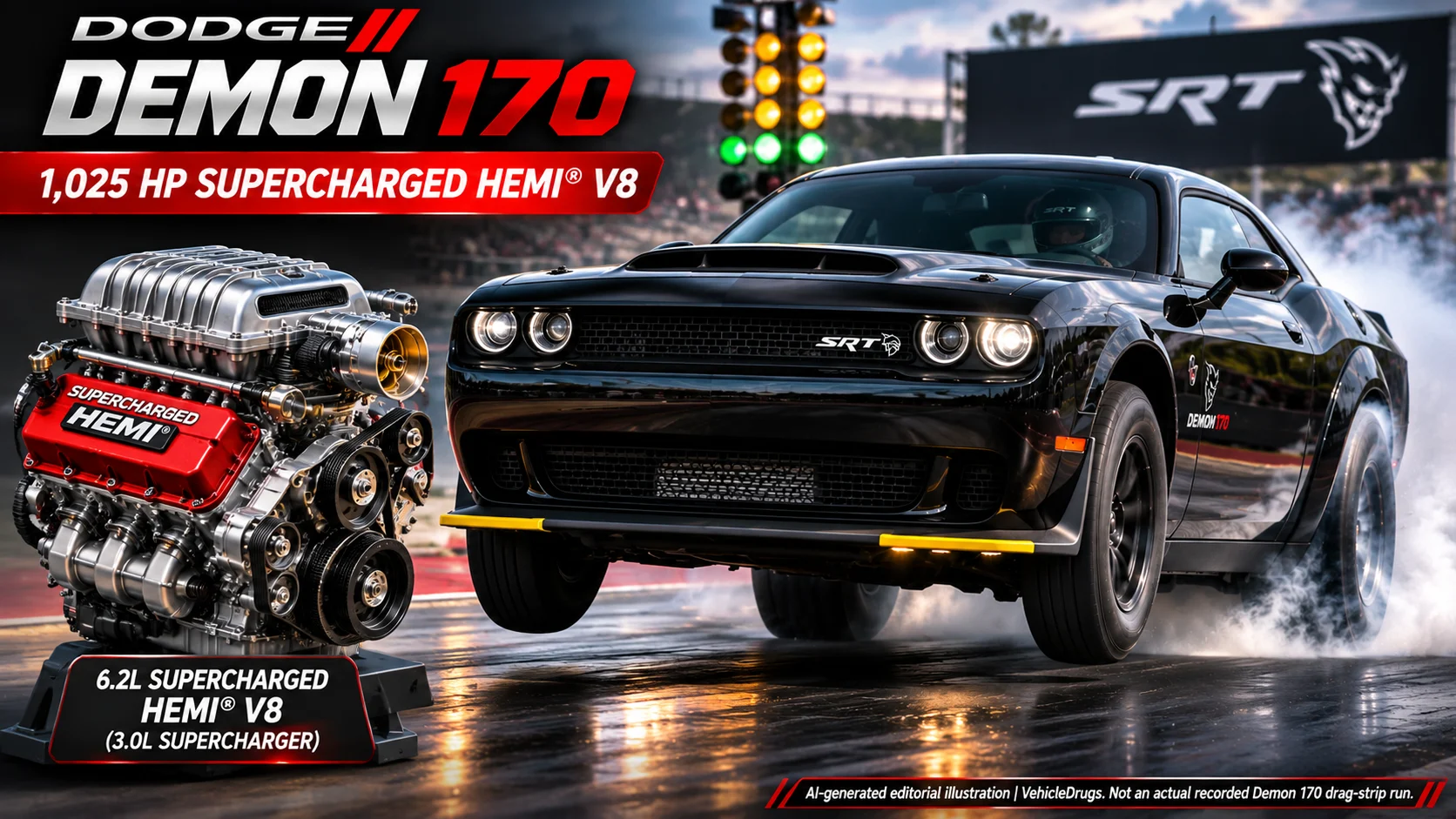
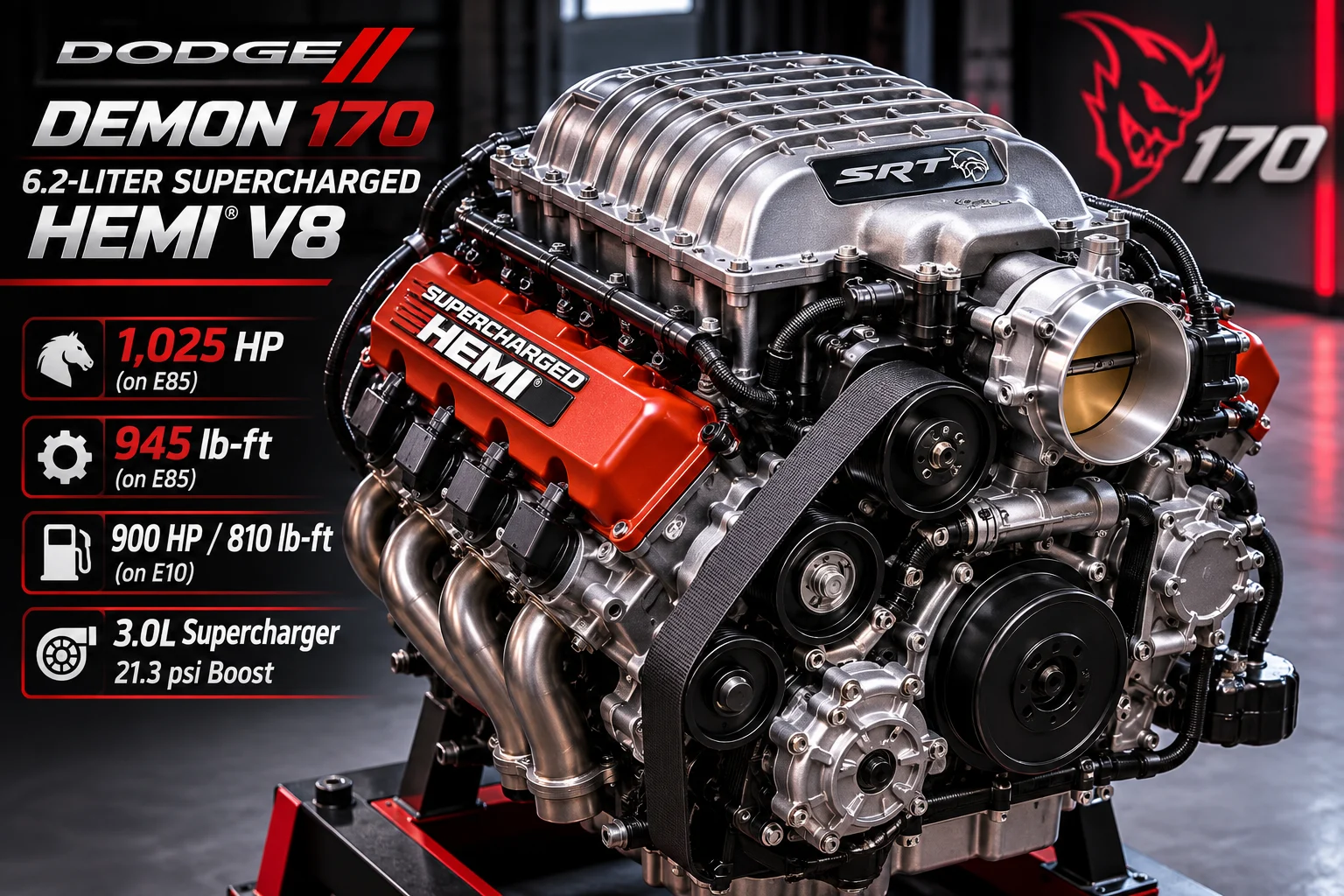
At the center of this machine is a heavily upgraded 6.2-liter supercharged HEMI V8 capable of producing an incredible 1,025 horsepower and 945 lb-ft of torque when running on E85 fuel.
Those numbers place the Demon 170 in a very special category. It can accelerate from 0 to 60 mph in a claimed 1.66 seconds and complete the quarter-mile in an NHRA-certified 8.91 seconds at 151.17 mph.
But the Demon 170 is not simply a Challenger with a bigger supercharger and more horsepower. Dodge upgraded almost every major engine component, reinforced the drivetrain, developed specialized drag tires and introduced advanced launch technology to help transfer its enormous power to the pavement.
This is the story of the supercharged HEMI V8 that pushed factory-built American muscle into extraordinary territory.
The Birth of the Dodge Challenger SRT Demon 170
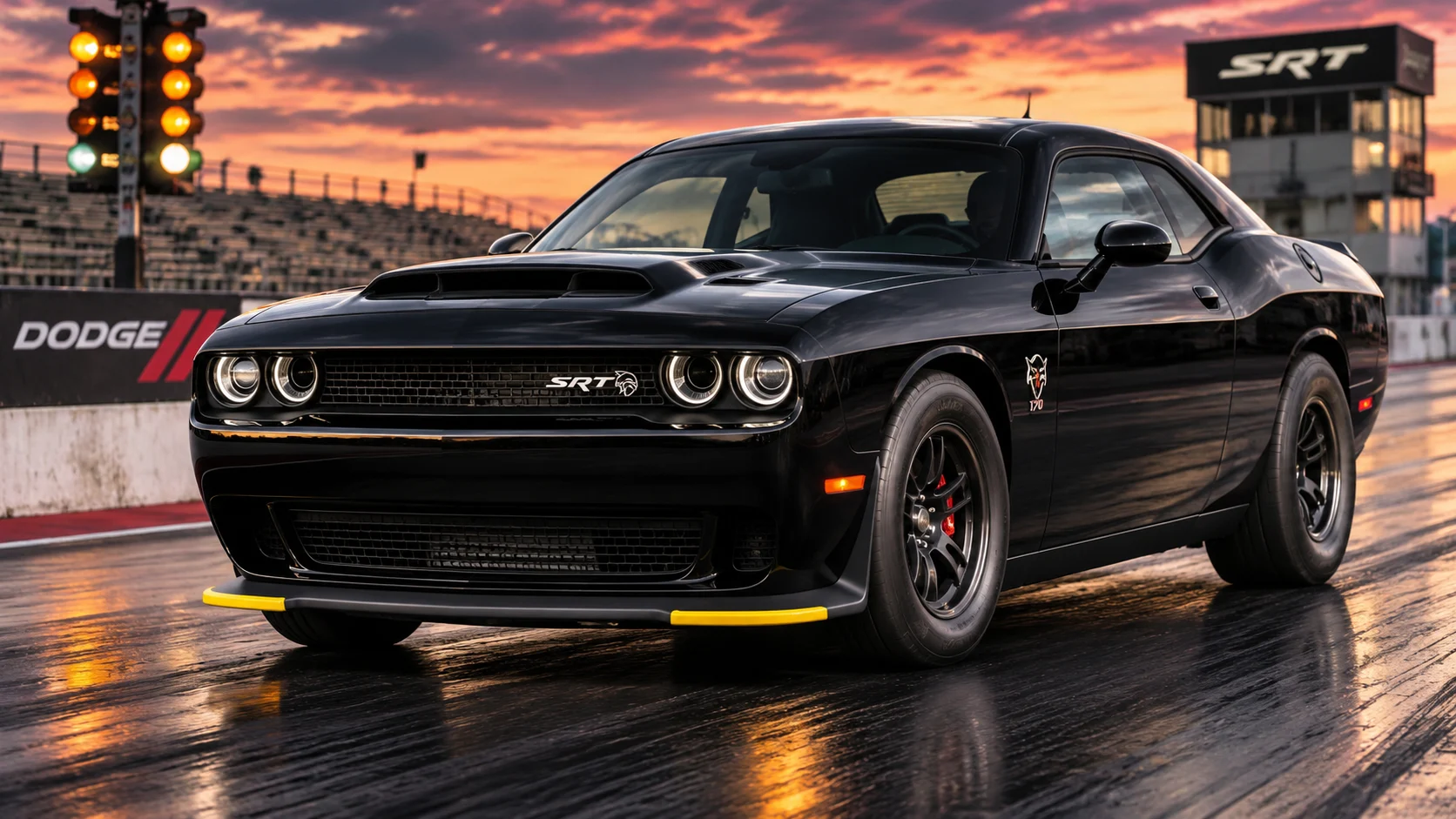
The 2023 Dodge Challenger SRT Demon 170 was introduced on March 20, 2023, in Las Vegas as the seventh and final vehicle in Dodge's special Last Call series.
Its arrival marked the closing chapter of the HEMI-powered Dodge Challenger and Charger era.
The original 2018 Challenger SRT Demon had already established an extraordinary reputation with its 840-horsepower supercharged HEMI V8 when running on high-octane race fuel.
However, Dodge wanted its final special-edition Challenger to go even further.
The result was the Demon 170, a factory-developed drag-strip machine with significantly upgraded engine hardware, improved fuel delivery, stronger drivetrain components and a specialized suspension setup.
The name itself reflects its connection to Dodge's Direct Connection Hellephant C170 crate-engine family.
Production was originally planned for a maximum of 3,300 vehicles, including 3,000 for the United States and 300 for Canada, subject to production capacity.
The Demon 170 was not designed to be an ordinary high-performance coupe. It was engineered to deliver extraordinary acceleration while retaining its factory-production, street-legal status.
The Heart of the Beast: 6.2L Supercharged HEMI V8
The most important part of the Dodge Demon 170 is its 6.2-liter high-output supercharged HEMI V8.
This engine shares its basic architecture with the supercharged HEMI family used in other Dodge SRT performance models, but the Demon 170 received extensive internal upgrades to support its dramatically increased output.
Dodge modified almost every major primary engine power component, with the camshaft being the notable exception.
The engine combines a large supercharger, upgraded cylinder-head hardware, stronger connecting rods, improved fuel delivery and revised combustion components.
On E85 ethanol-blended fuel, the result is 1,025 horsepower at 6,500 rpm and 945 lb-ft of torque at 4,200 rpm.
When running on E10 fuel, the engine produces 900 horsepower and 810 lb-ft of torque.
That difference is one of the most fascinating aspects of the Demon 170. Its power output is directly influenced by the ethanol content detected in the fuel.
2023 Dodge Challenger SRT Demon 170 Engine Specifications
| Specification | Factory Details |
|---|---|
| Engine | 6.2L Supercharged HEMI V8 |
| Engine Configuration | V8, OHV |
| Supercharger | Modified 3.0L supercharger |
| Maximum Horsepower | 1,025 hp on E85 |
| Maximum Torque | 945 lb-ft on E85 |
| Power on E10 | 900 hp |
| Torque on E10 | 810 lb-ft |
| Maximum Power RPM | 6,500 rpm |
| Maximum Torque RPM | 4,200 rpm |
| Transmission | TorqueFlite 8HP90 8-speed automatic |
| Drivetrain | Rear-wheel drive |
The Massive 3.0-Liter Supercharger: Building 1,025 Horsepower
One of the biggest changes made to the Demon 170 engine is its upgraded supercharger.
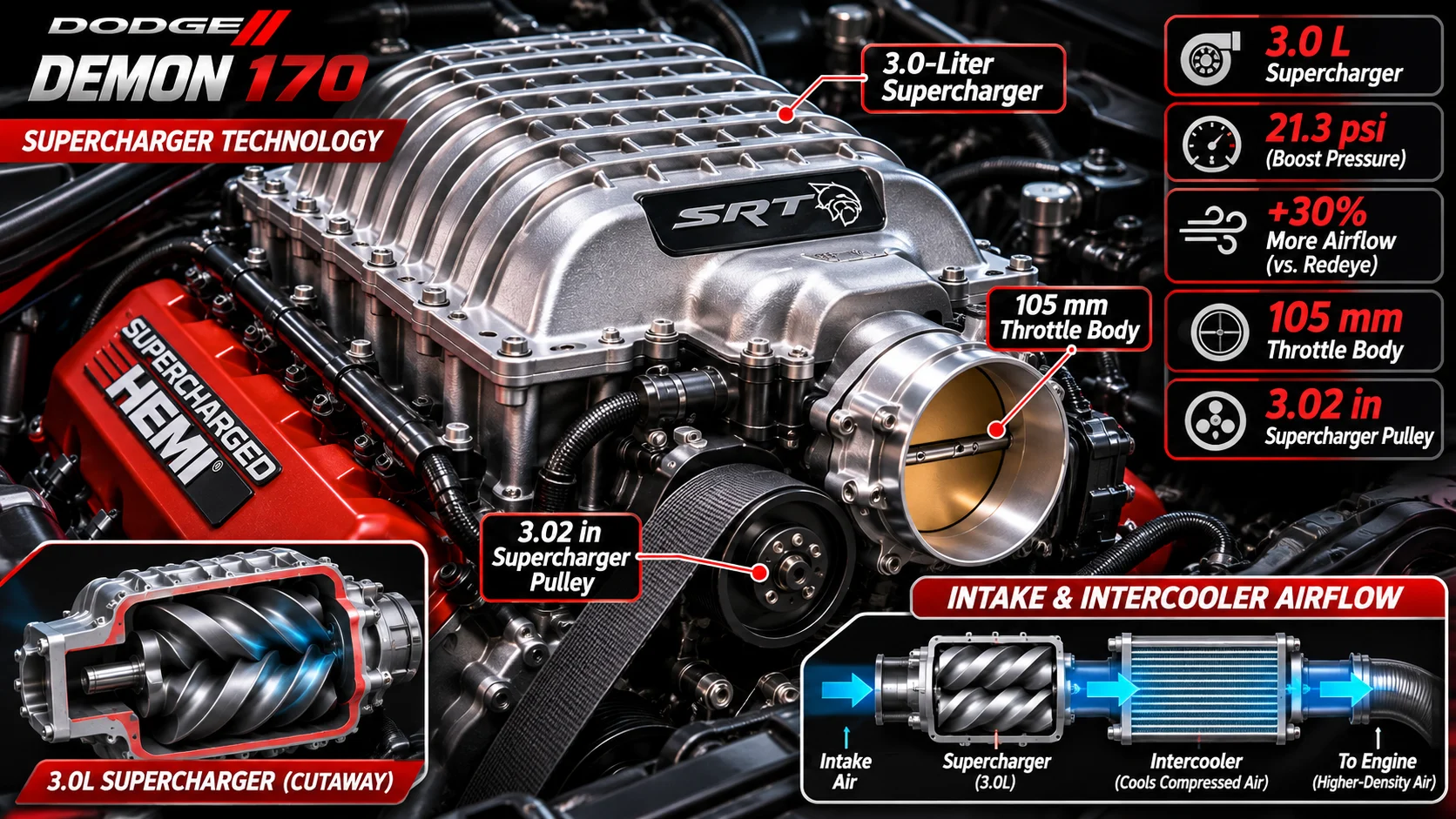
Dodge equipped the vehicle with a modified 3.0-liter supercharger derived from the Direct Connection Hellephant C170 crate-engine program.
Compared with the Challenger SRT Hellcat Redeye Widebody, the Demon 170's supercharger system delivers a 40% increase in boost pressure.
The factory figures are:
Demon 170 boost pressure: 21.3 psi
Hellcat Redeye Widebody boost pressure: 15.3 psi
Supercharger displacement: 3.0 liters
Throttle body diameter: 105 mm
Supercharger pulley diameter: 3.02 inches
Airflow improvement: Approximately 30% over the Redeye Widebody
The larger throttle body allows significantly more air to enter the engine.
The increased boost pressure forces more air into the cylinders, allowing the engine to burn more fuel and generate greater combustion energy.
However, producing 1,025 horsepower requires more than simply increasing boost pressure. The engine's fuel system, internal components, cooling system and drivetrain must all be capable of handling the additional load.
That is why Dodge made extensive changes throughout the Demon 170 powertrain.
Inside the Engine: The Upgrades That Make It Different
The Demon 170's engine is not simply a standard Hellcat engine running higher boost.
Dodge made extensive modifications to improve its ability to withstand the greater combustion pressure associated with high-output ethanol operation.
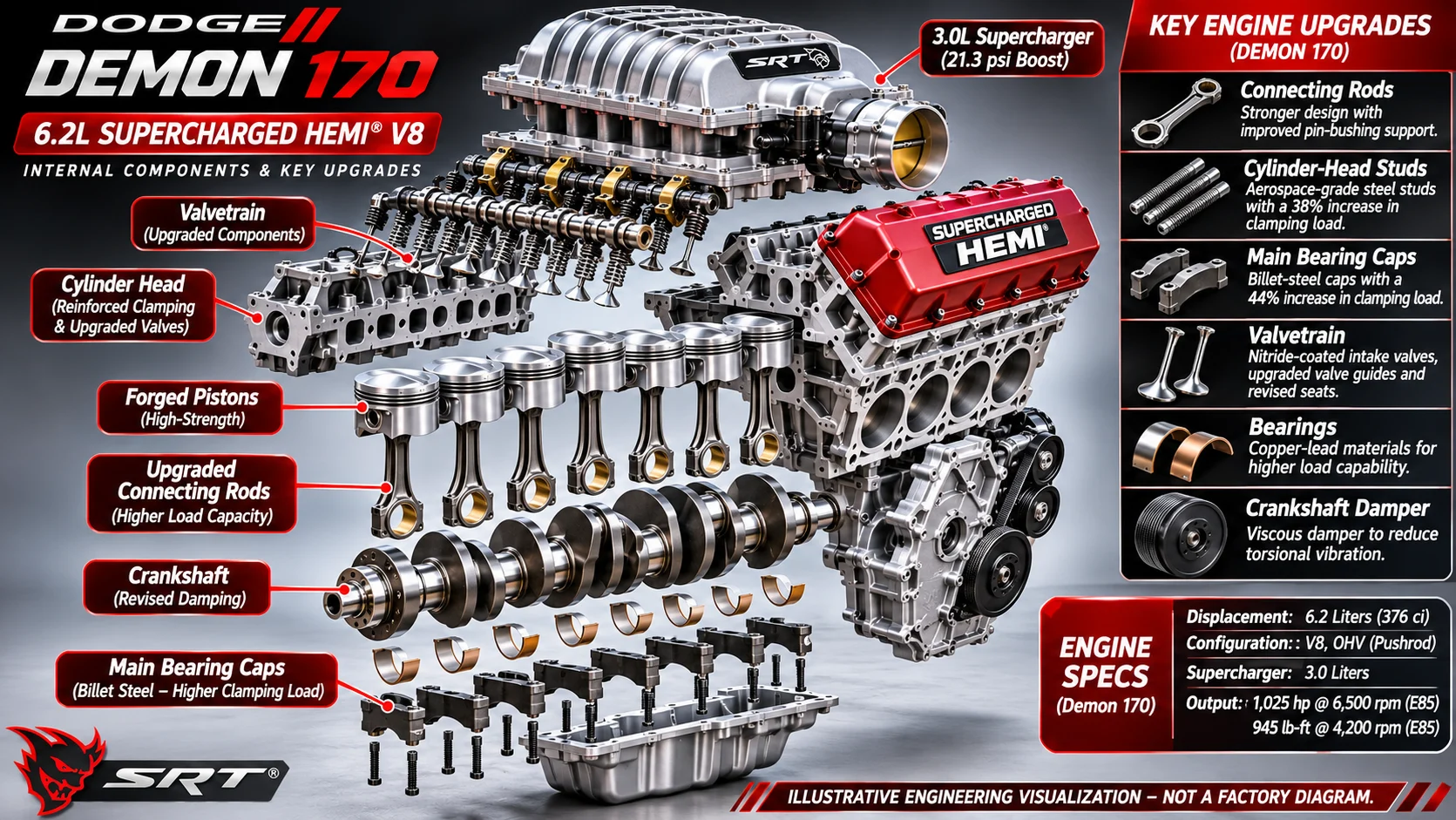
Important upgrades include:
Upgraded Connecting Rods
Stronger connecting rods were developed to handle the increased forces generated during combustion.
The upgraded connecting-rod design and improved pin-bushing support help the engine withstand higher cylinder pressure.
Reinforced Cylinder-Head Clamping
High-strength aerospace-specification steel studs and integrated steel inserts increase cylinder-head clamping capability.
Dodge reports a 38% increase in clamping load compared with the relevant previous configuration.
Upgraded Main Bearing Caps and Fasteners
Billet-steel main bearing caps and stronger fasteners improve the engine's ability to withstand the additional mechanical stress.
Dodge reports a 44% increase in clamping load compared with the Hellcat Redeye.
Improved Valvetrain Components
Nitride-coated intake valves, upgraded valve guides and revised valve-seat materials help accommodate the engine's high-performance ethanol operation.
Upgraded Bearings
Copper-lead main and rod bearing materials were selected to improve load capability.
Revised Crankshaft Damping
A viscous crankshaft damper helps reduce torsional vibration during high-load operation.
These improvements demonstrate how much engineering work was required to turn the supercharged HEMI into a 1,025-horsepower production engine.
E85 Fuel: The Secret Behind the Demon 170's Maximum Power
One of the most unusual features of the Dodge Demon 170 is its ability to adjust engine output according to the ethanol content in the fuel.
E85 is a high-ethanol fuel blend that can contain up to approximately 85% ethanol, depending on the actual blend.
Compared with conventional gasoline, ethanol has different combustion characteristics and a high resistance to knock.
This allows engineers to calibrate an engine for higher boost and more aggressive operation when the appropriate fuel is detected.
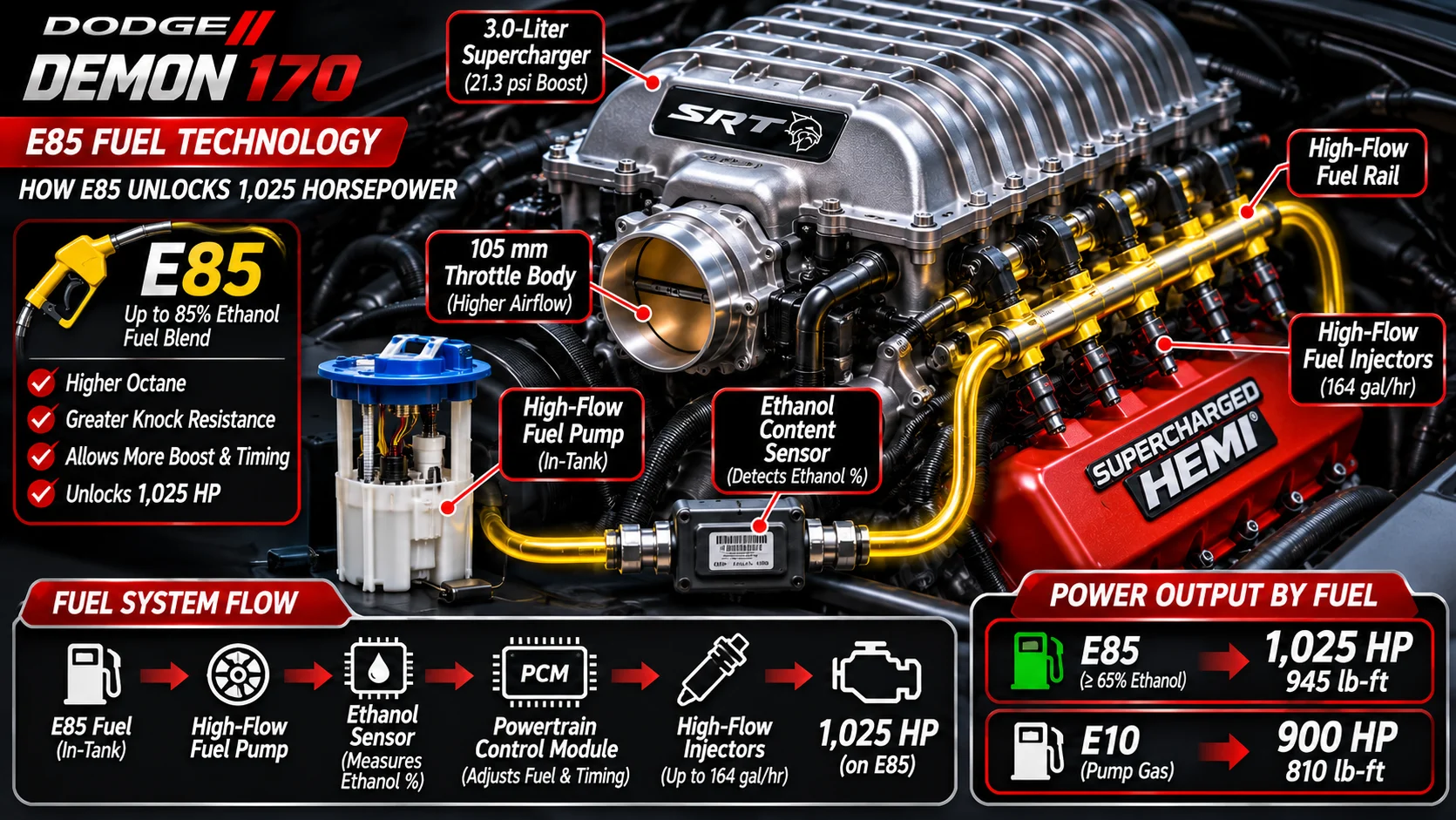
The Demon 170 uses a fast-response ethanol-content sensor integrated into its fuel system.
The powertrain control module monitors the ethanol percentage and adjusts fueling and ignition timing accordingly.
When the system detects more than 65% ethanol content, the instrument cluster indicates that the engine can access its maximum 1,025-horsepower output.
With E10 fuel, the engine produces 900 horsepower.
This means the Demon 170's headline horsepower figure is not available regardless of what fuel is in the tank.
The fuel itself plays an essential role in unlocking the engine's maximum potential.
High-Flow Fuel System: Feeding the Supercharged HEMI
An engine producing 1,025 horsepower requires an enormous amount of fuel.
Dodge upgraded the Demon 170's fuel-delivery system to support the demands of high-ethanol operation.
The engine uses high-flow fuel injectors capable of delivering up to 164 gallons per hour.
The system also includes an integrated ethanol sensor that measures the percentage of ethanol in the fuel.
The powertrain control module uses this information to adjust the engine's fueling strategy and ignition timing.
The throttle body was also increased to 105 mm in diameter, allowing approximately 33% greater airflow volume compared with the Hellcat Redeye Widebody and the original 2018 Demon.
The combination of increased airflow, higher boost pressure and upgraded fuel delivery is central to the Demon 170's extraordinary output.
TorqueFlite 8HP90: Sending 1,025 Horsepower to the Rear Wheels
Producing 1,025 horsepower is one challenge. Transferring that power to the rear tires is another.
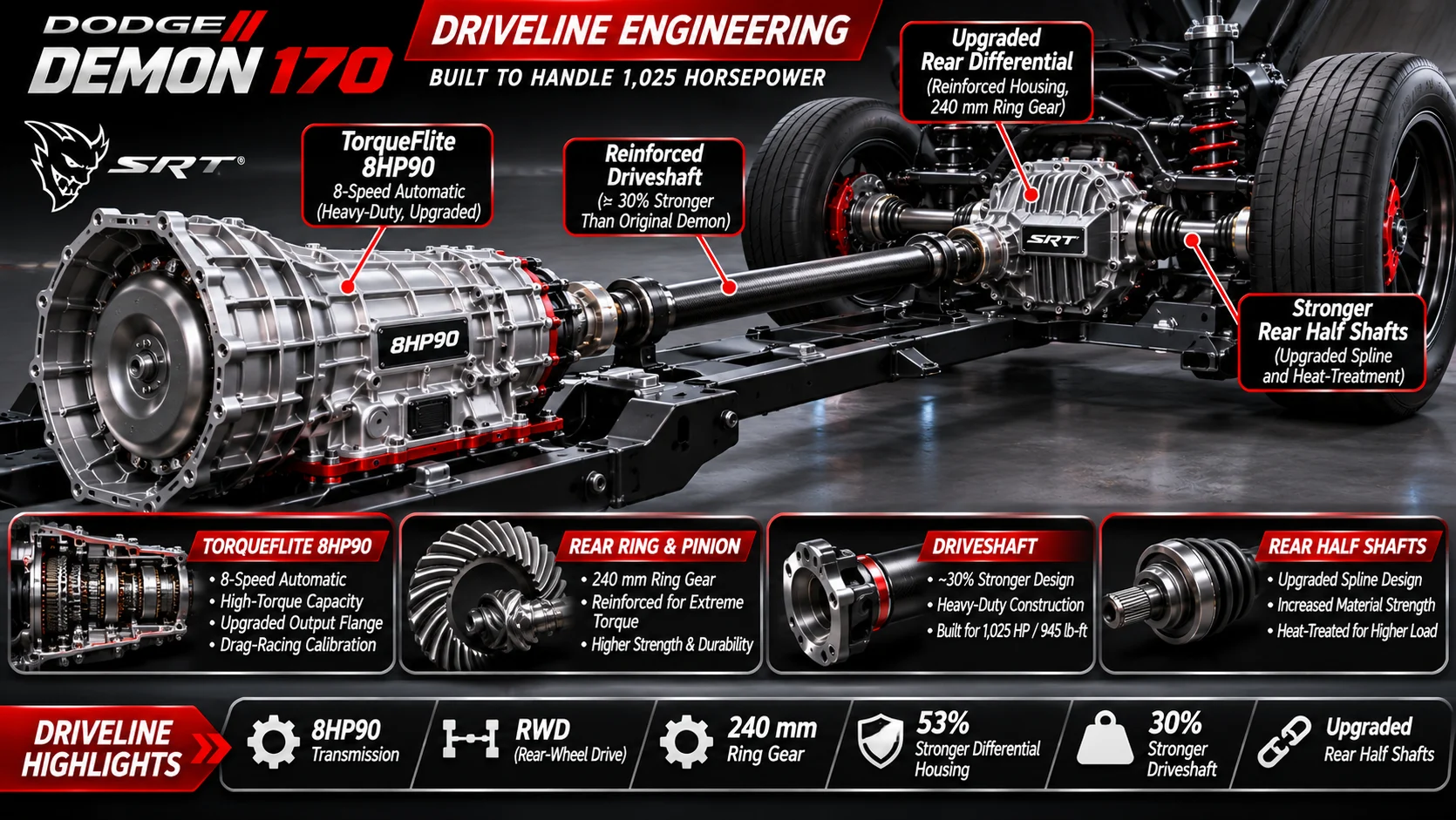
The Demon 170 uses the TorqueFlite 8HP90 eight-speed automatic transmission.
Dodge upgraded the output flange to accommodate the larger and stronger prop shaft required for the vehicle's extreme acceleration.
The rear drivetrain received significant reinforcement.
Important upgrades include:
Larger 240 mm rear ring gear and pinion
Reinforced rear differential housing
Aerospace-grade materials in the rear axle housing
Rear prop shaft approximately 30% stronger than the original Demon
Stronger rear half shafts with revised spline and heat-treatment specifications
Dodge also reports that the rear differential housing is 53% stronger.
These upgrades are essential because the enormous torque produced by the supercharged HEMI places extreme loads on the drivetrain during hard launches.
TransBrake 2.0: Drag-Racing Technology From the Factory
The Demon 170 features TransBrake 2.0, an advanced system designed to help the driver prepare for a drag-strip launch.
A transbrake helps hold the vehicle stationary while engine torque builds before launch.
Dodge's TransBrake 2.0 introduces torque-shaping capability, allowing preset torque limits to be selected for improved control during acceleration.
This technology is particularly important in a vehicle with more than 1,000 horsepower.
Without sufficient traction, a large amount of engine power can be wasted through wheelspin.
By helping manage torque delivery during launch, the system works with the vehicle's drag-focused suspension and tire setup to improve acceleration performance.
The Demon 170 also includes updated Drag Mode settings and performance pages that allow drivers to monitor important vehicle information.
Mickey Thompson Drag Radials: Putting the Power on the Pavement
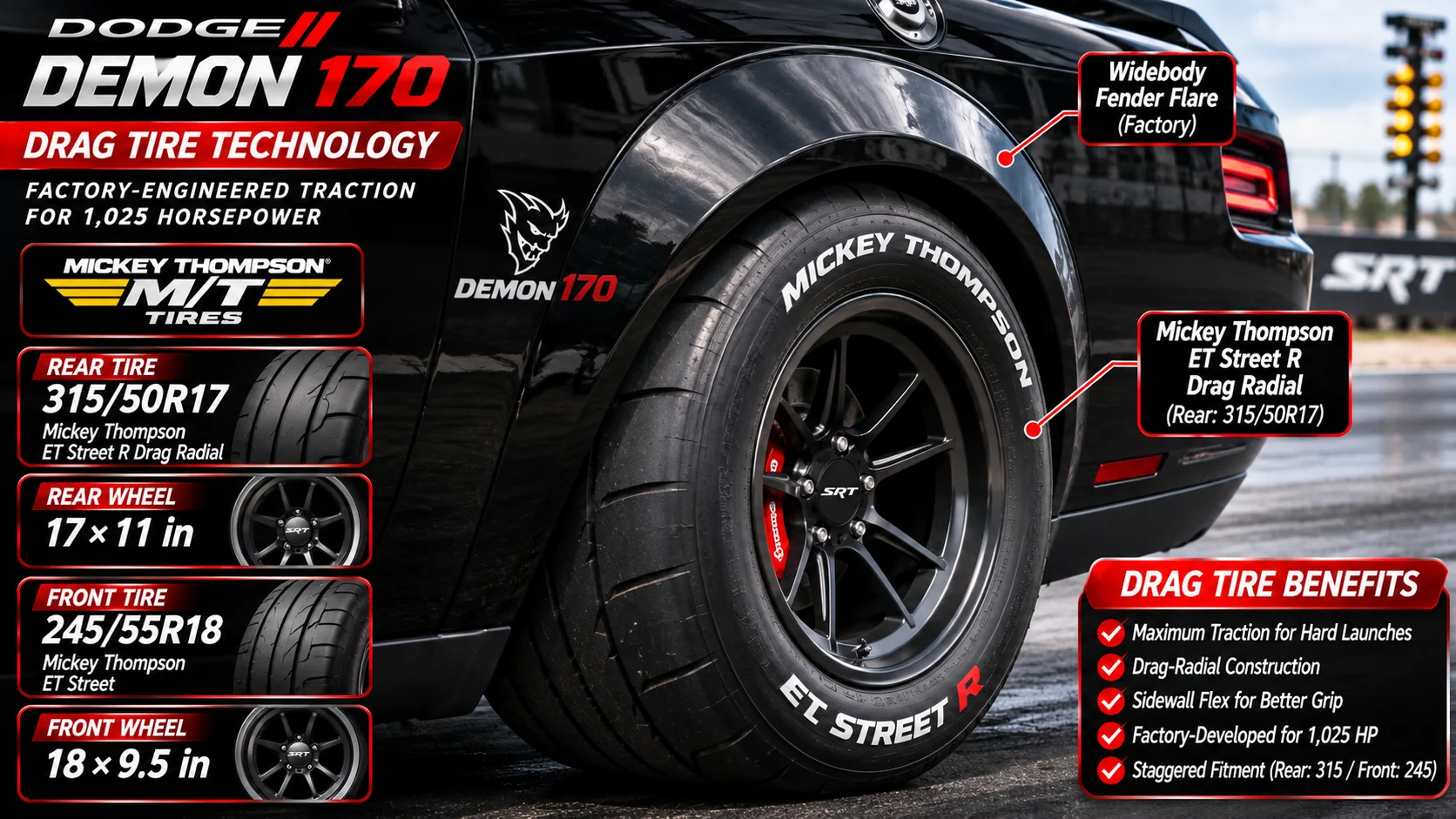
The Demon 170 was developed with specialized drag-racing tires.
Dodge worked with Mickey Thompson Tires to develop a unique tire package for the vehicle.
At the rear, the car uses 315/50R17 Mickey Thompson ET Street R drag radials mounted on 17-by-11-inch wheels.
The front uses 245/55R18 Mickey Thompson ET Street tires.
This staggered configuration provides a larger rear contact footprint, helping the vehicle transfer its enormous power to the road during acceleration.
The rear tires also feature a specialized construction designed to improve traction during hard launches.
The tire sidewalls can flex under acceleration, helping improve power transfer and reduce tire slip.
Dodge described the Demon 170 as the first factory-production car built with staggered drag radial tires and matching fender flares.
1,025 Horsepower and the Performance Numbers
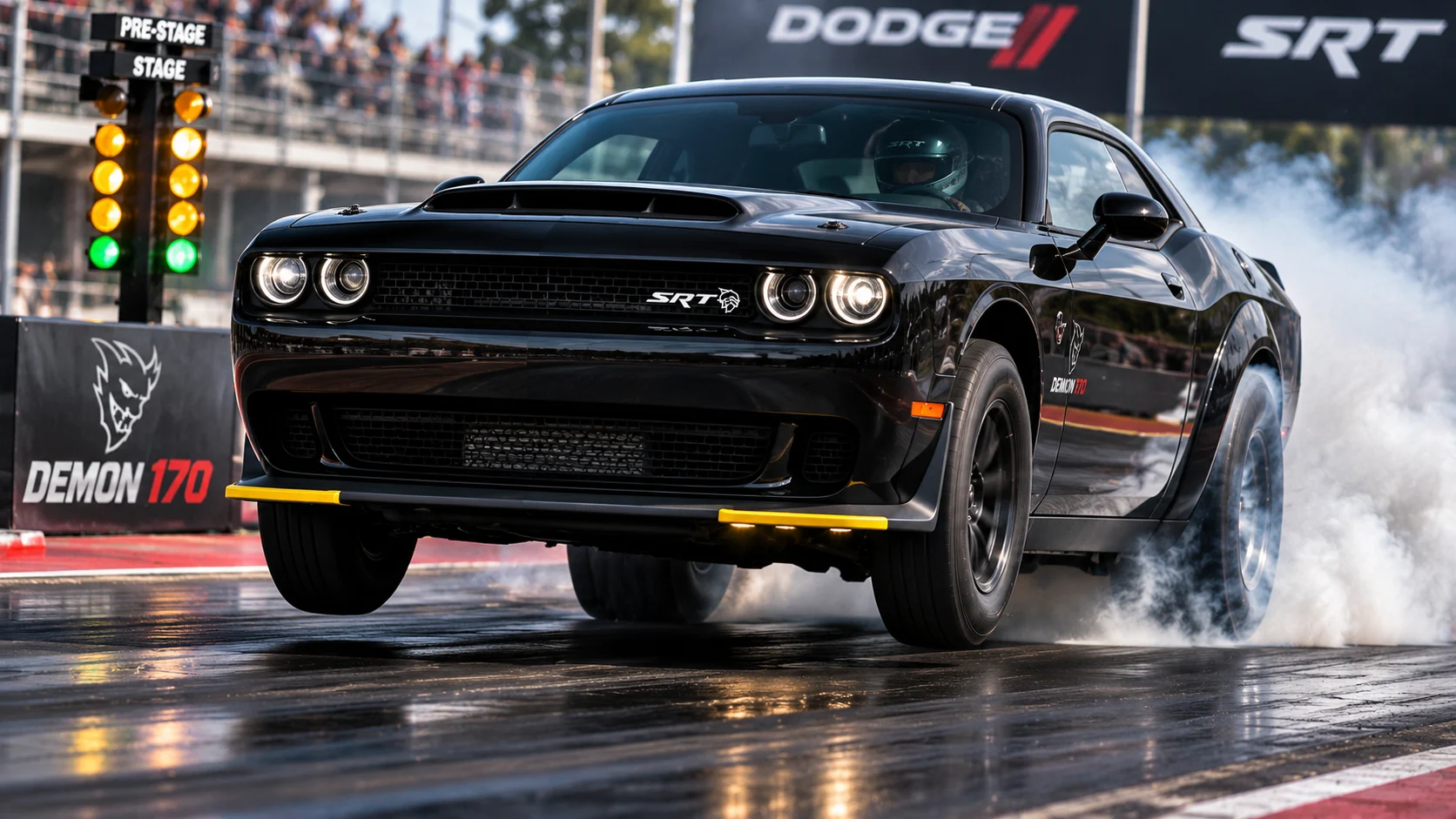
The Demon 170's performance figures are among the most impressive ever announced for a factory-built American muscle car.
Dodge's official figures include:
| Performance Measurement | Factory Figure |
|---|---|
| Maximum Horsepower | 1,025 hp |
| Maximum Torque | 945 lb-ft |
| 0–60 mph | 1.66 seconds |
| Quarter-Mile | 8.91 seconds |
| Quarter-Mile Trap Speed | 151.17 mph |
| Maximum Launch G-Force | 2.004 g |
The quarter-mile time was NHRA-certified.
Dodge described the Demon 170 as the first factory-production car to complete the quarter-mile in less than nine seconds.
Its performance was so extreme that the NHRA issued a violation letter because the vehicle ran quicker than the organization's nine-second threshold without the required safety cage and parachute.
That detail became part of the Demon 170's legendary reputation.
It was engineered as a street-legal production vehicle, yet its factory drag-strip performance crossed into territory that triggered NHRA safety requirements.
Demon 170 vs Hellcat Redeye vs Original Demon
The Demon 170 belongs to a special family of supercharged Dodge performance cars.
However, its output and engineering upgrades place it above the earlier versions.
| Model | Horsepower | Torque |
|---|---|---|
| Challenger SRT Hellcat Redeye Widebody | 797 hp | 707 lb-ft |
| 2018 Challenger SRT Demon | 840 hp | 770 lb-ft |
| 2023 Challenger SRT Demon 170 | 1,025 hp | 945 lb-ft |
Note: Demon 170 figures shown are for E85 operation. The original Demon figure is its factory rating on high-octane race fuel.
The Demon 170 is not simply a more powerful version of the original Demon.
It features a larger supercharger, improved fuel delivery, stronger internal engine components, upgraded drivetrain hardware and specialized drag-strip technology.
The result is a substantially more advanced factory drag-focused Challenger.
The Final Chapter of the HEMI Challenger Era
The Demon 170 also carries historical importance beyond its performance numbers.
Dodge introduced the vehicle as the seventh and final Last Call special-edition model, celebrating the end of the HEMI-powered Challenger and Charger in their existing forms at the end of 2023.
For enthusiasts, this marked the end of a major chapter in modern American muscle-car history.
The supercharged HEMI V8 had become a defining feature of Dodge's high-performance identity, particularly through the Hellcat, Redeye, original Demon and Demon 170 models.
The Demon 170 represented the most extreme factory-developed version of that formula.
Its limited production, unique engineering and extraordinary acceleration helped establish its place among the most memorable modern American muscle cars.
Why the Dodge Demon 170 Still Matters
The 2023 Dodge Challenger SRT Demon 170 demonstrates what can happen when an automaker develops a vehicle around one clear objective: extreme straight-line performance.
Its 6.2-liter supercharged HEMI V8, upgraded 3.0-liter supercharger, ethanol-sensitive powertrain calibration and reinforced drivetrain work together as one complete performance package.
The 1,025-horsepower figure is impressive, but the engineering behind it is arguably even more interesting.
Dodge did not rely on engine output alone. It developed the supporting systems needed to manage the power, deliver it through the rear wheels and achieve extraordinary acceleration on a prepared drag strip.
With its 8.91-second quarter-mile capability, specialized drag tires and TransBrake 2.0 technology, the Demon 170 became a fitting farewell to the modern HEMI-powered Challenger.
For American muscle-car enthusiasts, it remains one of the defining symbols of the supercharged V8 era.
The Dodge Challenger SRT Demon 170 was more than a final edition. It was the ultimate factory-built expression of Dodge's supercharged HEMI muscle-car philosophy.
Editorial and specification note: All factory horsepower, torque, engine, supercharger, transmission and performance figures in this article are based on Dodge's published 2023 Challenger SRT Demon 170 specifications. The 1,025-horsepower rating requires high-ethanol fuel content; the vehicle produces 900 horsepower on E10. Quarter-mile performance is dependent on track preparation, conditions and vehicle configuration.
Have thoughts, dyno data, or build feedback?
Join automotive enthusiasts in the paddock below to debate engineering, lap times, and modifications.
Community Pulse
How does this machine make you feel? Drop your reaction!

VehicleDrugs Editorial
VehicleDrugs Editorial Team
A passionate collective of automotive purists, track drivers, and mechanical engineers uncovering high-octane engineering breakthroughs worldwide.
🏁 Pit Crew Discussions
Drop your telemetry, debate the engineering, or talk track times with fellow petrolheads.
The Pit Lane is Quiet
Be the first driver to drop your opinion on this machine!